


Claude for PowerPoint — Decks That Follow Your Brand, Built by AI
6 ready-to-use prompts that turn Claude's PowerPoint add-in into your presentation engine. From stakeholder business cases to QBR decks — structured prompts, your template, professional results.
For Procurement Professionals Who Spend Too Much Time on Slide Decks
Procurement professionals build more presentations than most people realise. Sourcing recommendations for the CFO. Category strategy decks for leadership. Quarterly business review packs for supplier meetings. Savings reports for the board. Budget proposals. Risk assessments. The work is in the analysis — but the time is in the slides.
Claude for PowerPoint changes that. It sits inside PowerPoint as a sidebar, reads your template — slide masters, layouts, fonts, color schemes — and creates content that follows your brand guidelines automatically. No more reformatting AI output. No more copying from ChatGPT and spending an hour fixing the layout.
These 6 prompts are designed specifically for procurement professionals using Claude for PowerPoint. Each one follows a structured prompt engineering framework — role definition, objective, constraints, output format — that tells Claude exactly what deck to build, how to structure it, and what your audience expects.
Every prompt includes [BRACKETED] fields for you to customise. Load your corporate template in PowerPoint, paste the prompt into the Claude sidebar, and let it build the deck in your format.
What Makes Claude for PowerPoint Different
Claude for PowerPoint reads your slide master, layouts, fonts, and color schemes. When it creates slides, they follow your brand guidelines automatically — correct fonts, correct colors, correct slide layouts. It does not generate generic slides and hope you fix them.
You can set permanent Instructions in the sidebar — your company's presentation standards, preferred slide structure, branding rules. You can use Skills to save repeatable deck formats as one-click actions. And Claude can share context with Claude for Excel — analyse data in a spreadsheet, then build a presentation from those findings without copy-pasting.
Claude for PowerPoint is available on Max ($100/month), Team, and Enterprise plans. It is not yet available on Pro.
How to Get Started
Install the add-in, load your corporate template, and paste a prompt into the Claude sidebar.
Requirements
- Claude Max subscription ($100/month), Team, or Enterprise
- PowerPoint 2016+ (Windows or Mac)
- Claude for PowerPoint add-in installed
- Your corporate/client PowerPoint template
The 6 Prompts at a Glance
The 6 Procurement Prompts for Claude in PowerPoint
Each prompt is structured with role definition, objective, constraints, and output format. Fill in the [BRACKETED] fields to customise. Load your corporate template, then paste the prompt into the Claude sidebar.
You have completed a supplier evaluation — bids compared, scores calculated, risks assessed — and now you need to present your recommendation to leadership. This deck takes your analysis and structures it into a clear, professional presentation that makes the recommendation, shows the evidence, and addresses the questions your CFO will ask.
Inputs═══ ROLE ═══ You are a senior procurement presentation specialist who builds committee-ready sourcing recommendation decks. You understand what CFOs and procurement committees need to see: a clear recommendation, the evidence behind it, the risks, and the financial impact. ═══ OBJECTIVE ═══ Build a sourcing recommendation deck using my loaded template. The deck should present my recommendation for [CATEGORY / PROJECT] to [AUDIENCE — e.g., "the procurement committee," "the CFO and COO," "the executive leadership team"]. Use the slide layouts available in this template. ═══ CONTEXTUAL DETAILS ═══ - I am recommending: [SUPPLIER NAME(S)] for [WHAT — e.g., "a 3-year framework agreement for IT hardware supply"] - The evaluation covered [NUMBER] suppliers over [TIMELINE] - Key evaluation criteria: [LIST — e.g., "Price (40%), Quality (25%), Delivery (20%), Commercial Terms (15%)"] - Top-line results: [e.g., "Supplier A scored highest on composite weighted score at 87/100. Supplier B was close at 82/100 but had delivery concerns."] - Financial impact: [e.g., "Expected savings of €340K annually versus current contract, plus improved payment terms from 30 to 60 days"] - Key risks: [e.g., "Supplier A is a smaller company — capacity risk if our volumes increase by more than 20%"] - Decision needed: [e.g., "Approval to award to Supplier A with a 3-year term"] ═══ CONSTRAINTS & ASSUMPTIONS ═══ - Use the slide layouts available in this template — do not create custom layouts - Maximum 12 slides — procurement committees lose attention after that - Every slide must have a clear headline that states the conclusion, not just the topic (e.g., "Supplier A delivers 15% lower TCO with equivalent quality" not "Cost comparison") - Include a risk slide — leadership always asks about risk, so address it before they do - End with a clear decision slide: what you are asking for, what it costs, and what happens next ═══ OUTPUT FORMAT ═══ Build the deck with this structure: 1. Title slide (project name, date, presenter) 2. Executive summary (recommendation + 3 key reasons in one slide) 3. Project scope and evaluation approach (what was sourced, how many suppliers, evaluation criteria) 4. Supplier shortlist overview (who responded, high-level comparison) 5. Evaluation results — scoring summary (weighted scores, visual ranking) 6. Evaluation results — pricing comparison (TCO, not just unit price) 7. Evaluation results — non-price factors (quality, delivery, commercial terms) 8. Recommended supplier deep-dive (why this supplier — evidence-based) 9. Risk assessment (risks of the recommendation AND risks of alternatives) 10. Financial impact summary (savings, terms improvement, budget impact) 11. Implementation timeline (key milestones if awarded) 12. Decision slide (the ask: approve/reject, next steps, deadline) ═══ ABOUT ME ═══ I am a [PROCUREMENT ROLE — e.g., "Category Manager" / "Head of Procurement"] at [COMPANY TYPE]. I have completed the supplier evaluation for [CATEGORY / PROJECT] and need to present my recommendation for approval. The total contract value is approximately [AMOUNT] over [DURATION]. My credibility with this audience is [STRONG / MODERATE / NEW — this affects how assertive the deck should be]. ═══ AUDIENCE ═══ Primary: [DECISION-MAKERS — e.g., "CFO and COO" / "Procurement Committee" / "Board"]. They are analytically literate but not procurement specialists. They need a clear recommendation with evidence, not a procurement process walkthrough. Secondary: The evaluation team who will verify the methodology if challenged. ═══ DO'S ═══ - Lead with the recommendation — do not bury it after 10 slides of background. - Use headline statements on every slide that state the conclusion, not just the topic. - Include a risk slide — leadership always asks about risk. - Show total cost of ownership, not just unit price. ═══ DON'TS ═══ - Do not exceed 12 slides — procurement committees lose attention after that. - Do not present a balanced comparison without a clear recommendation — indecision is not a deliverable. - Do not use procurement jargon — speak the language of the C-suite. - Do not skip the "what happens next" slide — leadership needs to know the implementation path. ═══ CLARIFYING QUESTIONS ═══ Before producing any output, ask me 5 targeted follow-up questions. Choose questions that surface information you cannot infer from what I have provided alone — information that will meaningfully change the deck you produce. Do not begin building slides until I have answered. ═══ TONE ═══ Confident and evidence-driven. Every slide should earn its place. Lead with conclusions, support with data. Write for an audience that has 20 minutes and wants to leave with a clear decision. ═══ LENGTH ═══ Maximum 12 slides. Executive summary: 1 slide. Evaluation detail: 4-5 slides. Risk and financials: 2 slides. Decision slide: 1 slide.
You need to present a category strategy to leadership — the market landscape, your current supply position, the opportunities, and your plan for the next 12-24 months. This prompt structures a comprehensive category strategy deck that positions procurement as strategic, not just operational.
Inputs═══ ROLE ═══ You are a senior category strategy advisor who builds board-level procurement strategy presentations. You know how to translate category data into strategic narratives that connect procurement decisions to business outcomes. ═══ OBJECTIVE ═══ Build a category strategy presentation for [CATEGORY NAME] using my loaded template. The deck should present the current state of the category, the market dynamics, the strategic opportunities, and a clear plan for the next [12 / 24] months. ═══ CONTEXTUAL DETAILS ═══ - Category: [DESCRIBE — e.g., "Indirect procurement — professional services (consulting, legal, audit)"] - Annual spend: [AMOUNT] - Number of active suppliers: [NUMBER] - Current state: [e.g., "Fragmented supply base, no preferred supplier programme, spend is largely unmanaged with individual business units procuring independently"] - Market conditions: [e.g., "Tight labour market driving rate increases, large firms consolidating, increase in offshore delivery models"] - Strategic priorities: [e.g., "Reduce supplier count from 45 to 10-15 preferred suppliers, implement rate cards, achieve 8-12% cost reduction over 2 years"] - Key challenges: [e.g., "Business units resist centralized procurement of professional services, relationship-driven buying"] ═══ CONSTRAINTS & ASSUMPTIONS ═══ - Use the slide layouts available in this template - Maximum 15 slides - Every recommendation must be grounded in data or market evidence — no generic strategy statements - Include a clear "so what" on every slide — leadership needs to know why each point matters - Include a 12-month action plan with milestones — strategy without execution is a wish list ═══ OUTPUT FORMAT ═══ Build the deck with this structure: 1. Title slide 2. Executive summary (strategic headline + 3-4 key messages) 3. Category overview (what's in scope, spend breakdown, supplier landscape) 4. Current state assessment (strengths, gaps, pain points — be honest) 5. Market dynamics (supply market trends, pricing outlook, opportunities and threats) 6. Spend analysis highlights (concentration, maverick spend, savings opportunities — charts where possible) 7. Strategic options (2-3 strategic directions evaluated — pros, cons, recommended approach) 8. Recommended strategy (the chosen direction with clear rationale) 9. Target supplier model (preferred supplier programme structure, criteria, expected benefits) 10. Financial business case (investment required, expected savings, payback period) 11. Risk assessment (implementation risks and mitigation) 12. 12-month action plan (milestones, owners, dependencies — make it concrete) 13. Decision/approval slide (what you need from leadership to proceed) ═══ ABOUT ME ═══ I am a [PROCUREMENT ROLE] at [COMPANY TYPE] in [SECTOR]. I am responsible for [CATEGORY] with annual spend of approximately [AMOUNT]. This strategy presentation is for [PURPOSE — e.g., "annual category review" / "new category strategy approval" / "transformation programme kick-off"]. My relationship with this leadership team is [CONTEXT — e.g., "well-established" / "I am new to the role"]. ═══ AUDIENCE ═══ Primary: [LEADERSHIP — e.g., "CPO and executive team" / "Board" / "Category review committee"]. They expect strategic thinking, not operational detail. They will challenge the financial case and ask about implementation feasibility. Secondary: My category team who will execute the strategy. ═══ DO'S ═══ - Connect every recommendation to a business outcome — not just a procurement metric. - Include market data to justify strategic direction — strategy without market context is guesswork. - Make the action plan specific enough to hold people accountable. - Show the cost of inaction — what happens if we do nothing. ═══ DON'TS ═══ - Do not exceed 15 slides. - Do not present generic strategy frameworks — every slide must be specific to this category and this data. - Do not end with "next steps TBD" — the action plan must be concrete. - Do not assume the audience understands procurement methodology — explain the "so what" on every slide. ═══ CLARIFYING QUESTIONS ═══ Before producing any output, ask me 5 targeted follow-up questions. Choose questions that surface information you cannot infer from what I have provided alone — information that will meaningfully change the strategy deck. Do not begin building slides until I have answered. ═══ TONE ═══ Strategic and commercially sharp. This is a leadership presentation, not a procurement report. Connect every recommendation to business outcomes. Avoid procurement jargon — speak the language of the C-suite. ═══ LENGTH ═══ Maximum 15 slides. Market analysis: 2-3 slides. Strategy and recommendations: 3-4 slides. Financial case: 1-2 slides. Action plan: 1-2 slides.
You have a quarterly business review with a key supplier and need a professional review pack. You want performance data visualised, issues documented, actions tracked, and an agenda that keeps the conversation productive. This prompt builds the entire QBR deck.
Inputs═══ ROLE ═══ You are a senior supplier relationship manager who builds structured quarterly business review packs. You understand that QBR decks serve two purposes: internal preparation and external presentation to the supplier. ═══ OBJECTIVE ═══ Build a quarterly business review deck for the upcoming review with [SUPPLIER NAME] using my loaded template. The deck should present performance data, track outstanding actions, raise the issues that need discussion, and set the agenda for a productive review meeting. ═══ CONTEXTUAL DETAILS ═══ - Supplier: [NAME] - Review period: [e.g., "Q4 2025"] - Key KPIs and targets: [LIST — e.g., "OTIF ≥ 97%, defect rate ≤ 0.3%, invoice accuracy ≥ 99%"] - Actual performance highlights: [e.g., "OTIF was 94% in October and improved to 96% in December. Invoice accuracy has been consistently below target at 95%."] - Open issues: [LIST — e.g., "3 overdue corrective actions from Q3 QBR, 1 ongoing quality issue on product line X"] - Relationship context: [e.g., "This is a strategic supplier, contract renewal in 6 months. We want to raise performance standards before renewal negotiations."] - Meeting attendees: [e.g., "Our side: Category Manager + Operations Director. Their side: Account Director + Operations Lead"] ═══ CONSTRAINTS & ASSUMPTIONS ═══ - Use the slide layouts available in this template - Maximum 10 slides — QBRs work best when focused - Performance slides should show trend data (by month), not just period averages - Include a clear action tracker with status from previous QBR — accountability matters - The deck should be shareable with the supplier as pre-read material ═══ OUTPUT FORMAT ═══ Build the deck with this structure: 1. Title slide (QBR — Supplier Name — Period — Date) 2. Agenda slide (what we will cover) 3. Relationship overview (contract summary, spend, strategic importance) 4. Performance dashboard (KPIs with targets, actuals by month, RAG status, trend arrows) 5. Performance deep-dive (the 2-3 KPIs that need discussion — what happened and why) 6. Previous QBR action tracker (action | owner | due date | status — green/red) 7. Open issues and escalations (current unresolved items) 8. Forward look (upcoming milestones, volume forecasts, planned changes) 9. Discussion points for this meeting (specific items requiring supplier input or commitment) 10. Actions and next steps (to be completed during the meeting) ═══ ABOUT ME ═══ I am a [PROCUREMENT ROLE] responsible for the relationship with [SUPPLIER NAME]. This QBR covers [PERIOD]. The relationship context is: [e.g., "contract renewal in 6 months — we want to set expectations before negotiation" / "performance has been improving — this is a recognition meeting" / "we have serious concerns about delivery and need to escalate"]. I will be accompanied by [ATTENDEES]. ═══ AUDIENCE ═══ Primary: The supplier's team ([ATTENDEES — e.g., "Account Director and Operations Lead"]) who will receive this as pre-read and discuss it live. Secondary: My internal team who need the data to be credible and defensible. The deck must be professional enough to share externally. ═══ DO'S ═══ - Show trends by month, not just period averages — trends tell the story. - Include the action tracker from the previous QBR — accountability requires continuity. - Acknowledge good performance as well as problems. - Make the agenda items specific — "discuss delivery issues" is weaker than "root cause review of 7 OTIF breaches in Q3." ═══ DON'TS ═══ - Do not exceed 10 slides — QBRs work best when focused. - Do not soften poor performance data — the purpose of a QBR is commercial accountability. - Do not present data the supplier can factually challenge — every figure must be traceable. - Do not create a deck that only looks backward — include a forward look section. ═══ CLARIFYING QUESTIONS ═══ Before producing any output, ask me 4 targeted follow-up questions. Choose questions that surface information you cannot infer from what I have provided alone — information that will meaningfully change the QBR deck. Do not begin building slides until I have answered. ═══ TONE ═══ Factual and constructive. A QBR deck should present data as it is — acknowledge good performance, flag poor performance, and focus the conversation on improvement. Professional, not adversarial. ═══ LENGTH ═══ Maximum 10 slides. Performance dashboard: 1-2 slides. Issues and actions: 2-3 slides. Forward look and agenda: 1-2 slides.
It is time to show what procurement has delivered. You need a presentation that tells the savings story — hard savings, cost avoidance, process improvements, strategic value — in a way that resonates with the board and CFO.
Inputs═══ ROLE ═══ You are a senior procurement communications specialist who builds executive-level value reports. You know that procurement value stories fail when they lead with numbers instead of narrative — the story must connect savings to business outcomes. ═══ OBJECTIVE ═══ Build a procurement savings and value report deck for [PERIOD — e.g., "FY2025" / "H1 2026"] using my loaded template. Present procurement's financial and strategic contribution in a way that resonates with the board and positions the function as a strategic asset. ═══ CONTEXTUAL DETAILS ═══ - Total validated hard savings: [AMOUNT] - Total cost avoidance: [AMOUNT] - Key projects delivered: [LIST 3-5 — e.g., "Logistics consolidation (€220K saving), IT hardware renegotiation (€180K saving), Raw materials hedging strategy (€150K cost avoidance)"] - Process improvements: [e.g., "PO cycle time reduced by 30%, supplier onboarding time halved, 15 contracts brought under management"] - Strategic contributions: [e.g., "Led ESG supplier assessment programme, implemented preferred supplier model for professional services, supported new product launch with accelerated sourcing"] - Comparison to target: [e.g., "Target was €1.2M total savings, delivered €1.4M"] - Audience: [e.g., "Board of Directors" / "CFO and executive team" / "Annual procurement review"] ═══ CONSTRAINTS & ASSUMPTIONS ═══ - Use the slide layouts available in this template - Maximum 10 slides — board members have short attention windows - Lead with the headline number and the narrative, not the methodology - Distinguish hard savings from cost avoidance — do not combine them in a single headline number - Include a forward look — what procurement will deliver next period - Make it visual — charts and key numbers, not paragraphs of text ═══ OUTPUT FORMAT ═══ Build the deck with this structure: 1. Title slide 2. Headline slide (the big number + 3 key headlines — one slide that tells the whole story) 3. Financial impact summary (hard savings, cost avoidance, value improvements — visualised) 4. Top 5 project highlights (one slide, brief — project name, saving, what changed) 5. Savings by category or business unit (chart showing where value was delivered) 6. Performance vs target (were we on track, ahead, behind — and why) 7. Process and efficiency improvements (non-financial value — metrics-driven) 8. Strategic contributions (how procurement supported broader business goals) 9. Forward look (next period priorities, pipeline of opportunities, expected savings) 10. Thank you / Q&A slide ═══ ABOUT ME ═══ I am a [PROCUREMENT ROLE] at [COMPANY TYPE]. This value report covers [PERIOD]. My procurement team delivered [HEADLINE SAVINGS FIGURE] against a target of [TARGET]. I need this deck to [PURPOSE — e.g., "secure continued investment in the procurement function" / "demonstrate procurement's strategic value" / "report annual results to the board"]. ═══ AUDIENCE ═══ Primary: [BOARD / CFO / Executive team] who think in P&L and business outcome terms. They want to see impact, not methodology. They will challenge savings numbers if they seem inflated. Secondary: Procurement team who want their work recognised. ═══ DO'S ═══ - Lead with the headline number and the narrative — make the first slide tell the whole story. - Distinguish hard savings from cost avoidance visually — the board cares about the difference. - Show performance vs target — accountability builds trust. - Include a forward look — what procurement will deliver next period. ═══ DON'TS ═══ - Do not exceed 10 slides. - Do not combine hard savings and cost avoidance into one number. - Do not lead with methodology — lead with impact. - Do not use procurement jargon — P&L impact, ROI, and business outcomes are the language of the board. - Do not present only the numbers — tell the story of what changed and why it matters. ═══ CLARIFYING QUESTIONS ═══ Before producing any output, ask me 4 targeted follow-up questions. Choose questions that surface information you cannot infer from what I have provided alone — information that will meaningfully change the value report. Do not begin building slides until I have answered. ═══ TONE ═══ Confident and business-oriented. This is a value report, not a status update. Lead with impact. Use the language of the board — P&L impact, ROI, business outcomes — not procurement terminology. ═══ LENGTH ═══ Maximum 10 slides. Headline slide: 1. Financial detail: 2-3 slides. Project highlights: 1-2 slides. Forward look: 1 slide.
A supplier risk has been identified — financial distress, performance failure, geopolitical exposure, or a disruption event — and you need to brief leadership. This prompt builds a structured risk briefing deck with the situation assessment, business impact, and recommended response.
Inputs═══ ROLE ═══ You are a supply chain risk communication specialist who builds leadership-level risk briefing decks. You know that risk briefings must be fast, clear, and action-oriented — leadership needs to understand the exposure and decide on a response. ═══ OBJECTIVE ═══ Build a supplier risk briefing deck for [SUPPLIER NAME / RISK EVENT] using my loaded template. Present the risk situation clearly, quantify the business exposure, and recommend a course of action with options. ═══ CONTEXTUAL DETAILS ═══ - The risk situation: [DESCRIBE — e.g., "Supplier X has reported financial difficulties — their latest quarterly results show declining revenue and they have requested extended payment terms," or "Geopolitical developments in [REGION] threaten our supply of [COMPONENT] — 60% of our supply comes from this region"] - Supplier importance: [e.g., "Strategic supplier, sole source for Component Y, annual spend €2.4M, contract runs until Q3 2027"] - Business impact if supply is disrupted: [e.g., "Production line shutdown within 3 weeks, estimated cost of €150K per day of disruption"] - Alternative supply options: [e.g., "One qualified alternative supplier exists but requires 8-week lead time for qualification," "No current alternative — dual-source qualification would take 4-6 months"] - Actions already taken: [e.g., "Increased safety stock from 2 to 4 weeks, initiated contact with alternative suppliers"] - Decision needed: [e.g., "Approval for emergency dual-source qualification and increased inventory investment"] ═══ CONSTRAINTS & ASSUMPTIONS ═══ - Use the slide layouts available in this template - Maximum 8 slides — risk briefings must be concise - Lead with the headline risk and business exposure — do not bury bad news - Present options with trade-offs, not just a single recommendation — leadership wants choices - Include a clear decision slide with specific asks and deadlines ═══ OUTPUT FORMAT ═══ Build the deck with this structure: 1. Title slide (RISK BRIEFING — Supplier Name — Date — CONFIDENTIAL) 2. Situation summary (what happened, when, headline risk level — one slide) 3. Supplier profile (who they are, what they supply, our dependency level) 4. Business impact assessment (financial exposure, operational impact, timeline) 5. Current mitigation actions (what has already been done) 6. Response options (2-3 options with trade-offs: cost, timeline, risk level — presented as a comparison) 7. Recommended course of action (preferred option with justification) 8. Decision and next steps (what you need approved, by when, who owns what) ═══ ABOUT ME ═══ I am a [PROCUREMENT ROLE] at [COMPANY TYPE]. I am briefing leadership on [RISK EVENT / SUPPLIER SITUATION — e.g., "financial distress at our sole-source supplier for Component X" / "geopolitical disruption affecting 60% of our raw material supply"]. The business exposure is approximately [IMPACT — e.g., "€150K per day of production disruption" / "potential 3-month supply gap"]. I need a decision from leadership by [DEADLINE]. ═══ AUDIENCE ═══ Primary: [EXECUTIVE TEAM / RISK COMMITTEE / CPO] who need to understand the exposure quickly and decide on a response. They have limited time and want clarity, not detail. Secondary: Operations team who will execute the mitigation plan. ═══ DO'S ═══ - Lead with the headline risk and business exposure — do not bury bad news. - Present 2-3 response options with trade-offs — leadership wants choices, not just a recommendation. - Quantify everything: financial exposure, timeline, probability. - End with a clear decision slide — what you need approved, by when. ═══ DON'TS ═══ - Do not exceed 8 slides — risk briefings must be concise. - Do not present the situation without a recommended course of action — diagnosis without prescription wastes leadership time. - Do not panic the audience — present facts clearly, show that there is a plan. - Do not use vague language like "significant risk" — quantify the exposure. ═══ CLARIFYING QUESTIONS ═══ Before producing any output, ask me 4 targeted follow-up questions. Choose questions that surface information you cannot infer from what I have provided alone — information that will meaningfully change the risk briefing. Do not begin building slides until I have answered. ═══ TONE ═══ Urgent but controlled. Risk briefings that panic leadership are counterproductive. Present the facts clearly, quantify the exposure honestly, and show that there is a plan. Confidence in the face of risk builds trust. ═══ LENGTH ═══ Maximum 8 slides. Situation and impact: 2-3 slides. Options and recommendation: 2-3 slides. Decision slide: 1 slide.
You need approval for a procurement initiative — new headcount, a technology investment, a category management programme, a supplier consolidation project. This prompt builds a structured business case deck that speaks the language of the CFO and makes the financial case clearly.
Inputs═══ ROLE ═══ You are a senior procurement business partner who builds investment cases for the C-suite. You understand that procurement business cases fail not because the numbers are wrong, but because the framing is wrong. You lead with the problem and its cost, not with the procurement solution. ═══ OBJECTIVE ═══ Build a budget proposal and business case deck for [INITIATIVE NAME] using my loaded template. Present the case for investment in a way that resonates with [AUDIENCE — e.g., "the CFO," "the executive committee," "the board"]. ═══ CONTEXTUAL DETAILS ═══ - The initiative: [DESCRIBE — e.g., "Implementation of a procurement management platform to replace manual processes," "Hiring two additional category managers to bring €15M of unmanaged spend under control," "Supplier consolidation programme for indirect categories"] - The problem it solves: [e.g., "Currently 40% of our spend is with unapproved suppliers. We lose an estimated €800K annually in foregone volume discounts and have zero visibility of contract compliance."] - Investment required: [e.g., "€120K one-time implementation + €45K annual license for a P2P platform" / "€180K annual cost for 2 additional FTEs"] - Expected return: [e.g., "5-8% spend reduction on addressed categories = €750K-€1.2M annually, payback within 8 months"] - Timeline: [e.g., "6-month implementation, benefits realisation from month 4"] - Key risks: [e.g., "Change management — business units may resist centralised procurement controls"] ═══ CONSTRAINTS & ASSUMPTIONS ═══ - Use the slide layouts available in this template - Maximum 12 slides - Lead with the problem and its cost — make the audience feel the pain before presenting the solution - Distinguish hard savings from cost avoidance — your CFO will - Include an objection handler slide — anticipate the top 3 questions and answer them pre-emptively - End with a clear ask: what you need, how much, by when ═══ OUTPUT FORMAT ═══ Build the deck with this structure: 1. Title slide 2. The problem (current state — what is broken and what it costs, with data) 3. The opportunity (what could be different — quantified) 4. Proposed solution (what you want to do — clear and concise) 5. How it works (approach, methodology, what changes for whom) 6. Financial business case (investment, savings, ROI, payback period — table or chart) 7. Non-financial benefits (risk reduction, compliance, efficiency, strategic positioning) 8. Implementation plan (timeline, milestones, resource requirements) 9. Risk assessment (risks of doing this AND risks of not doing this) 10. Anticipated questions and answers (top 3 objections with prepared responses) 11. The ask (specific decision, amount, timeline, what happens next if approved) ═══ ABOUT ME ═══ I am a [PROCUREMENT ROLE] at [COMPANY TYPE]. I am requesting approval for [INITIATIVE — e.g., "procurement platform implementation" / "2 additional category managers" / "supplier consolidation programme"]. The investment required is [AMOUNT] with an expected return of [RETURN] over [TIMEFRAME]. My credibility with this audience is [CONTEXT — e.g., "this is my first major budget request" / "I have a track record of delivering on business cases" / "the organisation is cost-cutting and sceptical of new investments"]. ═══ AUDIENCE ═══ Primary: [CFO / Executive Committee / Board] who evaluate investments based on financial return, risk, and strategic alignment. They will challenge the savings assumptions and question the implementation plan. Secondary: My line manager who needs to pre-approve before the formal presentation. ═══ DO'S ═══ - Lead with the problem and its cost — make the audience feel the pain before presenting the solution. - Quantify the cost of inaction — status quo has a price. - Make the ask unambiguous — end with a specific decision request. - Include an objection handler — anticipate the top 3 questions. ═══ DON'TS ═══ - Do not exceed 12 slides. - Do not bury the headline — the strongest argument belongs in the first three slides. - Do not conflate cost avoidance with hard savings without labelling them separately. - Do not present a risk-free business case — acknowledging risk builds more credibility. - Do not produce a procurement-centric document — this is a business investment case. ═══ CLARIFYING QUESTIONS ═══ Before producing any output, ask me 5 targeted follow-up questions. Choose questions that surface information you cannot infer from what I have provided alone — information that will meaningfully change the business case deck. Do not begin building slides until I have answered. ═══ TONE ═══ Commercial and confident. This is not a procurement report — it is a business investment case. Speak the language of the CFO. Lead with impact. Be direct about what you need and why. A business case that hedges everything gets deferred. ═══ LENGTH ═══ Maximum 12 slides. Problem and opportunity: 2-3 slides. Solution and financials: 3-4 slides. Risk and objection handler: 2 slides. The ask: 1 slide.
Pricing
Note: Claude for PowerPoint is available on Max, Team, and Enterprise plans. It is not yet included in the Pro plan. Claude for Excel is available from Pro ($20/month) and up.
AI Fundamentals for procurement
Get Your Procurement Team AI-Ready
Some of your team members already use AI. Others barely started. This program trains AI skills for everyone within 21 days. Many procurement teams are seeing massive results. Are you?
✓ Team-wide AI adoption in 21 days
✓ Built for real procurement tasks

Talk to a procurement AI specialist







Procurement's AI Opportunity is Now
Procurement leaders, you have a clear responsibility: you have to lead the AI transformation. AI is not a hype. It is no longer optional. It is a must-have skill for excelling procurement teams. Equip your team with the skills they need to extract the maximum from AI.
Teams that invest now will gain a strategic advantage, future-proof their operations, and drive real impact value in a fast-changing business landscape.

“If you’re not using this technology, you’re not going to be relevant compared to your peer groups and your competitors… Adopt it, and adopt it fast.”
Eric Schmidt, Former CEO Google
%
of executives say AI adoption is essential to stay competitive
%
expected productivity gains from leveraging AI
For Procurement Teams & Procurement Leaders
Short, intensive programs designed to set procurement teams and leaders up for success in the AI era. Developed and delivered by procurement experts who are leading the adoption of AI; built for procurement, by procurement.
AI Fundamentals For Your Team
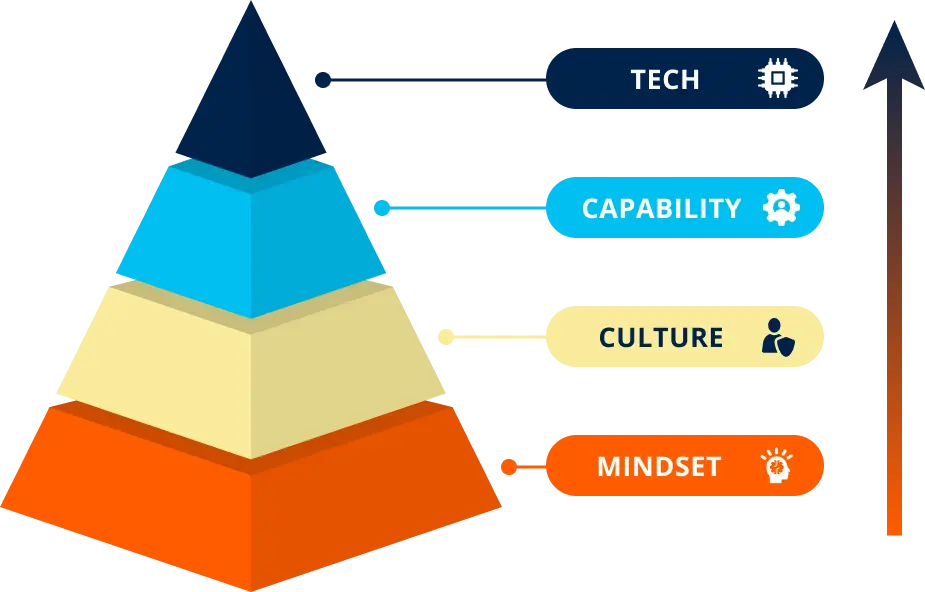
Build the mindset, culture, and capabilities to start unlocking real AI impact, fast!
📚 Immersive Learning
Live expert sessions + self-paced modules for procurement teams.
📅 21-Day Program
Flexible, high-impact AI training tailored to your goals.
🌍 Real Examples
Apply AI to sourcing, contracts, and supplier management.
📈 AI Progress Tracker
Benchmark and measure ROI with clear and accurate metrics.
🤝 Hands-On Projects
Encourage practical use and secure ongoing advancement.
💬 Expert Access
Monthly Q&A with AI and procurement experts to solve your problems.
AI Fundamentals For Procurement Leaders
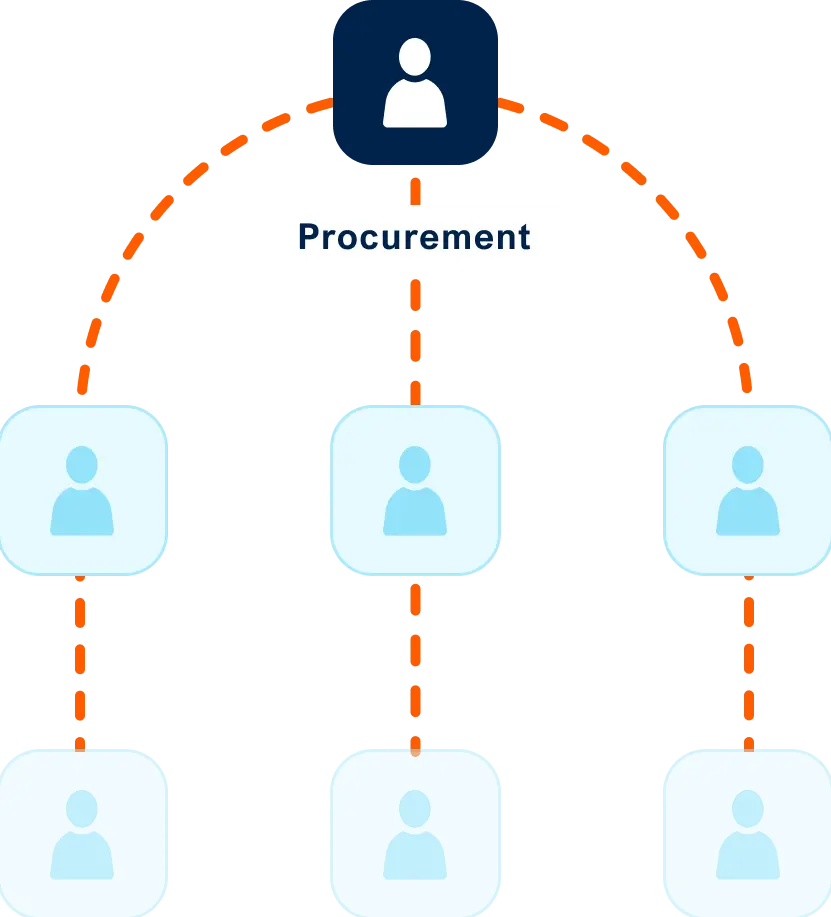
Align your team on an AI vision and build a strategic roadmap for procurement transformation.
📅 21-Day Program
Focused, high-impact training to accelerate AI usage in your team.
🌍 Real Examples
Learn from real examples of procurement leaders leading the AI-way
💬 Expert Access
Monthly Q&A with AI and procurement experts to solve your problems.
🎯 Leaders Aligned
Unify your team with a shared understanding of AI's role in procurement.
📚 Immersive Learning
Live expert sessions + self-paced modules for procurement leaders.
📍 Actionable Roadmap
Leave with a clear plan to implement AI in your procurement process
Succeeding in AI through Talent
Mastering AI isn't about using the newest tool
Winning with AI requires investing in people, not just tools.
We see many people caring too much about using the newest tool, but they are utilizing only 10% of what is possible.
Using the newest tools is great, but actually knowing how to use them is key.
Leading procurement teams adopt a structured approach to change, integrating talent and technology to transform their function into an AI-driven powerhouse.
Program Overview For Your Team
Program Overview for Procurement Leaders
Meet your instructors

Marijn Overvest
Procurement Thought Leader & AI Expert

Ralph De Groot
Senior Learning Consultant & AI Expert
SUPPORT
FAQs
Have more questions? Get in touch with one of our sales consultants. Book a demo for further questions.
How do I enroll my team?
Schedule a demo call with our team. You can book a consultation directly on their calendar or reach out to us at [email protected]. We'll discuss timelines and get your team on board!
How much time does this require?
The leadership program can be finished within 5-6 hours.
The program for your team can also be finished within 5-6 hours.
If you decide to also participate in the optional modules that cover AI agent building, this will take another 5-6 hours.
Need help choosing the right pace? Discuss your team’s goals and timeline with one of our Procurement Learning Specialists in a free discovery call.
Is there a fixed schedule?
No. Your dedicated Procurement Learning Consultant will work with you during onboarding to:
- Agree on a tailored timeline
- Lock in dates for the kick-off, live sessions, and graduation/demo day
- Define progress checkpoints to keep learners on track
Before each live session, participants should complete a set portion of the self-paced modules, ensuring productive, focused discussions.
This structured yet flexible approach keeps teams aligned while accommodating procurement professionals’ busy schedules.
Is there a live learning component?
Yes!
This program comes with a kickoff and a 2 live Q&A sessions to solve your AI problems in procurement.
What type of support can we expect?
During the pre-enrollment process, our procurement specialists will guide your decision-making and address all your questions. You can reach them by email or schedule a quick consultation call whenever needed.
Once enrolled, you'll be assigned a dedicated Procurement Learning Consultant who will:
-
Serve as your single point of contact throughout the program
-
Coordinate all logistics including kickoff, scheduling, and live sessions
-
Onboard your procurement team and handle any program-related needs
-
Work closely with you to maximize the impact on your team's procurement capabilities
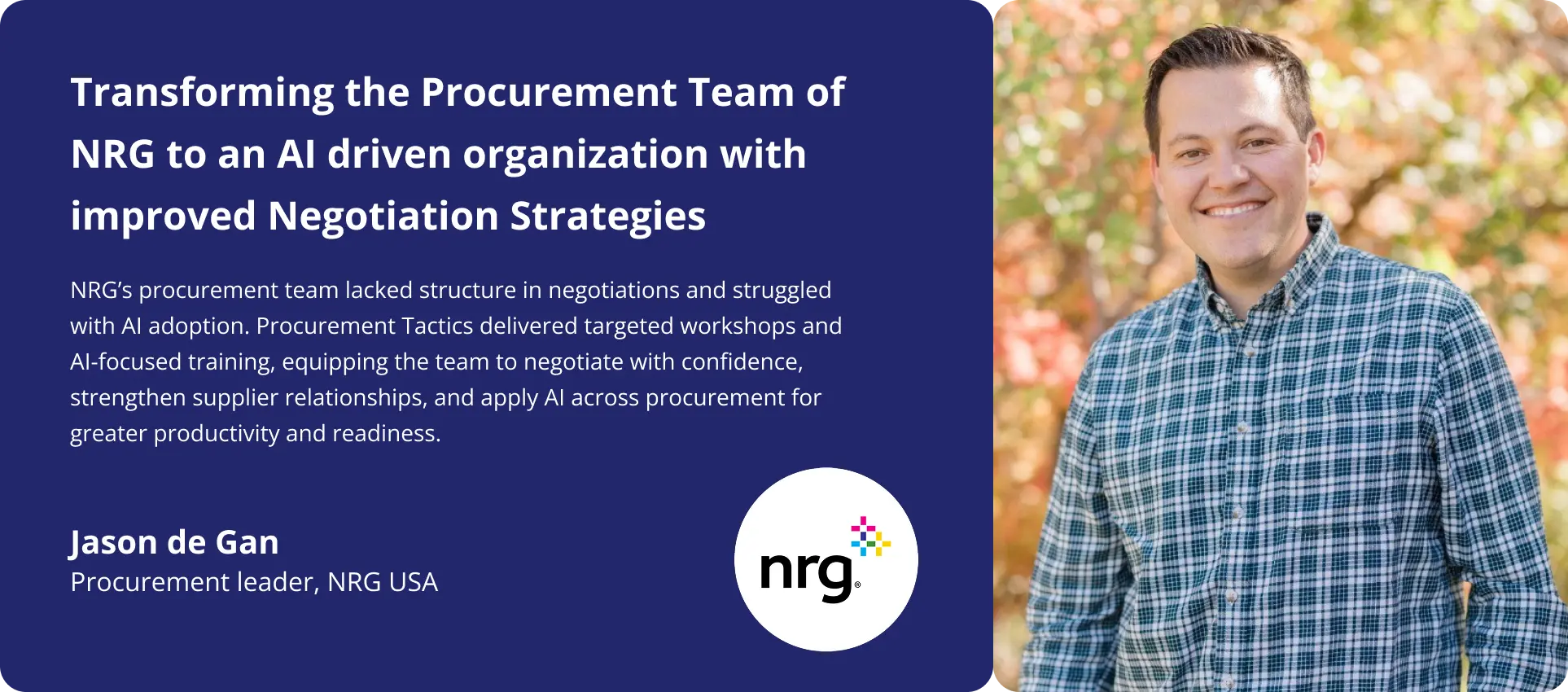
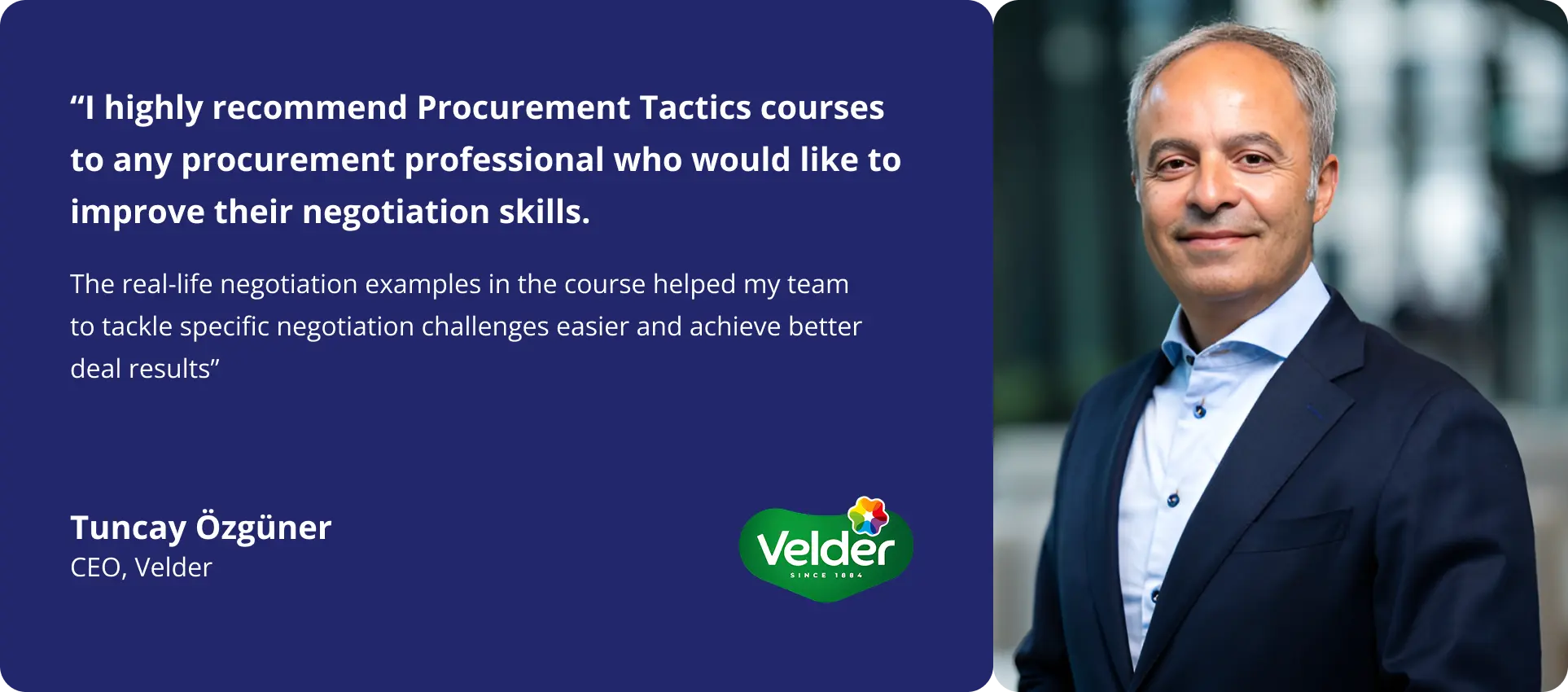
Client Success Stories
NEXT STEP
Program Overview + Price Quote
Ready to upskill your procurement team with critical AI skills?
Request a price quote and the program overview using the form, or reach out to us directly if you'd like to discuss what's right for your team.
Click here to grab a slot in my calendar. Talk soon!

Pim Herremans 
Get Price Quote
Get Price Quote