


Top 15 Contract AI Software Tools in 2026 — Features + Pricing
What is contract ai software tools?
- Contract AI software uses AI to automate contract drafting, review, and lifecycle management.
- These tools improve compliance, reduce manual work, and speed up approvals.
- They help businesses manage contracts more efficiently while minimizing legal and operational risks.
Top 15 Contract AI Software Tools in 2026
Below is an overview of the leading contract AI software platforms in 2026, each designed for different business sizes, legal workflows, and levels of contract management complexity.
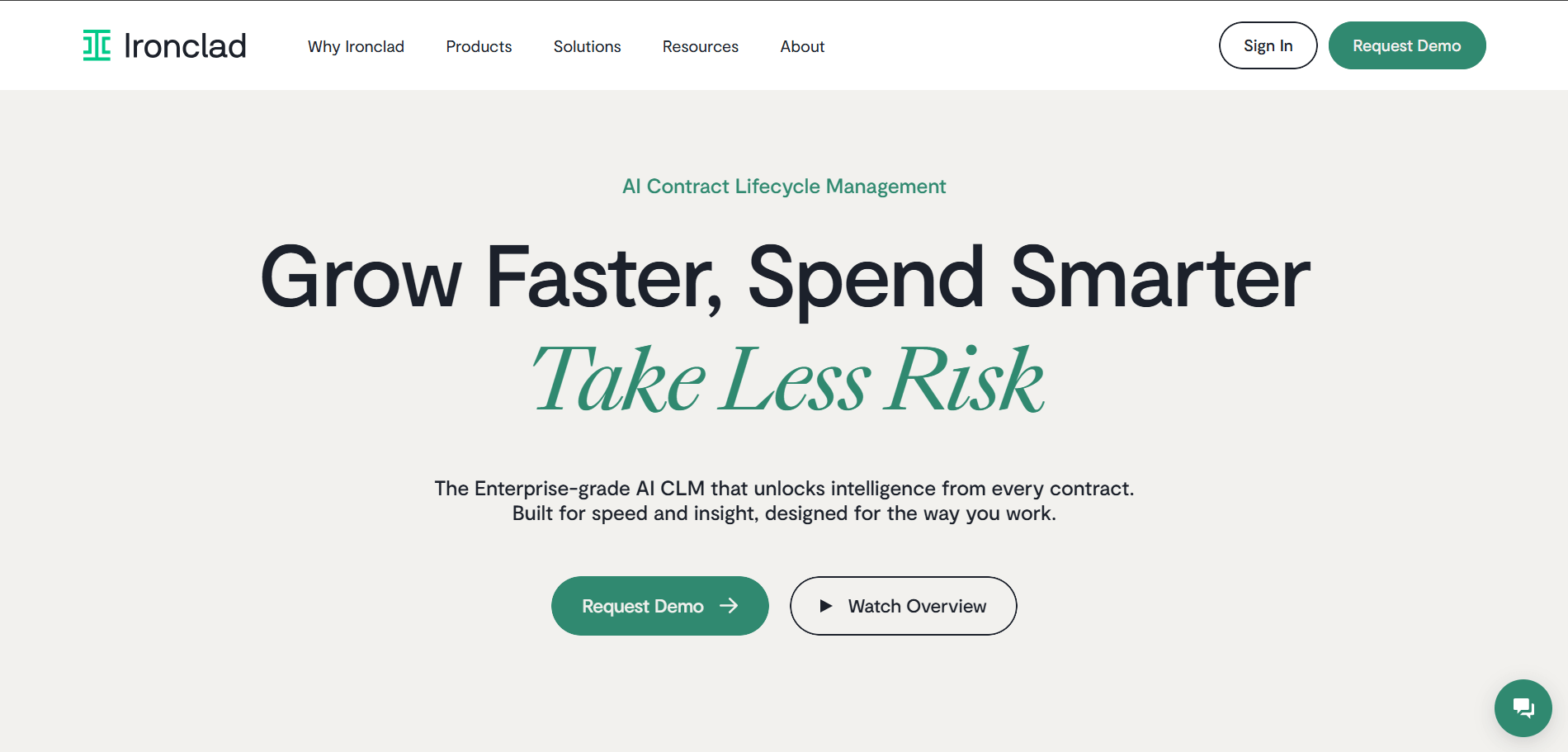
1. Ironclad
Ironclad is a cloud-based contract lifecycle management (CLM) platform that uses AI to streamline contract creation, review, approval, and management processes. It is widely used by legal, procurement, and sales teams to automate workflows and improve contract visibility across organizations.
Why choose Ironclad?
- AI-powered contract drafting and clause recommendations
- Automated approval workflows and contract tracking
- Centralized contract repository with advanced search capabilities
- Strong collaboration features for legal and business teams
- Integrates with CRM, ERP, and e-signature platforms
Pricing
Pricing for Ironclad is customized based on company size, number of users, and the scope of contract lifecycle management features required.
For a more accurate and tailored quote, pricing information is available upon request directly through the vendor’s website.
Ratings and Reviews
- G2: ~4.5/5
- Capterra: ~4.4/5
Pros and Cons
| Pros | Cons |
| Strong AI-powered workflow automation | Pricing is not publicly transparent |
| User-friendly interface | Implementation may take time |
| Excellent collaboration capabilities | Advanced customization may require support |
| Robust integrations with enterprise systems | Better suited for mid-sized and large companies |
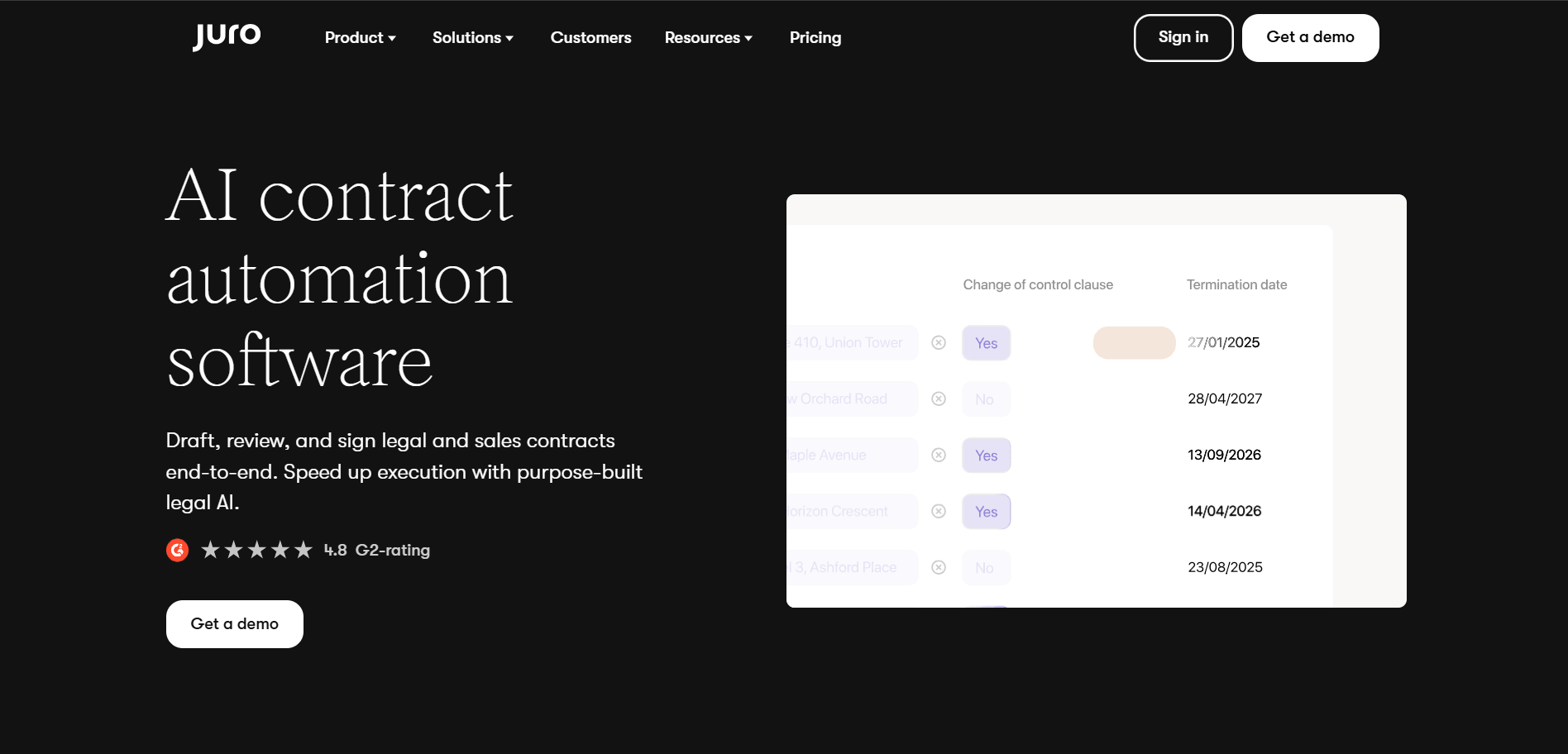
2. Juro
Juro is an AI-native contract automation platform built to help businesses create, negotiate, approve, and manage contracts in one unified workspace. It focuses on speed, collaboration, and ease of use, making it especially popular among startups and scaling companies.
Why choose Juro?
- AI-assisted contract drafting and editing
- Browser-based collaborative contract workflows
- Built-in e-signature and approval automation
- Centralized contract storage and analytics
- Modern and intuitive user experience
Pricing
Pricing for Juro is typically customized depending on the number of users, workflow complexity, and contract volume.
For detailed pricing information, organizations are encouraged to request a quote directly through the vendor’s website.
Ratings and Reviews
- G2: ~4.7/5
- Capterra: ~4.8/5
Pros and Cons
|
Pros |
Cons |
|
Very intuitive and modern UI |
Less suitable for highly complex enterprise workflows |
|
Fast implementation and onboarding
|
Limited advanced enterprise customization |
|
Strong collaboration tools |
Some integrations may require additional setup |
|
Good fit for startups and SMBs |
Advanced analytics are less extensive than enterprise CLMs |

3. DocuSign
DocuSign CLM combines electronic signature capabilities with AI-powered contract lifecycle management tools. It helps organizations automate agreement workflows, improve compliance, and accelerate contract turnaround times.
Why choose DocuSign CLM?
- Combines e-signature and AI contract automation
- Automated workflow and approval routing
- AI-powered contract analytics and search
- Strong compliance and audit trail capabilities
- Integrates well with CRM and ERP systems
Pricing
Pricing for DocuSign CLM varies depending on the number of users, contract volume, and selected features.
For accurate pricing details, organizations typically request a custom quote through the vendor’s website.
Ratings and Reviews
- G2: ~4.1/5
- Capterra: ~4.3/5
Pros and Cons
| Pros | Cons |
| Industry-leading e-signature ecosystem | Can become expensive at scale |
| Strong workflow automation | UI can feel complex for new users |
| Reliable integrations | Advanced features may require higher-tier plans |
| Good compliance and audit capabilities | Setup can require technical assistance |
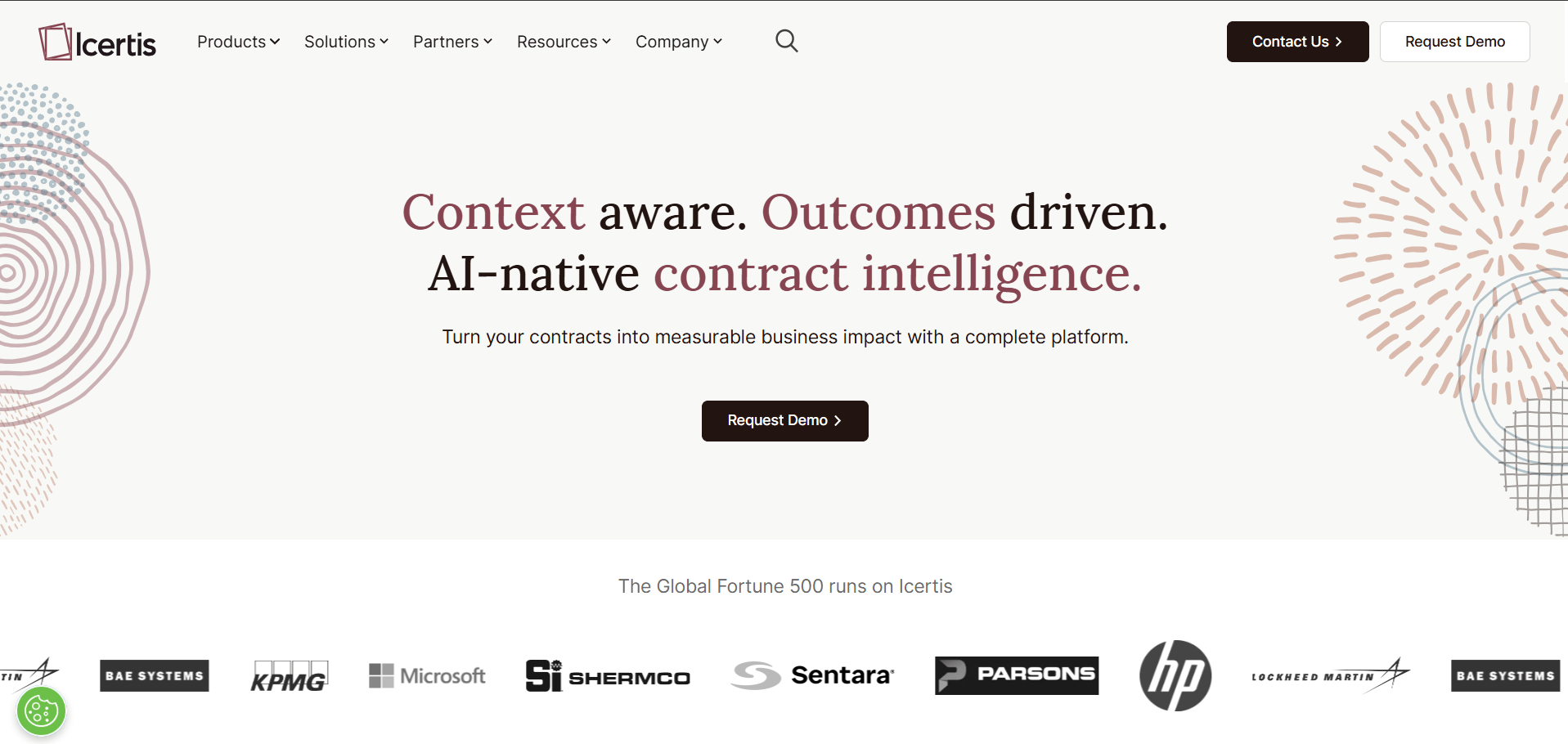
4. Icertis
Icertis is an enterprise-grade contract intelligence platform designed to help organizations manage complex contract ecosystems using AI-driven automation and analytics. It is commonly used by global enterprises that require strong compliance, governance, and contract visibility.
Why choose Icertis?
- AI-powered contract analytics and risk identification
- End-to-end contract lifecycle management capabilities
- Strong compliance and governance features
- Advanced workflow automation for enterprise operations
- Deep integration with ERP and CRM systems
Pricing
Pricing for Icertis is customized based on organizational size, contract volume, number of users, and required modules.
For a more detailed and tailored pricing estimate, organizations typically request a quote directly through the vendor’s website.
Ratings and Reviews
- G2: ~4.4/5
- Capterra: ~4.5/5
Pros and Cons
| Pros | Cons |
| Strong enterprise contract management capabilities | Complex implementation process |
| Advanced AI analytics and reporting | Pricing is not transparent |
| Excellent compliance and governance tools | Requires training for full adoption |
| Highly scalable for global organizations | May be too advanced for smaller businesses |

5. ContractPodAi
ContractPodAi is a legal and contract management platform that combines AI automation with contract lifecycle management tools. It is designed to help legal teams automate contract workflows, reduce manual work, and improve operational efficiency.
Why choose ContractPodAi?
- AI-driven contract review and data extraction
- Automated legal workflows and approvals
- Centralized contract repository and search
- Built-in analytics and reporting capabilities
- Strong focus on legal operations automation
Pricing
Pricing for ContractPodAi is typically tailored based on the organization’s legal operations requirements, user count, and workflow complexity.
For accurate pricing information, companies are encouraged to request a quote directly from the vendor.
Ratings and Reviews
- G2: ~4.4/5
- Capterra: ~4.5/5
Pros and Cons
| Pros | Cons |
| Strong AI automation capabilities | Setup can require significant configuration |
| Good legal workflow management | Pricing may be high for smaller teams |
| Centralized contract intelligence | Some advanced features have a learning curve |
| Flexible enterprise integrations | Implementation can take time |

6. Evisort
Evisort is an AI-powered contract intelligence platform that helps organizations analyze, manage, and extract insights from contracts automatically. It is known for its strong document analysis and machine learning capabilities.
Why choose Evisort?
- AI-based contract data extraction and analysis
- Automated contract organization and tagging
- Powerful search and reporting capabilities
- Fast deployment with minimal manual data entry
- Helps identify risks, obligations, and renewal dates
Pricing
Pricing for Evisort is customized based on contract volume, number of users, and required AI functionality.
For a detailed pricing estimate, organizations typically contact the vendor directly.
Ratings and Reviews
- G2: ~4.7/5
- Capterra: ~4.6/5
Pros and Cons
| Pros | Cons |
| Excellent AI contract analysis capabilities | Pricing is not publicly available |
| Strong search and data extraction features | Advanced enterprise customization may require support |
| Easy-to-use interface | Better suited for organizations with high contract volumes |
| Fast onboarding compared to legacy CLMs | Some integrations may require additional setup |
7. Lexion
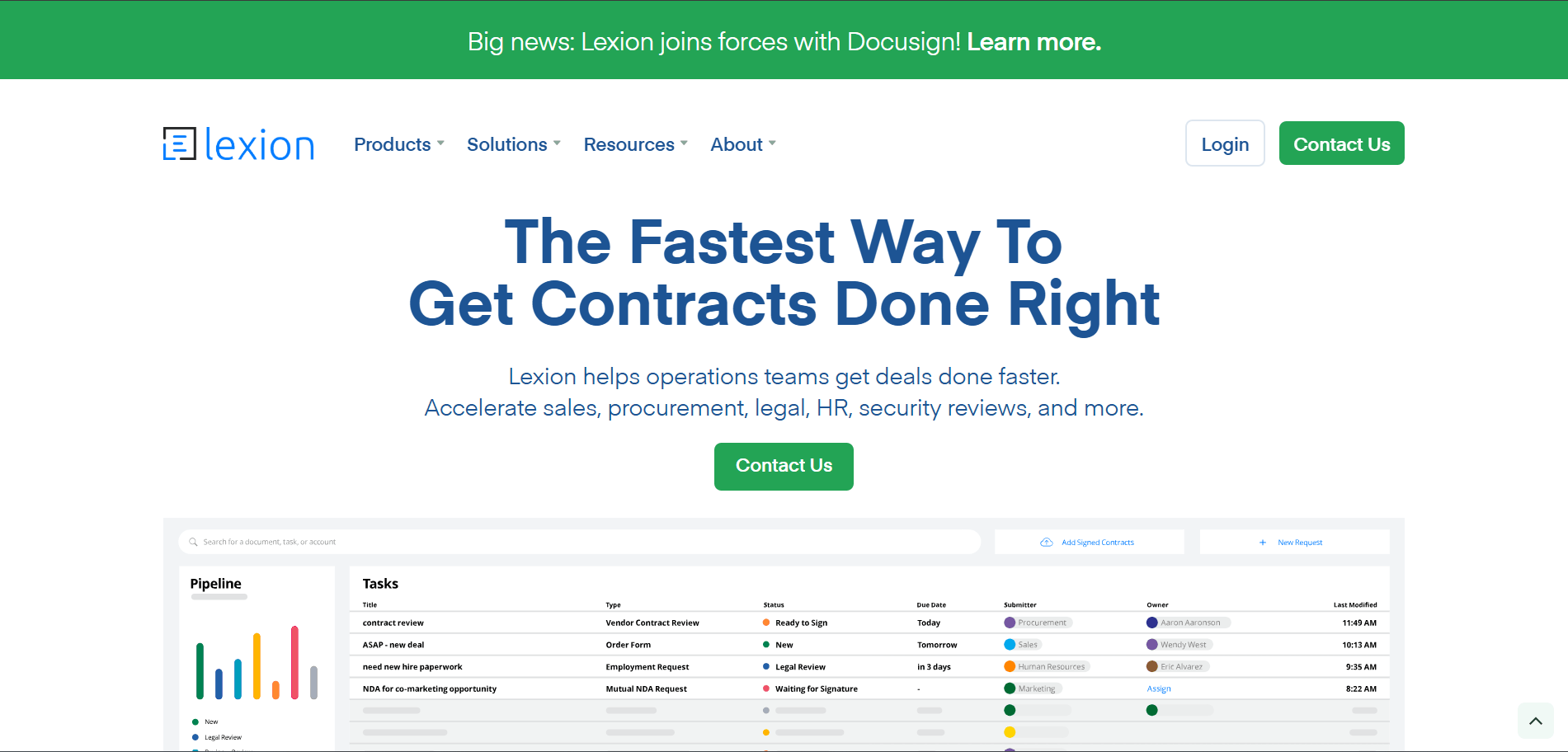
Lexion is an AI-driven contract management platform focused on simplifying legal workflows and improving contract visibility for business teams. It combines automation, collaboration, and AI-powered search in a user-friendly interface.
Why choose Lexion?
- AI-assisted contract review and tracking
- Automated workflows and approval processes
- Centralized repository with smart search
- Strong collaboration features for legal and business teams
- Easy integration with common business tools
Pricing
Pricing for Lexion depends on company size, number of users, and contract management requirements.
For detailed and customized pricing information, organizations should contact the vendor directly.
Ratings and Reviews
- G2: ~4.8/5
- Capterra: ~4.7/5
Pros and Cons
| Pros | Cons |
| User-friendly and intuitive platform | Less suitable for highly complex enterprise environments |
| Strong AI search and automation | Advanced customization options may be limited |
| Fast implementation process | Some enterprise integrations may require configuration |
| Good collaboration and workflow management | Pricing may increase with scale |

8. LinkSquares
LinkSquares is a contract lifecycle management and analytics platform designed to help legal teams manage contracts more efficiently using AI-powered insights and automation.
Why choose LinkSquares?
- AI-powered contract analysis and metadata extraction
- Centralized contract repository with advanced search
- Workflow automation for approvals and renewals
- Strong analytics and reporting tools
- Built specifically for legal and in-house counsel teams
Pricing
Pricing for LinkSquares is customized depending on contract volume, number of users, and selected modules.
For accurate pricing information, organizations are encouraged to request a quote directly from the vendor.
Ratings and Reviews
- G2: ~4.7/5
- Capterra: ~4.6/5
Pros and Cons
| Pros | Cons |
| Strong legal analytics and AI capabilities | Pricing is not transparent |
| Good contract visibility and organization | Advanced workflows may require setup support |
| User-friendly platform | Some features are enterprise-focused |
| Strong reporting and search functionality | Can become expensive for larger deployments |
9. Agiloft
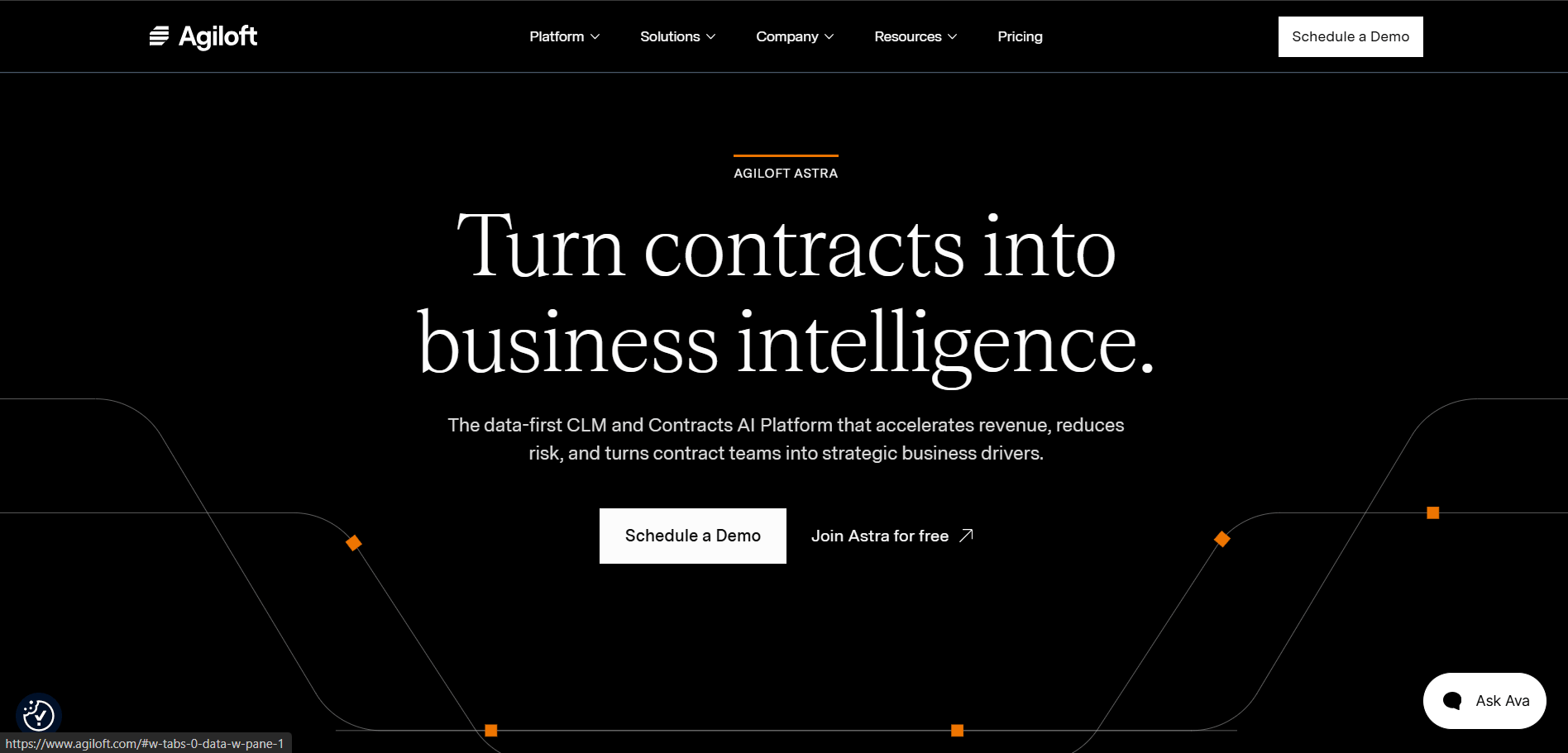
Agiloft is a highly customizable contract lifecycle management platform that combines AI-driven contract analysis with workflow automation. It is widely used by enterprises that require flexible contract processes and advanced customization capabilities.
Why choose Agiloft?
- AI-powered contract review and clause analysis
- Highly customizable workflows and approval processes
- Strong compliance and audit tracking features
- No-code configuration for contract automation
- Integrates with ERP, CRM, and business systems
Pricing
Pricing for Agiloft is customized based on organization size, contract complexity, number of users, and selected modules.
For detailed pricing information, organizations typically request a quote directly through the vendor’s website.
Ratings and Reviews
- G2: ~4.6/5
- Capterra: ~4.5/5
Pros and Cons
| Pros | Cons |
| Highly flexible and customizable platform | Initial setup can be complex |
| Strong workflow automation | Requires training for advanced configuration |
| Good AI contract analysis capabilities | UI may feel less modern compared to newer tools |
| Strong compliance and audit support | Better suited for mid-sized and large organizations |
10. Conga
Conga is a contract lifecycle management and document automation platform designed to help businesses streamline contract creation, negotiation, and compliance processes. It is particularly popular among sales and revenue operations teams.
Why choose Conga?
- Automated contract generation and approval workflows
- AI-assisted document and contract management
- Strong Salesforce integration capabilities
- Centralized contract visibility and reporting
- Supports quote-to-cash and revenue operations
Pricing
Pricing for Conga is generally customized based on deployment size, feature requirements, and integration needs.
For a more accurate pricing estimate, organizations are encouraged to contact the vendor directly.
Ratings and Reviews
- G2: ~4.0/5
- Capterra: ~4.1/5

Pros and Cons
| Pros | Cons |
| Excellent Salesforce ecosystem integration | Implementation can be time-consuming |
| Strong document automation capabilities | UI may feel complex for new users |
| Good workflow and approval management | Some advanced features require add-ons |
| Helpful for revenue and sales operations | Pricing may increase significantly with scale |
11. Sirion
Sirion is an AI-powered contract lifecycle and contract governance platform focused on helping enterprises manage contractual obligations, supplier relationships, and compliance more effectively.
Why choose Sirion?
- AI-driven contract obligation tracking
- Strong supplier and contract governance capabilities
- Real-time contract performance monitoring
- Automated risk and compliance management
- Advanced analytics and reporting features
Pricing
Pricing for Sirion is customized depending on enterprise requirements, contract volumes, and workflow complexity.
For detailed pricing information, organizations should request a quote directly from the vendor.
Ratings and Reviews
- G2: ~4.4/5
- Capterra: ~4.5/5

Pros and Cons
| Pros | Cons |
| Strong contract governance and compliance features | Complex enterprise implementation |
| Advanced AI analytics and monitoring | Pricing is not publicly transparent |
| Good supplier relationship management capabilities | May require significant onboarding |
| Suitable for large enterprise environments | Less ideal for smaller businesses |
12. SpotDraft
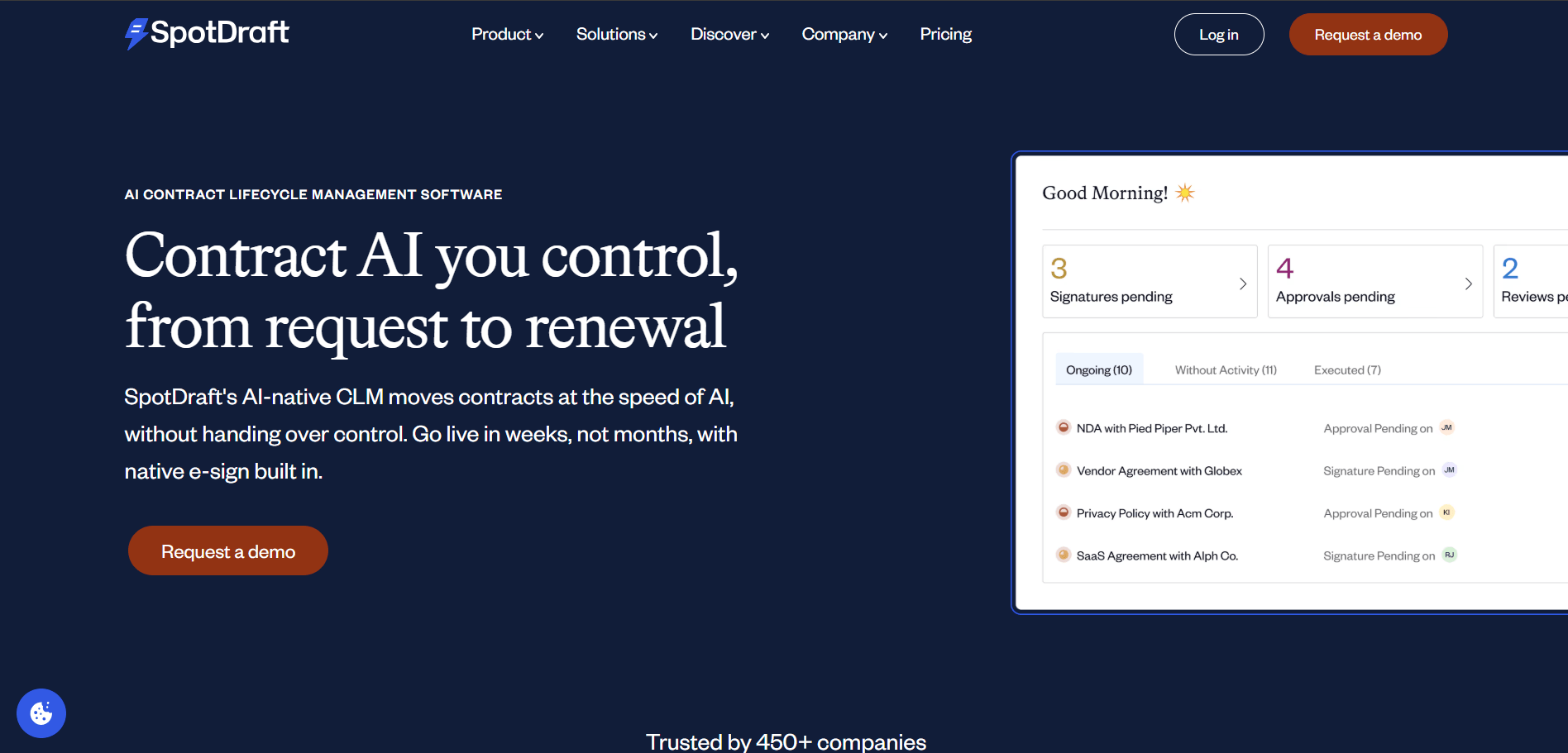
SpotDraft is an AI-powered contract management platform designed to simplify contract creation, collaboration, and lifecycle management for legal and business teams.
Why choose SpotDraft?
- AI-assisted contract drafting and review
- Collaborative workflows for legal and business users
- Centralized contract storage and smart search
- Automated reminders and obligation tracking
- Easy-to-use and modern interface
Pricing
Pricing for SpotDraft varies depending on team size, contract volume, and workflow requirements.
For detailed pricing information, organizations typically contact the vendor directly.
Ratings and Reviews
- G2: ~4.7/5
- Capterra: ~4.6/5
Pros and Cons
| Pros | Cons |
| Modern and user-friendly interface | Advanced enterprise customization may be limited |
| Strong collaboration features | Some integrations may require setup assistance |
| Good AI-assisted drafting capabilities | Better suited for growing businesses than highly complex enterprises |
| Fast onboarding and implementation | Pricing is not publicly available |
13. Robin AI
Robin AI is an AI-powered legal assistant platform focused on contract review, editing, and negotiation support. It combines generative AI capabilities with legal expertise to help businesses accelerate contract workflows.
Why choose Robin AI?
- AI-assisted contract review and redlining
- Fast clause analysis and risk detection
- Supports legal negotiation workflows
- Natural language search and contract insights
- Designed specifically for legal teams
Pricing
Pricing for Robin AI is customized based on contract usage, legal workflow requirements, and team size.
For accurate pricing details, organizations should request a quote directly through the vendor’s website.
Ratings and Reviews
- G2: ~4.6/5
- Capterra: ~4.5/5

Pros and Cons
| Pros | Cons |
| Strong AI contract review capabilities | Newer platform compared to legacy CLMs |
| Helps accelerate legal workflows | Enterprise customization may require support |
| Good clause and risk analysis | Pricing is not transparent |
| Modern AI-driven experience | Some advanced integrations are limited |
14. Lawgeex
Lawgeex is an AI-powered contract review platform designed to automate legal review processes and help businesses accelerate contract approvals while reducing legal risk. It focuses heavily on automated redlining and compliance checking.
Why choose Lawgeex?
- AI-driven contract review and approval automation
- Automated policy and compliance checks
- Fast identification of risky clauses and deviations
- Reduces manual legal review workload
- Designed for legal departments and in-house counsel teams
Pricing
Pricing for Lawgeex is customized based on contract volume, legal workflow complexity, and the size of the organization.
For detailed pricing information, organizations are encouraged to request a quote directly from the vendor’s website.
Ratings and Reviews
- G2: ~4.5/5
- Capterra: ~4.4/5

Pros and Cons
| Pros | Cons |
| Strong AI-powered legal review automation | Primarily focused on contract review rather than full CLM |
| Helps reduce manual legal workload | Enterprise setup may require customization |
| Good compliance and policy enforcement capabilities | Pricing is not publicly transparent |
| Speeds up contract approval cycles | Less suitable for smaller businesses with simple workflows |
15. Kira Systems
Kira Systems is a machine learning-powered contract analysis platform widely used by legal professionals for contract review, due diligence, and document analysis. It is especially popular in law firms and enterprise legal departments handling large volumes of contracts.
Why choose Kira Systems?
- Machine learning-based contract data extraction
- Strong due diligence and contract analysis capabilities
- Automated identification of clauses and obligations
- Supports legal audits and compliance reviews
- Designed for high-volume legal document processing
Pricing
Pricing for Kira Systems is typically customized based on the number of users, document volume, and required AI analysis capabilities.
For a more detailed and accurate pricing estimate, organizations usually request a quote directly from the vendor’s website.
Ratings and Reviews
- G2: ~4.6/5
- Capterra: ~4.5/5

Pros and Cons
| Pros | Cons |
| Excellent contract analysis and due diligence functionality | Not a full end-to-end CLM platform |
| Strong machine learning capabilities | It can be expensive for smaller organizations |
| Handles large contract volumes efficiently | Requires training for optimal use |
| Widely trusted in legal industry workflows | UI may feel less modern compared to newer AI tools |
Why is There a Need for Contract AI Software?
Even before the rapid rise of generative AI, businesses were already struggling with inefficient contract management processes. Legal teams often relied on email threads, spreadsheets, and manual reviews to manage contracts, making workflows slow, fragmented, and difficult to scale.
Today, organizations handle hundreds or even thousands of contracts across sales, procurement, HR, finance, and legal departments. Without centralized systems and automation, contract creation, negotiation, approval, and tracking become time-consuming and error-prone.
Contract AI software addresses these challenges by using artificial intelligence to automate contract drafting, review, clause analysis, approval workflows, and obligation tracking. These platforms help organizations reduce manual legal work, improve compliance, accelerate negotiations, and gain better visibility into contract risks and performance.
The demand for contract AI software has grown significantly as companies prioritize operational efficiency, compliance, and faster business execution. With remote collaboration, increasing regulatory complexity, and growing contract volumes, businesses require intelligent tools that can streamline legal workflows while minimizing risk.
In short, contract AI software enables organizations to manage contracts more efficiently, reduce bottlenecks, and improve decision-making across the entire contract lifecycle.
Advantages and Disadvantages of Contract AI Software
|
Advantages |
Disadvantages |
|
Automates contract drafting, review, and approval workflows |
Implementation can be complex for large organizations |
|
Reduces manual legal work and operational bottlenecks |
Pricing is often not publicly transparent |
|
Improves contract visibility and centralized management |
Requires employee training and adoption |
|
Helps identify risks, obligations, and compliance issues faster |
AI-generated recommendations may still require legal oversight |
|
Accelerates contract turnaround and negotiation cycles |
Integration with legacy systems may require additional effort |
|
Enhances collaboration between legal and business teams |
Advanced enterprise features can increase costs |
|
Enables better reporting, analytics, and contract tracking |
Smaller businesses may not need full enterprise functionality |
|
Supports scalability as contract volumes grow |
Dependence on system reliability and integrations |
Conclusion
Contract AI software has become an essential tool for modern organizations looking to streamline legal operations, improve compliance, and accelerate business processes. Instead of relying on fragmented manual workflows, companies can now use AI-driven platforms to automate contract creation, review, negotiation, and lifecycle management.
As shown throughout this article, there are many different types of contract AI solutions available, ranging from enterprise-grade CLM platforms like Icertis and Ironclad to specialized AI contract review tools like Robin AI and Lawgeex.
The right choice ultimately depends on factors such as company size, contract volume, workflow complexity, compliance requirements, and integration needs. Some organizations may prioritize advanced analytics and governance, while others may focus on ease of use, faster implementation, or AI-assisted drafting capabilities.
The key takeaway is that successful adoption goes beyond simply selecting software. Businesses must also ensure proper workflow integration, employee adoption, and continuous optimization of legal processes. Organizations that treat contract management as a strategic function rather than an administrative task are better positioned to reduce risk, improve efficiency, and scale operations more effectively.
Frequentlyasked questions
What is contract AI software?
Contract AI software is a platform that uses artificial intelligence to automate and optimize contract-related processes such as drafting, review, approval, analysis, and lifecycle management. These tools help organizations reduce manual legal work, improve compliance, and manage contracts more efficiently.
What are the benefits of contract AI software?
Contract AI software helps organizations automate repetitive legal tasks, accelerate contract approvals, improve visibility into obligations and risks, and centralize contract management processes. It also enhances collaboration between legal and business teams while improving operational efficiency and compliance.
How do you choose the right contract AI software?
Choosing the right contract AI software depends on factors such as contract volume, business size, workflow complexity, compliance requirements, and integration needs. Organizations should look for solutions that offer strong AI capabilities, user-friendly workflows, reliable integrations, scalability, and features that align with their legal and operational priorities.
About the author
My name is Marijn Overvest, I’m the founder of Procurement Tactics. I have a deep passion for procurement, and I’ve upskilled over 200 procurement teams from all over the world. When I’m not working, I love running and cycling.
