


50 Powerful Negotiation Tactics
Negotiation is more than just a skill. It is an essential tool that can influence every aspect of our personal and professional lives. Whether you are securing a critical business deal, navigating supplier contracts, or resolving workplace conflicts, understanding and mastering negotiation tactics can be the key to achieving successful outcomes.
Introduction
Effective negotiators are not born, they are made. They thrive on preparation, continuous learning, and the ability to understand the perspectives of others. With the right tools and techniques, anyone can sharpen their negotiation skills to achieve results that align with their goals.
In today's dynamic and interconnected world, the ability to negotiate effectively is more critical than ever. As markets evolve and global interactions become commonplace, possessing strong negotiation skills enables individuals and organizations to adapt, collaborate, and thrive amidst change.
In the following sections, we look at 50 negotiation tactics and how to counter them.
Table of Contents
Negotiation Tactics and How to Counter Them
Atom Bomb / Dropping the Bomb
This type of tactic suggests that a failure to concede or drop a line that has been taken will lead to grave consequences.
An example of this would be: "This may only be a small order. However, failure to agree could affect the entirety of your business."
Counter tactics
When this tactic is used against you, you can do the following:
- Become very grim and just respond with "I see."
- List down the disadvantages to them of carrying out their threat.
- List down the advantages you have if they carried out their threat.
- You can indicate to the other party that you are not overly concerned even though you both have invested a lot of time in the negotiation. You can say that it would be a shame if that were to be the case.
- Show them that you are capable of walking away.
Back Burner / Postpone
This tactic is used when you want to put off an item or issue you had not planned for to a later stage in the negotiation. Give yourself time to work out a position regarding the issue.
Additionally, professionals use this tactic when it appears that a particular issue might prevent the negotiation from continuing. Proposing "let's leave that for the moment" can stop this from happening. As the negotiation progresses, the issue usually resolves itself and does not need revisiting.
Counter tactics
To counter this tactic, you may insist to the other party that it will not be possible to move on
unless you can agree on the issue at hand.
The 'Journalist-trick'
The Journalist-trick
At the start of my career, I worked for a few years as a journalist. What I learned in that experience is that people gave me the best quotes after the official part walking towards the exit door when I just asked my final question.
For example, just when the supplier is about to sign the deal, you may say something like, "And it includes this, doesn't it?".
Always think ahead of any negotiation of two things that you can include in your last sentence and use them at the end of the negotiation.
The other party may give in to what you just asked at this point as they do not want to waste what you both agreed. Using this wisely can get you a little bit more out of the deal.
Counter tactics
To counter this tactic, it's important not to agree instantly with whatever the other party may bring
up when you are about to sign the negotiation. Keep calm, smile, and take your time to consider
your response.
Brinkmanship / Bluffing
Going right to the edge requires great skill not to fall over. One way is to try and get the other party to see the edge as being closer than it is.
However, you must beware of bluffing. If you are going to bluff, you should be aware of what to do once your bluff is called.
Bluffing is a tactic I frequently use as well. However, there is a significant difference between bluffing and lying.
Bluffing usually involves being prepared to take action if the supplier does not agree to your proposal. I often combined it with my BATNA or the sticks I had prepared for the negotiation.
For example, I would request a specific purchasing discount and threaten to switch to another supplier if the current supplier did not comply. Whether you ultimately follow through is always in question.
Bluffing generally concerns things you might do in the future. Lying, on the other hand, typically involves distorting facts or making promises you cannot keep. For instance, claiming you expect to sell 1 million units when you know it will be no more than 100,000.
This might secure a lower price initially but cause a lot of trouble later. Bluffing is a good tactic; lying should always be avoided. It damages the relationship and is counterproductive in the long term.
Counter tactics
You can use these methods when you encounter this tactic:
- When someone uses this tactic against you, you must remain cool and calm.
- You may also use the counter tactic we discussed earlier in the "Dropping the bomb" tactic.
- You may say that if that is the case, then it would appear that it will not be possible to achieve a negotiated agreement.
- Begin to gather your things up or wait for a response. In addition to the four counter tactics mentioned earlier, another response I often used, especially when I knew the power balance was in my favor, was to counter the bluff with a bluff. For instance, when I received emails or letters from various small suppliers announcing their price increases effective January 1st, I would respond by stating that I would delist all their products as of January 1st. Within five minutes, I would receive calls from most of them, often indicating that the price increase was not as steep as initially stated.
Hanging Gramophone Record
This tactic uses an approach wherein you repeat your demand over and over again in the negotiation. This may help you to win because the other party might become frustrated with your constant repetition and feel that no progress can be made unless this obstacle is removed.
It emphasized the need for persistence in negotiation and a refusal to accept "no" at its face value.
Additionally, the hanging gramophone record tactic is employed when the negotiating parties are close to an agreement. The other party will claim that they cannot meet your price no matter what they
try.
This may also be reinforced by showing evidence like a memo about cost-cutting from their top management. Psychologically speaking, the printed word seems to carry more authority than spoken words.
Counter tactics
You can use these methods when you encounter this tactic:
- Take care not to believe everything that is shown or told to you.
- Decide if you can meet the demand.
- Decide if you still want to reach an agreement with the other party.
- Insist that if you will meet their price, you will gain some concessions in return.
- Reconfigure the negotiation for you to explore various alternatives to retain your desired position and maintain your objective in the negotiation.
- Use your broken record tactic.
Deadlines
This tactic can be imposed or agreed upon and can encourage parties to concentrate on creative solutions while realizing that a concession is necessary.
Counter tactics
You can use these methods when you encounter this tactic:
- Make a note of the deadline.
- Always expect this to happen at some stage, and even play a game with yourself to guess when they will launch it to you.
- Avoid further discussion. However, be a little brisker in your demeanor.
- Itis their deadline and not yours. So remind them that their deadline is getting near. @ —_— » @
Russian Front
In this tactic, you are presented with two options. The first one is awful that you will agree to the second option.
Counter tactics
To counter this tactic, it's important not to agree instantly with whatever the other party may bring
up when you are about to sign the negotiation. Keep calm, smile, and take your time to consider
your response.
Silence
Silence is a good tactic to diffuse emotions in the negotiation. Generally, many people are uncomfortable with it. Thus, they will have the urge to fill the silence and when they usually do, it weakens their position.
Counter tactics
These are some ways you can do to counter this tactic:
- Use the broken record tactic.
- Use even more silence in return.
- Tell them that you would appreciate a response to your last statement.
- Smile and wait for them to fill the void.
Hypothetical Question
A helpful technique for conversations and negotiations is to use the "what if" approach. This method allows you to test your assumptions, gauge the other person's commitment, and move negotiations forward when it seems like there's no more leeway.
"If I were to give you this, how would you feel about doing this for me?"
When you ask this question, you're not making an offer yet; you're using words to gauge the other party's flexibility and to explore potential agreements.
This can help explore new ideas and break deadlocks without making commitments. It can be beneficial during the testing stage to explore alternatives and shape a deal.
This tactic is one of my favorites, and it has helped me close several deals that were completely stuck. The best part about this tactic is that you have almost nothing to lose.
It works especially well when your counterpart may not have full authority but knows there is still room for negotiation.
If you find it too early to escalate (which is also a good tactic), this is a great way to determine if there is still flexibility on the other side.
Counter tactics
For this, none is required. It is generally a good tactic, to be used by either party to arrive at the
best mutually agreed solution.
Salami
In this tactic, you feed difficulty or bad news in thin slices, piece by piece. This usually produces concessions because the other party wishes to get away from an increasingly uncomfortable situation.
Counter tactics
To counter this tactic, you can use the following methods below:
- If you feel like this is occurring, stop the slippery slope at this point.
- Tell them the agreement is impossible without putting all the issues at the negotiation table.
- Withdraw previous concessions and tell them the new information puts the whole negotiation in a new light. Thus, the whole negotiation has to be reconsidered.
Why
You should not be afraid to challenge the other party, especially at the early stage of the negotiation when positions are being defined.
However, you must remember not to use it excessively as it can cause frustration and inhibit the other party from checking some other alternatives.
Counter tactics
These are some ways to counter this tactic:
- Be prepared to answer any challenge confidently and easily.
- Challenge back in equal measure.
Physically Disturb Them
This uses various physical non-violent movements to throw the other party off balance. Examples are lean inventory across the table, changing the normal seating pattern, sitting close to them, and asking them not to smoke if they usually do.
Counter tactics
To counter this tactic, you can use the following methods below:
- If you feel like this is occurring, stop the slippery slope at this point.
- Tell them the agreement is impossible without putting all the issues at the negotiation table.
- Withdrawing previous concessions and telling them the new information puts the whole negotiation in a new light. Thus, the whole negotiation has to be reconsidered. © a = ©) This tactic refers to a change to another team or refers to other individuals or groups.
New Faces
This tactic refers to a change to another team or refers to other individuals or groups.
Counter tactics
These are some methods you can use to counter this tactic:
- Ask them the reason for the change.
- Bring in new faces on your own.
- Bring in your superior.
Building Block Technique
The building block technique can be used in various ways. You could start by asking about the cost of a portion of your needs. Then, during face-to-face negotiations, request pricing for different quantities leading up to your actual requirements. This approach makes the other party more open to accommodating your full needs when you finally reveal them.
Counter tactics
When this tactic is used against you, you can do the following:
- Avoid giving your best prices first. Always leave room for maneuver.
- Try finding out about the minimum and maximum order quantities in advance of quoting.
- Have clear and published price breakpoints.
- Ask about extreme cases before quoting for the level of volume or contract length. Deliberate Misunderstanding
Deliberate Misunderstanding
This tactic is employed to gain time to think after receiving a complex proposal. By saying, "Could you run through that again?" you either gain additional time to consider the proposal or discourage the other party from using such complicated tactics.
Counter tactics
You can use these methods when you encounter this tactic:
- Always get details that have been agreed upon in writing.
- If you did not say what they insist that you have agreed upon, refuse it firmly.
- Reopen the negotiation on the basis that the whole deal will need to be reviewed if the extras that they want are to be included.
- No matter how urgently you need to agree on a deal, never appear flustered.
Dunce
If you can demonstrate this, it's possible to sow seeds of doubt about the matter and undermine their confidence, making them feel inferior. Just make sure you can back up any claim you make, or your credibility will suffer.
Counter tactics
You can try to use these methods when you encounter this tactic:
- Be prepared.
- Challenge them back. Defense in Depth
Defense in Depth
This tactic uses several levels of staff or management before the issue reaches its final destination.
At each level, it is hoped that additional information will be obtained. This must be done carefully to not undermine your authority.
Counter tactics
You can prevent this at its early stages by asking whether the other party is in a position to
commit the company or who else might be involved with the decision-making.
Divide and Rule
Use this tactic when you are facing a team of negotiators on the other side. By listening and observing, you may pick up more positive or agreeable signals from a particular member. You can concentrate on them as being more reasonable and supportive.
Counter tactics
You can try to use these methods when you encounter this tactic:
- Work out your strategy as a team beforehand.
- Make sure that during the preparation, you have taken the steps to ensure that you will not fall into this trap yourself if you are leading a team negotiation. This tactic does not seem professional, but doing it at a proposal or request is a good way of signaling to the other party that what they have suggested is unacceptable. If you are uncomfortable with flinching, you can react with surprise or silence.
Flinching
This tactic does not seem professional, but doing it at a proposal or request is a good way of signaling to the other party that what they have suggested is unacceptable. If you are uncomfortable with flinching, you can react with surprise or silence.
Personally, flinching is not my favorite tactic. It is crucial to indicate when you disagree with their proposal. Flinching, on the other hand, often quickly becomes playacting that you see through easily.
I noticed this happening frequently with junior negotiators. In response, I would either indicate that it seemed we had received the same training, or I would point out that I noticed the person was acting and ask if they were done with this game.
In my view, this helped create a more open and honest communication during the negotiation.
Counter tactics
These are some of the ways that you can use to counter this tactic:
- Use silence.
- Re-state your case and keep calm and composed.
- Wait for a verbal response.
- Recognize that they are probably doing it deliberately. Smile because you know that it will not work on you.
Guilty Party
This tactic implies that the other party is breaking a code, an agreement, or refusing something conceded by others.
Counter tactics
These are some ways you can do to counter this tactic:
- Ifyou are wrong, then rectify it yourself.
- Bring the conversation back to a level of what is reasonable.
- Remember that nobody can make you feel guilty; we make ourselves feel guilty. Good Guy/Bad Guy
Good Guy / Bad Guy
This tactic is often demonstrated on most US cop shows. In a meeting with two or more representatives, one may behave rudely, ask challenging questions, or make high demands.
Before he loses face by having to back down, another team member takes over who is pleasant and agreeable. This needs close cooperation and pre-planning between members to carry out.
Counter tactics
These are the methods you can do if you encounter this tactic:
- Expose them for what they are doing. They know they are trying to pressure you into conceding something, so let them know it won't work.
- Remember that they both have the same interest in mind.
- Negotiate with the good guy as if he is the bad guy because, in reality, they are both working together.
Headache
This is an emotional appeal not to press a point and is designed to make the other party feel it would be unreasonable to do so.
Counter tactics
These are the things you can do if someone uses this tactic against you:
- Show empathy with the other party and use humor as appropriate.
- Remind them that you both need to resolve the issues at some point.
Joker
This tactic suggests that the proposals made by the other party are ridiculous and cannot be taken seriously. This can be done by using phrases such as "You've got to be joking" or "Pull the other one."
Counter tactics
These are some methods you can use to counter this tactic:
- Use the same tactic.
- Tell them that if they cannot meet your demands then there is no point in negotiating further.
- Another tactic I frequently used in response was to send the party away and indicate that they could return when they had a reasonable proposal.
Funny Money
When providing quotes, suppliers may attempt to downplay the significance of the amount they are requesting. Remember, every concession costs you something, and not gaining your target discount on a major contract could amount to wiping half of your supposed profit.
Counter tactics
These are some ways to counter this tactic:
- Aggregate any figures into bigger timescales like monthly, quarterly, or annually.
- Use the tactic for yourself.
- Remember that their "small" $50 per day is just short of a whopping $20,000 extra per year.
Higher Authority
In this tactic, you are claiming that you lack the authority to make a final decision during a crucial negotiation. You can gain time to understand the other party's perspective and to prepare counter- arguments.
However, this approach can weaken your position for future negotiations and may result in being excluded from important decisions in the future.
Counter tactics
These are some of the ways that you can try to counter this tactic:
- Always ask, "If we reach an agreement do you have the authority to commit your organization?"
- Politely ask them that you should perhaps negotiate directly with someone who has the authority to make a decision.
- You should object if they ask for better terms just to please their superiors. They must provide evidence of their bosses' instructions.
Incorrect Summary
This tactic summarizes the negotiation, tipping the balance just in your favor. If the other party does not object at the time of the agreement, they will appear unreasonable if they raise it later in the negotiation.
Counter tactics
These are some of the ways you can do if you encounter this tactic:
- Try to be the party that takes control of both the written and oral summary of the negotiation.
- Challenge the summary immediately that does not conform with your understanding.
- Tell them that the negotiation will not progress until a clear agreement has been reached.
Low-Balling
In this tactic, you are presented with what appears to be a fantastic offer, such as a significant discount. Only after you agree, do you discover unexpected conditions or additional requirements from the supplier. At this point, you're already partially committed.
Counter tactics
These are some of the things that you can do if you encounter this tactic:
- You should not find yourself falling into this trap if you are careful in getting all variables on the table before negotiating an agreement.
- Take things slowly. Do not rush to say yes to a deal that seems too good to be true.
Linking Issues
This tactic is helpful, but it requires careful planning. Essentially, it involves creating movement by connecting previously separate issues. For instance, the seller might convince you to make an additional concession: if you purchase this car model, you will receive service at that garage.
Counter tactics
These are some of the ways you can counter this tactic:
- Tell them that asking for a linked deal indicates that they are feeling in a weaker position.
- Refuse to link two things if the linkage is not in your interest.
- Toughen your stance on all issues. Full Disclosure
Full Disclosure
This depends very much on the atmosphere that has been created. Both parties need to feel that they will not be exploited by the other.
This is often used when negotiators are well used to dealing with each other as they have a high level of trust between themselves.
Remember that trust takes time to build, but it can be destroyed easily.
Counter tactics
These are some of the ways you can do to counter this tactic:
- Although you have a high level of trust, you still need to be careful.
- Openness is shown through actions, not just words. Beware of those who declare, "I'm going to be open with you" as they rarely are.
Let's Do Lunch
This tactic is an informal meeting or contact that can be used to assess views, positions, and sensitivities and catch the other person off guard.
Counter tactics
These are some ways to counter this tactic:
- Know that there is no such thing as an informal meeting when it comes to negotiation.
- Treat every encounter as though the negotiation depends on it.
- Do not reach a formal settlement informally.
- Keep notes of what you have discussed in formal and informal meetings.
- Do not allow their pleasantries to make you feel obliged to make concessions. © —_— -)
Onus Transfer
This tactic puts the onus or burden on the other party to think of ideas. An example of this would be asking, "What must we do for you to reduce your prices?"
Counter tactics
To counter this tactic, you can use the same technique on the other party. Who is to say that
they are right in asking you to meet their demands, and not vice versa?
Mystery Man
The implication is that some absent third party is responsible for the unpleasant point you are about to deliver. For example: "I'm only telling you what the engineers are saying" or "I'm under pressure to achieve a 5% reduction in current prices
The third party must be placed at a level where it would be difficult for the person with whom you are negotiating to make a contract.
Counter tactics
These are some of the ways that you can counter this tactic:
- Get them to identify with and take personal responsibility for the issue by asking if they hold the same view.
- Suggest that the issue is between you and the "unseen" person.
- Stay calm and request a break to discuss the matter with your team
Outrageous Behavior
This tactic is where the other party shows shock, disgust, or annoyance at what you have suggested to force you to give in due to shock.
You must take note that this tactic can take on more subtle forms like smirking at their colleagues, closed body language, and a derisory snort. Whatever forms it may take, just remember that the point of this tactic is to make you feel insignificant or uncomfortable.
In some cases, a negotiator may bring in a top executive to make their case in a condescending and overpowering manner. The goal is not only to impress but to intimidate you.
We are all susceptible to feeling insignificant when someone talks down to us. However, the danger is that emotions can cloud your judgment and logic, leading you to try to please the person making threats.
Counter tactics
You can use these methods to counter this tactic:
- You need to recognize that the other party is using a tactic. Stay professional, try to calm down, and do nothing. Try not to engage. Enjoy every second of it and make notes so that you can tell stories about it after the negotiation.
- Meet with your team and try to brief them about intimidation tactics, especially those people new to your team.
- If worst comes to worst, try to raise the issue in the negotiator's company and ask if you can talk with someone who has a more polite attitude.
Personal Favor
This tactic is an emotive stance. Emphasize the trouble you went to for the other party, e.g. "I had to work hard to get the engineers to even look at your product" or "I had to make special arrangements to get your invoices paid in the time you wanted."
Counter tactics
You can use these methods if you encounter this tactic:
- Remember that it is a business deal that you have negotiated.
- Agree to the concession on the condition that they will also grant you a personal favor. © =
Red Herring
In negotiations, using a tactic where you divert attention from the main issue by focusing on a minor one is known as a red herring. For instance, a supplier might use this tactic to get what they want on a major issue by unnecessarily emphasizing a minor one.
Counter tactics
You can use one of the methods below when this tactic is used against you:
- Asking why may help you expose the weakness in their demands.
- Use the same tactic against them.
- Never jump at their request and give in immediately.
Pre-Emptive Strike
This tactic prevents any chance of negotiation. For example: "I have an order here for twenty tons. Give me a price for this product and I will put your name on it!" This tactic can sometimes pressure the other party into an agreement.
Counter tactics
You can use these methods to counter this tactic:
- Do not react; stay calm and be rational.
- Indicate your interest in discussing the situation and guide the conversation towards negotiation, considering various factors beyond just price.
- If you are under pressure to decide on a set price, base your decision on the value of the deal to you. Re-Escalation of Demand
Re-Escalation of Demand
This tactic suggests that after conceding and moving towards the other party, you find that they are unwilling to move and persist in pushing for more.
Counter tactics
These are some of the ways to defend yourself against this tactic:
- Appeal for their professionalism.
- If they are not prepared to honor their word, tell them that you have moved too far and must return to your original position or beyond
Recessing
This tactic seeks an adjournment or a break to review, recalculate, or reshape the deal. New ideas may emerge if a break is taken away from the stress of the actual negotiation
Recesses should be taken when some complicated computations need to be done, or the emotional temperature is rising.
Counter tactics
None is required for this tactic.
Trojan Horse
Trojan Horse
When some things are too good to be true, well because they are. For example, avoid following the buyer who gratefully accepted the offer of fixed prices for twelve months only to find the market price subsequently fell.
Counter tactics
You can use one of the methods below to protect yourself from this tactic:
- Never say yes to the first offer.
- It might be tempting to take offers that seem to be attractive. However, it would be unusual if you were not able to negotiate an even better deal.
Vice
Just like its name, this tactic is intended to pile on the pressure for the supplier to offer a lower price or a better deal.
Counter tactics
These are some ways to counter this tactic:
- Do not make an early negotiation concession.
- Ask them what you need to do to improve the deal. This will reveal what they really want in the negotiation.
- Use the trade-off technique.
Limited Budget
Just as the name suggests, this tactic uses the budget as an excuse for wanting a lower price. This tactic is a straightforward approach where negotiators claim they do not have enough money to meet your demands.
However, many negotiators avoid this tactic because it makes them look weak.
A problem with this tactic is that there can be a big difference between what is said and what the other party can see.
For example, a procurement professional working for a large company may find it difficult to convince the other party that they are having financial troubles.
Counter tactics
These are some ways you can do to protect yourself from this tactic:
- When you encounter this tactic, try to offer a lower-value product within their budget. Once you do this, the negotiator might slip on, revealing why they need the premium product. When they show their real agenda, you can plan your next move as you have the advantage.
- Another thing that you can try to counter this tactic is to ask for more information about the budget. Knowing what it covers and how it can be changed can give you more options on what you can do.
Early Commitments
Another tactic you must look at is when negotiators make commitments too early that assume a specific result.
Then, in the end, they may say that something is limiting their flexibility in negotiating with you.
You should closely observe this because if something is under the control of the other party, you should not let yourself accept it as a strict rule.
Sometimes, the issue is legitimate, and the other party should work to convince you to help. However, most of the time, these challenges are just tactics used to influence the negotiations.
Counter tactics
These are some ways to counter this tactic:
- Tell them it is not your problem anymore. If they need your help, they must give you a sensible proposal.
- Do not try to accept their excuses regarding the limitation on negotiations unless you understand and ensure their reasons are real. Tactics 32 Pat
Take It or Leave It
The "take it or leave it" tactic is quite common and similar to the "dropping the bomb" tactic. However, the difference is that in this tactic, the threat is to end the negotiation if the other party disagrees with the terms.
It's important to note that real ultimatums are rare unless the negotiation is naturally coming to a close. Usually, negotiators may try to give an ultimatum, but they often include the word "unless" at the end of their statement.
If they walk out without any signs of going back, then it is likely that the negotiator had no intention of reaching an agreement with you, no matter what offer you may give. Additionally, if you see that the negotiator is being irrational, then you should suspect something more than a negotiation tactic.
Counter tactics
These are some ways you can do to protect yourself from this tactic:
- Call their bluff and wait for them to come back. If they did, then you just exploited their weakness.
- If it was a real ultimatum, then do not try to renegotiate it. The negotiation is over, and you cannot do anything about it. However, what you can do is open a new deal with them. ) 1 ©
Anchoring
This tactic utilizes the trick of making an extreme offer to change your perception of what is acceptable. By opening extreme, it anchors what should only be the limit of your negotiation.
Additionally, some negotiators try to make a slow opening and then drop an extreme offer. This kind of technique makes the offer seem legitimate. If you are not careful enough, then you will fall for this trick unknowingly.
Furthermore, this kind of tactic is intended to make the other party feel uneasy about saying 'no' because the terms seem highly valuable even if in reality, it's not.
Counter tactics
You can use one of the methods below to counter this tactic:
- Make sure that you have objective facts to counter their proposals.
- Ask them to give more information or details about their offer. Exploring further will help you assess what move you should do next.
- Drop an extreme counteroffer as well. This tactic is known as making a fuss about a small issue and escalating that issue to hide the real reason. For this tactic, negotiators usually exaggerate the importance of something unimportant to them. They may even create issues that do not exist just so that they can trade something that they want.
Dummy
This tactic is known as making a fuss about a small issue and escalating that issue to hide the real reason. For this tactic, negotiators usually exaggerate the importance of something unimportant to them. They may even create issues that do not exist just so that they can trade something that they want.
Counter tactics
These are some ways to protect yourself from this tactic:
- Try to ask them about the background of the issue. This will catch them off guard, especially if it's just a made-up issue.
- Check for other ways to resolve the issues that do not involve getting more trade-offs from you.
Sunk Cost
This tactic intends to make you think that you already invested so much in the negotiation, that you will feel the need to be committed to closing the deal.
Once you become impatient, they will now try to make concessions or even start to work on what you have discussed, leaving you to only agree with what they are doing or requested.
Counter tactics
These are some ways to escape from this tactic:
- Always prepare your BATNA.
- You can try to let the deal cool off for a little while and resurrect it later when the other party becomes responsive. Outnumbering
Outnumbering
This tactic causes exhaustion by having multiple discussions about different issues at the negotiation table. Here, the other party assembles a large team.
Each of their members is instructed to lead some parts of the negotiation. The aim of the other party when using this tactic is to overwhelm or exhaust you.
Counter tactics
You can use one of the methods below to counter this tactic:
- Ensure you gather a team of comparable size to avoid being overwhelmed.
- Stick to your agenda and do not be distracted by details that are not too important in the negotiation.
Presenting Unsupported Claims
Presenting unsupported claims is a tactic that uses unverified documents to support an argument. For instance, a negotiator may state that they need the resources they purchased from you within 14 days.
The negotiator may then provide a document to support their claim. However, the document may represent the aspirational target of their department, rather than a firm deadline.
Counter tactics
These are some methods to counter this tactic:
- You can ignore the document and stick with what you are offering.
- Try to ask for evidence that what they are claiming is real or if it is implemented. 2.0) Exploiting the traveller pe
Exploiting the Traveller
This tactic, as the name suggests, takes advantage of your weariness to trick you into agreeing to their terms.
For example, suppose you have traveled from France to the United States to negotiate a deal. You are likely to be suffering from jet lag, stress, or sleep deprivation. Because you are tired and want to end the negotiation as soon as possible, they will throw out some terms that you will likely agree to.
Counter tactics
These are some ways to counter this tactic:
- Be prepared and control your schedule yourself.
- Try to arrive early without telling the other party so that you can get some rest that you will need at the negotiation table.
Fake Rivalry
Fake rivalry is a tactic used by negotiators to imply that there are more attractive or competitive deals than what you are offering.
For example, a negotiator may say that another party else has already negotiated a better offer than yours. However, in reality, the "rival" that you are supposedly competing with is just an illusion.
If you are not careful, you may fall for this trick because the fear of competition will creep in. You may even remove some of your terms just to match the "rival's" offer.
When this happens, you may feel like you have won, but in reality, you have lost because you have compromised your position.
Counter tactics
The following are some of the ways that you can do to protect yourself from this tactic:
- If you come across this tactic, try to gather more information. If you cannot get the names or source of the document they showed you, ask about other details like the terms associated with the document or how old the information is.
- Listen attentively to what they say, as no one likes to lie outright.
- Observe their body language as well. They will eventually become uncomfortable with their lies.
What Are Negotiation Tactics?
Negotiation tactics are methods used by negotiators to gain an advantage in discussions. They are often deceptive or manipulative, which is why you need to recognize when they are being used against you.
Awareness and how you respond is the key. By identifying the tactic being used, you reduce the likelihood of responding predictably and gain a degree of control in the negotiation.
Because all 50 tactics discussed here can be used in interpersonal settings, it is necessary to study the person you are negotiating with. As stated earlier: it is people who negotiate, not companies.
AI Fundamentals for procurement
Get Your Procurement Team AI-Ready
Some of your team members already use AI. Others barely started. This program trains AI skills for everyone within 21 days. Many procurement teams are seeing massive results. Are you?
✓ Team-wide AI adoption in 21 days
✓ For both leaders and buyers
✓ Built for real procurement tasks

Talk to a procurement AI specialist


Procurement's AI Opportunity is Now
Procurement leaders, you have a clear responsibility: you have to lead the AI transformation. AI is not a hype. It is no longer optional. It is a must-have skill for excelling procurement teams. Equip your team with the skills they need to extract the maximum from AI.
Teams that invest now will gain a strategic advantage, future-proof their operations, and drive real impact value in a fast-changing business landscape.

“If you’re not using this technology, you’re not going to be relevant compared to your peer groups and your competitors… Adopt it, and adopt it fast.”
Eric Schmidt, Former CEO Google
%
of executives say AI adoption is essential to stay competitive
%
expected productivity gains from leveraging AI
For Procurement Teams & Procurement Leaders
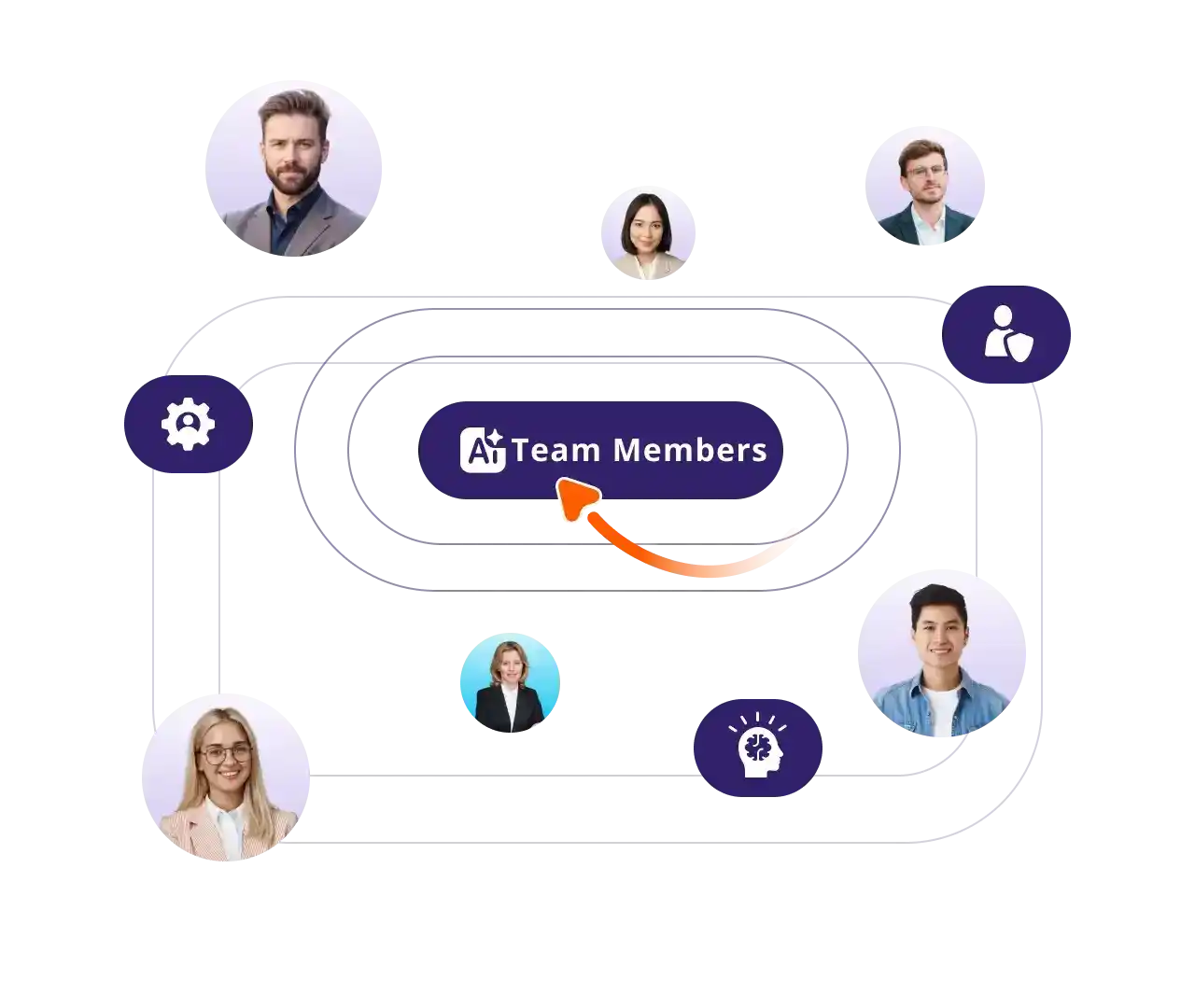
Short, intensive programs designed to set procurement teams and leaders up for success in the AI era. Developed and delivered by procurement experts who are leading the adoption of AI; built for procurement, by procurement.
AI Fundamentals For Your Team
Build the mindset, culture, and capabilities to start unlocking real AI impact, fast!
📚 Immersive Learning
Live expert sessions + self-paced modules for procurement teams.
📅 21-Day Program
Flexible, high-impact AI training tailored to your goals.
🌍 Real Examples
Apply AI to sourcing, contracts, and supplier management.
📈 AI Progress Tracker
Benchmark and measure ROI with clear and accurate metrics.
🤝 Hands-On Projects
Encourage practical use and secure ongoing advancement.
💬 Expert Access
Monthly Q&A with AI and procurement experts to solve your problems.
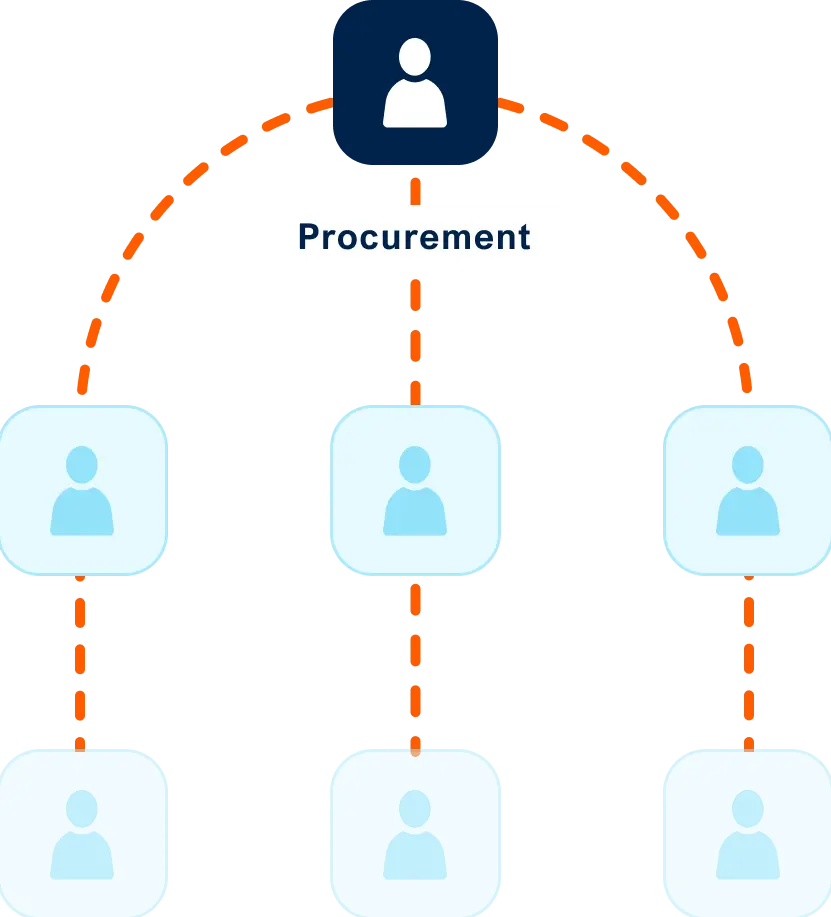
AI Fundamentals For Procurement Leaders
Align your team on an AI vision and build a strategic roadmap for procurement transformation.
📅 21-Day Program
Focused, high-impact training to accelerate AI usage in your team.
🌍 Real Examples
Learn from real examples of procurement leaders leading the AI-way
💬 Expert Access
Monthly Q&A with AI and procurement experts to solve your problems.
🎯 Leaders Aligned
Unify your team with a shared understanding of AI's role in procurement.
📚 Immersive Learning
Live expert sessions + self-paced modules for procurement leaders.
📍 Actionable Roadmap
Leave with a clear plan to implement AI in your procurement process
Succeeding in AI through Talent
Mastering AI isn't about using the newest tool
Winning with AI requires investing in people, not just tools.
We see many people caring too much about using the newest tool, but they are utilizing only 10% of what is possible.
Using the newest tools is great, but actually knowing how to use them is key.
Leading procurement teams adopt a structured approach to change, integrating talent and technology to transform their function into an AI-driven powerhouse.

Program Overview For Your Team
Program Overview for Procurement Leaders
Meet your instructors

Marijn Overvest
Procurement Thought Leader & AI Expert

Ralph De Groot
Senior Learning Consultant & AI Expert
SUPPORT
FAQs
Have more questions? Get in touch with one of our sales consultants. Book a demo for further questions.
How do I enroll my team?
Schedule a demo call with our team. You can book a consultation directly on their calendar or reach out to us at [email protected]. We'll discuss timelines and get your team on board!
How much time does this require?
The leadership program can be finished within 5-6 hours.
The program for your team can also be finished within 5-6 hours.
If you decide to also participate in the optional modules that cover AI agent building, this will take another 5-6 hours.
Need help choosing the right pace? Discuss your team’s goals and timeline with one of our Procurement Learning Specialists in a free discovery call.
Is there a fixed schedule?
No. Your dedicated Procurement Learning Consultant will work with you during onboarding to:
- Agree on a tailored timeline
- Lock in dates for the kick-off, live sessions, and graduation/demo day
- Define progress checkpoints to keep learners on track
Before each live session, participants should complete a set portion of the self-paced modules, ensuring productive, focused discussions.
This structured yet flexible approach keeps teams aligned while accommodating procurement professionals’ busy schedules.
Is there a live learning component?
Yes!
This program comes with a kickoff and a 2 live Q&A sessions to solve your AI problems in procurement.
What type of support can we expect?
During the pre-enrollment process, our procurement specialists will guide your decision-making and address all your questions. You can reach them by email or schedule a quick consultation call whenever needed.
Once enrolled, you'll be assigned a dedicated Procurement Learning Consultant who will:
-
Serve as your single point of contact throughout the program
-
Coordinate all logistics including kickoff, scheduling, and live sessions
-
Onboard your procurement team and handle any program-related needs
-
Work closely with you to maximize the impact on your team's procurement capabilities
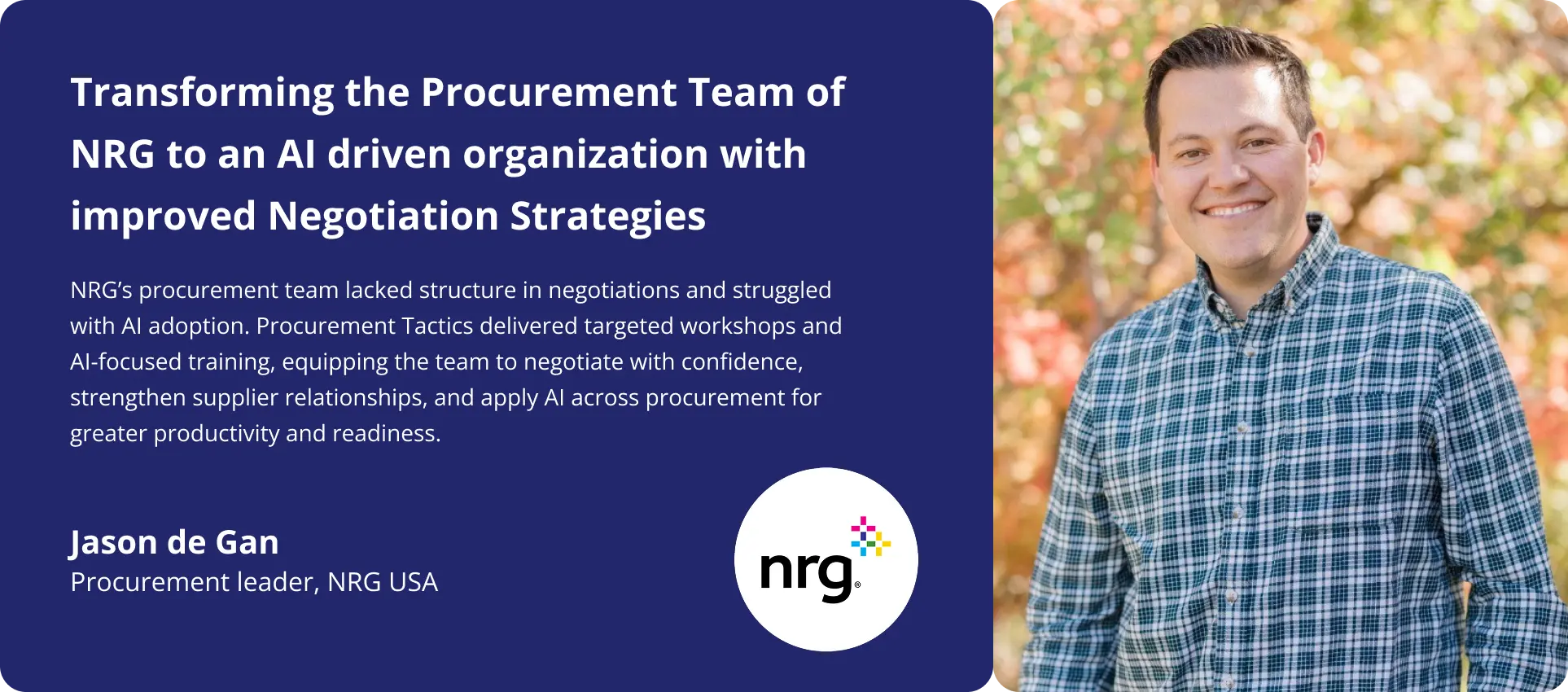
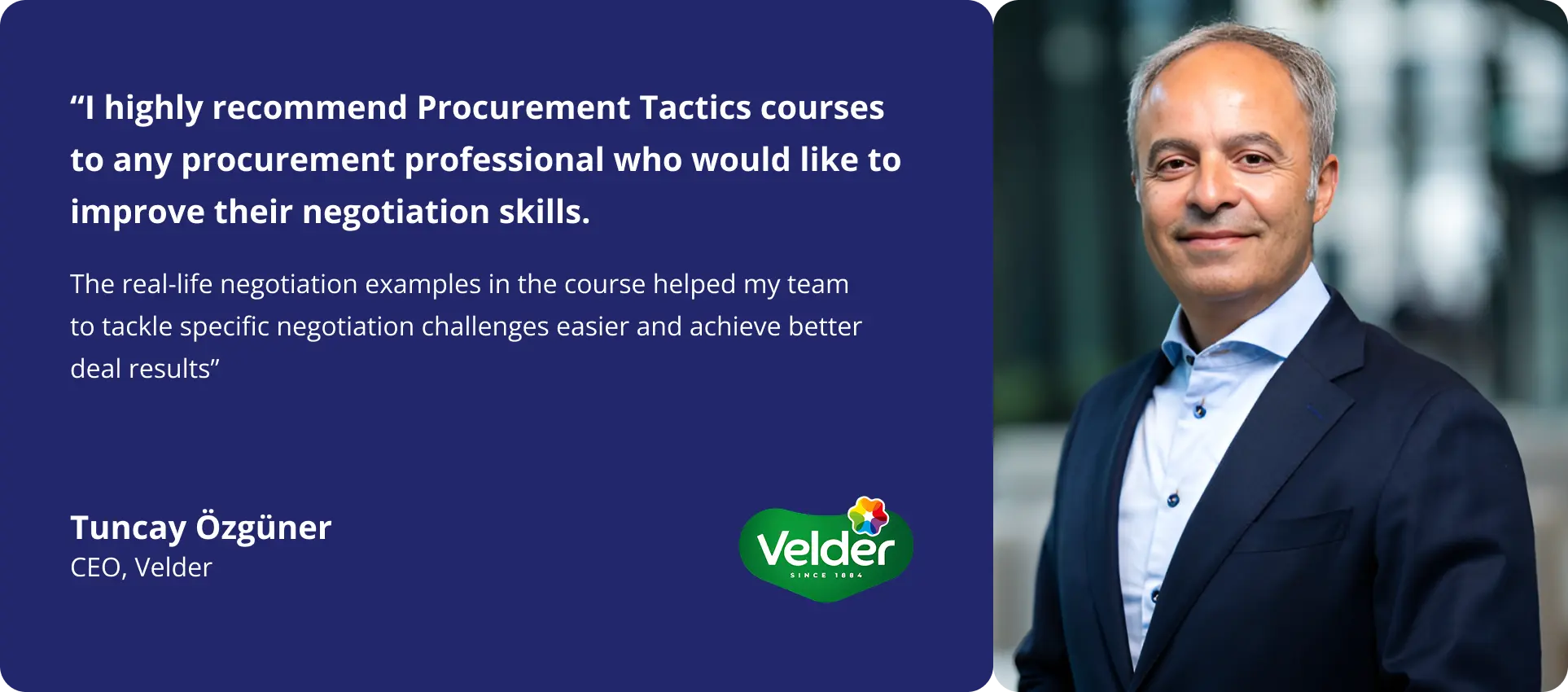
Client Success Stories

NEXT STEP
Program Overview + Price Quote
Ready to upskill your procurement team with critical AI skills?
Request a price quote and the program overview using the form, or reach out to us directly if you'd like to discuss what's right for your team.
Click here to grab a slot in my calendar. Talk soon!

Pim Herremans 
Get Price Quote
Get Price Quote