


Written by Marijn Overvest | Reviewed by Sjoerd Goedhart | Fact Checked by Ruud Emonds | Our editorial policy
Claude for Negotiation Preparation: Build a Complete Pack in 30 Minutes
As taught in the Claude Cowork For Procurement Course / ★★★★★ 4.9 rating
Table of contents
- Why Preparation is The Single Biggest Lever in a Procurement Negotiation
- The Three Parts of a Complete Negotiation Preparation Pack
- The Files Claude Needs to Produce a Real Preparation Pack
- The Four Clarifying Questions Claude Will Ask (and Why the Answers Matter)
- What The Finished Preparation Pack Actually Looks Like
- Cultural Preparation, The Part Most AI Negotiation Content Skips
- What the Preparation Pack is Not
- Conclusion
- Frequently asked questions
- Most procurement negotiations are won or lost in the preparation, not the tactics at the table. Claude closes the gap between what procurement teams know they should prepare and what they actually find time to prepare.
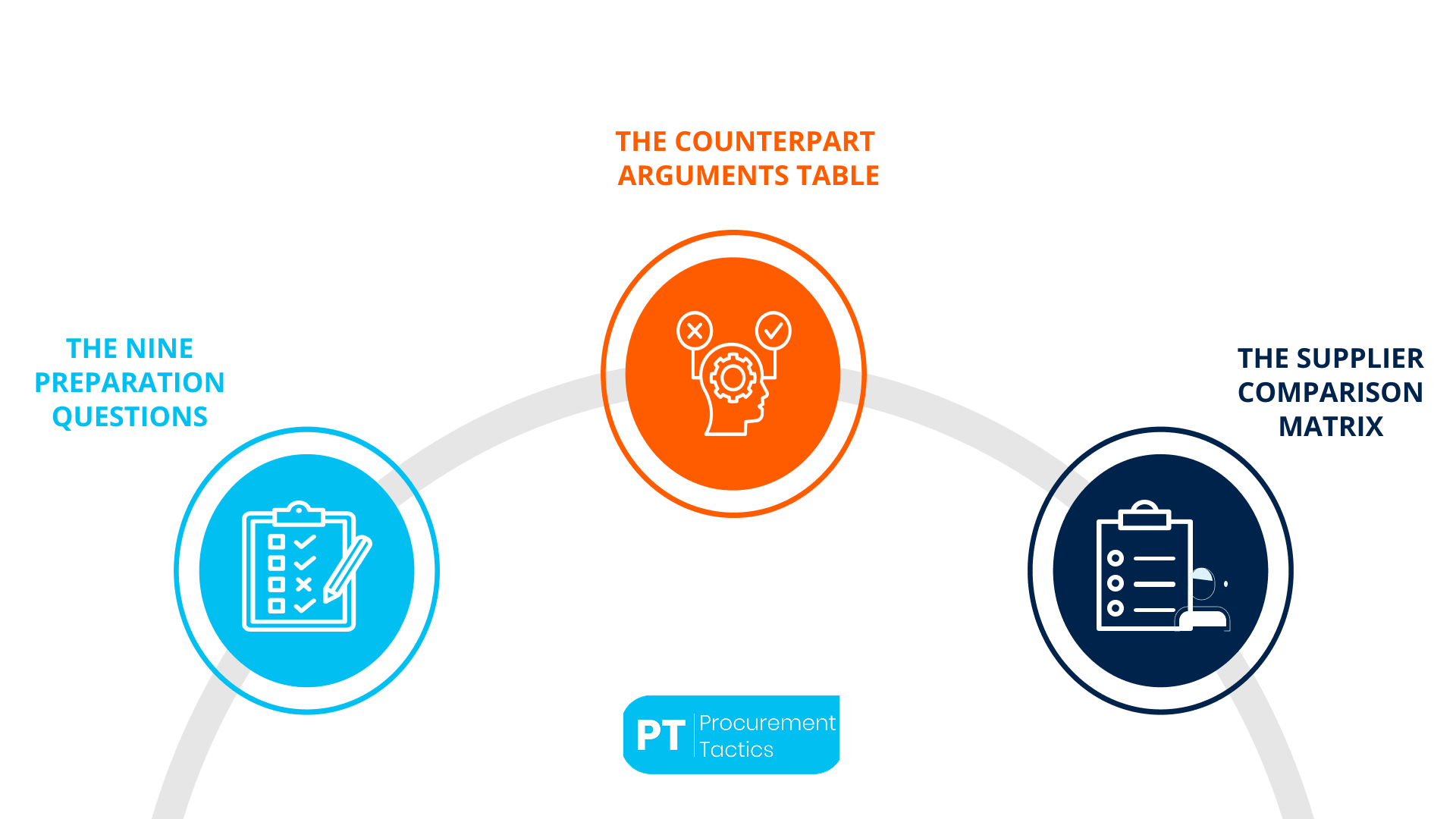
- A complete prep pack has three parts: a nine-question preparation analysis, a counterpart-arguments table across five commercial levers, and a supplier comparison matrix. Claude produces all three in one session.
- The framework works best when Claude has four inputs: the blank prep template, supplier performance scorecards, the internal market intelligence brief, and the active supplier list.
Why Preparation is the Single Biggest Lever in a Procurement Negotiation
Most procurement professionals have been in a meeting where a supplier brings up something unexpected, a cost-based change, a benchmark quote, a clause interpretation, and the procurement team does not have a ready answer. The negotiation does not always fail in that moment, but it tilts. And the tilt usually comes from one place: the procurement team did not prepare as thoroughly as the supplier did.
This is not a skills problem. It is a capacity problem. Preparing for a significant supplier negotiation to the standard described later in this guide, answering nine preparation questions, modelling five counterpart arguments with data, and comparing your primary supplier to a qualified alternative on four commercial dimensions, takes most procurement professionals a full day of deep work per major negotiation. Very few have a day of deep work available in the week leading up to a supplier meeting. So they prepare to the standard they have time for, not the standard they know the conversation requires.
Procurement Tactics' 2026 AI Readiness in Procurement survey found 40% of procurement teams spend 60% or more of their week on manual data work and reactive firefighting. That is where negotiation preparation time goes: not to the preparation itself, but to the work that displaces the preparation. Claude is useful here not because it negotiates better than a procurement professional, it doesn't, but because it compresses the preparation from a day of deep work into thirty minutes of structured interaction.
The Three Parts of a Complete Negotiation Preparation Pack
A prep pack is not a one-page set of talking points. It has three distinct parts, and Claude is genuinely good at all three.
Part 1, The nine preparation questions
The preparation analysis answers the nine questions every procurement professional should answer before any significant supplier negotiation: power balance, objectives, BATNA, concession strategy, counterpart profile, likely supplier tactics, red lines, walkaway point, and opening position. Answered properly, they give the procurement team a position before they walk into the room. Answered superficially, they produce a set of bullet points that do not survive contact with the supplier.
The power-balance question is the one most procurement teams under-answer. A real answer names the dimensions, availability of alternatives, volume importance to the supplier, financial strength, switching costs, time pressure, and scores who has the advantage on each. That scoring, done honestly, often reverses what the procurement team thought the power balance was.
Part 2, The counterpart arguments table
The counterpart arguments table is where preparation becomes specific. For each of the five most likely commercial levers the supplier will push on, unit price, payment terms, volume commitments, service-level scope, contract duration, the table contains the argument the supplier is most likely to make, the procurement team's data-backed counter, and a fallback position for negotiation.
The discipline here is the data-backed counter. A good counter cites a number the procurement team can produce on demand: a market price benchmark, a commodity-cost movement, a comparable service-level clause from a peer supplier, a calculation of the true cost of extended payment terms. Without the data, the counter is an opinion, and opinions lose negotiations.
Part 3, The supplier comparison matrix
The comparison matrix places the primary supplier alongside the best qualified alternative on four dimensions: price, quality, delivery performance, and strategic value. It is the procurement team's leverage table. When a supplier pushes back on a commercial point, the comparison matrix is what tells the procurement team whether "we have an alternative" is a genuine threat or a bluff.
Most procurement teams know, in the abstract, that they should have an alternative qualified. The comparison matrix forces the question of whether they actually do, and if they do not, the negotiation strategy for the meeting needs to adjust accordingly.
The Negotiation Course AI Prompt Pack
15 ready-to-use negotiation prompts built on the Procurement Tactics 11-Step Prompt Engineering Template, Strategy Foundation, BATNA & Leverage, Styles & Tactics, Communication & Roleplay, and Team & Post-Negotiation.
The Files Claude Needs to Produce a Real Preparation Pack
Claude's output is only as good as the inputs it is given. For a negotiation prep pack, the useful inputs are four files, usually already sitting somewhere in the procurement team's systems.
The blank preparation template. A structured template means Claude fills a specific format, the nine questions, the counterpart arguments table, and the comparison matrix, rather than producing free-form text that the procurement team still has to organise. Procurement teams using this framework regularly build their own template once; most of the value comes from having a consistent format that the whole team recognises.
Supplier performance scorecards. The scorecards are what let Claude produce data-backed counters and a credible comparison matrix. Twelve months of on-time delivery, quality performance, service-level compliance, and cost movement, in a simple table, is usually enough. Without this, Claude produces a generic prep pack that could apply to any supplier; with it, the pack is specific to the relationship.
Market intelligence brief. This is the document most procurement teams do not have and should. A two-page internal market brief per category, commodity cost movements, supply-base concentration, disruption risks, and pricing benchmarks, is enough to make Claude's counterpart's arguments land. Teams without a market brief can usually produce one with Claude in a separate session and reuse it across every negotiation in the category for the next quarter.
The active supplier list. This is what powers the comparison matrix. A simple list with the top four or five qualified alternatives for the category, a brief note on where they sit commercially, and a quality indicator is enough. If no alternatives are qualified, the comparison matrix becomes a different exercise, documenting the single-source dependency rather than the comparison, and the negotiation strategy adjusts accordingly.
From the field

With 20+ years in international sports and events, on cultural nuance in AI-assisted negotiation prep
The Four Clarifying Questions Claude Will Ask (and Why the Answers Matter)
A well-designed negotiation prompt asks Claude to clarify before drafting. In practice, Claude will typically ask four questions before it starts on the prep pack, and each answer meaningfully shapes the output.
What is the session format? A commercial renewal conversation scheduled for ninety minutes is a different preparation exercise from a three-hour multi-stakeholder renegotiation with legal and technical teams on both sides. Claude adjusts the level of detail, the number of fallback positions, and the counterpart modelling based on the format.
Who else is in the room? A negotiation attended only by procurement and the supplier's account manager is different from one attended by finance, legal, operations, and the supplier's commercial director. More stakeholders mean more potential points of friction and more potential alignment problems for the procurement team. Claude's output includes internal-alignment prompts when the stakeholder count is high.
Are there hard deadlines affecting leverage? A negotiation happening three months before a contract expiry is a different exercise from one happening three weeks before expiry. Hard deadlines typically favour the supplier if the procurement team has not qualified alternatives; Claude's output reflects the time pressure and flags it explicitly.
What are the internal approval thresholds? Every procurement team has a set of thresholds above which additional internal approval is required, price increase caps, contract duration extensions, and volume commitments. Claude's output respects those thresholds and flags any counterpart argument where the supplier's likely position would trigger an approval process.
These four clarifications are the difference between a generic negotiation checklist and a prep pack specific to the meeting. They take under five minutes to answer and disproportionately improve the output.
What the Finished Preparation Pack Actually Looks Like
A worked example helps. Consider a procurement team renegotiating a packaging supplier contract. The primary supplier accounts for 62% of category spend as a single source. On-time delivery performance sits at 84% against a contractual 95% target, consistently below target for three consecutive quarters. The contract has a 0.5% rebate per percentage point below target, which has never been invoked. Annual spend is €3.8 million. Renewal is in six months. Four alternative suppliers have been qualified through a recent RFI.
Claude's output on this scenario is specific, not generic.
On the power-balance question: the buyer has an advantage on three of five dimensions, available alternatives (four qualified), volume importance to the supplier (material share of their revenue), and financial strength. The supplier has an advantage in switching costs (high due to tooling) and time pressure (if the renewal slips, operations feel the risk first). That single paragraph changes how the negotiation opens.
On the counterpart arguments table: against an expected supplier push to increase unit price by 4%, the data-backed counter cites the Procurement Tactics market brief showing raw material costs decreased 3% in the preceding quarter, and proposes a price hold in exchange for a three-year commitment. Against an expected push to maintain ninety-day payment terms, the counter cites a working-capital cost calculation and proposes sixty days in exchange for a volume commitment above a stated floor. Each lever gets a counter and a fallback.
On the comparison matrix, the primary supplier sits in the Strategic quadrant of a Kraljic matrix today. The best qualified alternative would enter the Leverage quadrant within twelve months if awarded a minority share. The matrix makes the strategic path clear, dual-source the category, move the primary to leverage over two renewal cycles, and resolve the on-time delivery problem through commercial pressure backed by a visible alternative.
That is not a script. It is a position. The procurement professional still runs the meeting. But they walk in knowing more about the supplier's likely argument and their own counter than the supplier expects them to know, and that shifts the balance of the conversation before the first price discussion starts.
Cultural Preparation, the Part Most AI Negotiation Content Skips
Global procurement negotiations are not just commercial. They are cultural. A negotiation with a German supplier has a different tempo and format than one with a supplier in Japan, Brazil, or the United Arab Emirates. The same commercial position delivered in the wrong cultural register can produce a worse outcome than a weaker commercial position delivered well.
Claude handles cultural preparation as a separate pass through the prep pack. Given the supplier's country of origin, the counterpart's seniority, and the negotiation format, Claude produces a short section on expected communication norms, the likely pacing of the conversation, and the specific behaviours that will be read as positive or negative. This is not a substitute for the procurement professional's own cultural judgement, and procurement teams operating regularly across geographies often have this judgement internally, but it is useful as a check, particularly for negotiations with a region the procurement team does not regularly work in.
The framework draws on the cultural-impact material in Procurement Tactics' negotiation curriculum. Teams that want the structured version of the same cultural preparation can find it inside the AI Fundamentals for Procurement Teams program, which covers the prompt design needed to adapt the prep pack across geographies.
What the Preparation Pack is Not
Two things the prep pack is deliberately not.
It is not a script. A prep pack that tries to anticipate every possible supplier move and script every possible response produces a procurement professional who sounds like they are reading from a document, which suppliers notice, and which weakens the conversation. The pack is a framework, not a script. It gives the procurement team the shape of the meeting and the data behind their positions; the actual words belong to the human in the room.
It is not a substitute for the supplier relationship. Preparation compresses the work of thinking rigorously about a negotiation before it happens. It does not replace the years of relationship building that let a procurement professional read a supplier's real priorities, sense when a position is firm versus posture, and know when to push versus when to concede. AI preparation amplifies a skilled procurement professional. It does not replace them.
The procurement teams getting the most from this framework treat the prep pack as the first thirty minutes of a four-hour negotiation process. The last three and a half hours, reading the room, the side conversations, the follow-up, are still entirely human work.
Related resource: 53 Powerful Negotiation Tactics, Fifty negotiation tactics procurement professionals actually encounter at the table, Atom Bomb, Salami, Silence, Anchoring, Sunk Cost, Good Guy/Bad Guy, with a counter-move for each.
Conclusion
Most procurement professionals already know what good negotiation preparation looks like. The challenge is rarely knowledge. The challenge is finding the time to prepare at that level consistently while managing supplier issues, internal stakeholders, reporting, and day-to-day firefighting.
That is where Claude becomes genuinely useful. Not because it replaces negotiation skill, experience, or judgement, but because it dramatically reduces the time needed to organise information, structure thinking, and build a clear negotiation position. What previously took a full day of preparation can become a focused thirty-minute working session with the right inputs and prompts.
The strongest negotiation outcomes still depend on the human in the room, reading the supplier, understanding the relationship, adapting to the moment, and making decisions under pressure. Claude cannot do that. What it can do is make sure procurement professionals walk into the room better prepared, with clearer arguments, stronger data, and fewer blind spots.
And in procurement negotiations, that preparation often matters more than any tactic used at the table.
Frequentlyasked questions
How long does it take Claude to produce a full negotiation prep pack?
Thirty to forty-five minutes end-to-end, assuming the four input files are ready. Most of that time is the clarifying exchange and the procurement professional's review; the drafting itself takes Claude under ten minutes.
Can Claude replace a negotiation coach?
No. Claude produces a strong preparation artefact; a skilled negotiation coach provides in-the-moment judgement, pattern recognition from hundreds of prior negotiations, and role-play practice. The two are complementary. Procurement teams using both report the prep pack shifts the conversation with the coach toward higher-leverage questions.
Does Claude handle cultural differences in international negotiations?
Yes, Claude produces a dedicated cultural preparation section if the prompt provides the supplier's country, counterpart seniority, and negotiation format. The output is a useful check rather than a definitive cultural guide; procurement teams with deep experience in a region should still apply their own judgement.
What inputs improve the prep pack the most?
Supplier performance scorecards and a two-page market intelligence brief, in that order. The nine questions and comparison matrix can be produced from a lighter dataset, but the counterpart arguments table only works with specific data to back each counter.
Is this workflow appropriate for a single supplier or for a portfolio of negotiations?
Both. The framework scales well because the template, master prompt, and Claude Project structure can be reused across every negotiation in a category. Most procurement teams see the biggest gains when they run it across a full renewal cycle, five or six negotiations, rather than one.
Where should negotiation prep live after the meeting?
Inside the Claude Project for the supplier or category. Adding the post-meeting debrief, what happened, what worked, what surprised the team, compounds context for the next negotiation. Over a year, the Project becomes a living record of the commercial relationship.

About the author
My name is Marijn Overvest, I’m the founder of Procurement Tactics. I have a deep passion for procurement, and I’ve upskilled over 200 procurement teams from all over the world. When I’m not working, I love running and cycling.
