

Written by Marijn Overvest | Reviewed by Sjoerd Goedhart | Fact Checked by Ruud Emonds | Our editorial policy
4 Steps to Implement Innovation in Procurement

As taught in the Innovation in Procurement Course / ★★★★★ 4.9 rating
How to implement innovation in procurement?
- To implement innovation in procurement is to shift from concepts and workshops to concrete actions that change how procurement operates day to day.
- It integrates mindset, methods, and tools into sourcing, supplier collaboration, sustainability, and cost management with clear owners and metrics.
- Done deliberately, it turns procurement into a visible engine for efficiency, resilience, and growth across the organization
How to Implement Innovation in Procurement?
Implementing innovation is the move from theory to practice. It applies the principles covered earlier, such as foundations, culture, procurement’s role, and execution, so new ideas appear in processes, dashboards, supplier agreements, sustainability targets, and results. The emphasis is on action with measurable outcomes, not just intention.
Step 1: Build a Strong Foundation
Clarify what innovation means in your context. Decide where it creates the most value now: incremental improvements like automating routine tasks or bolder changes such as adopting transparent contracting technology. Align choices with goals and risk tolerance so early wins are realistic, and momentum grows.
Actions:
- Run a short cross-functional ideation session to surface high-impact areas.
- Use an Innovation Matrix or simple gap analysis to spot quick wins versus longer bets.
- Prioritize two or three domains such as cost, supplier experience, or sustainability.
Outcome:
A shared map of opportunities with an initial, agreed focus.
Step 2: Foster an Innovation-Ready Culture
Culture enables implementation. Clear sponsorship, psychological safety, and collaboration keep ideas moving from draft to delivery. Signal that experimentation and learning are expected, and frame setbacks as data.
Actions:
- Set a recurring Innovation Hour for idea pitches and cross-team sharing.
- Define two or three innovation KPIs, such as pilots launched per quarter, cycle-time reduction, or supplier co-creation trials.
- Launch a lightweight idea program so employees can submit, track, and co-own pilots.
Outcome:
A visible rhythm that normalizes experimentation, learning, and follow-through.
Step 3: Put Procurement at the Center
Procurement connects suppliers, internal teams, and enterprise goals, which makes it a natural hub for innovation. Co-develop solutions with suppliers, streamline internal processes, and anchor progress in sustainability objectives that matter to customers and regulators.
Actions:
- Perform a rapid process gap analysis on onboarding, PO to invoice, and risk checks, then pick one workflow to streamline first.
- Host a Supplier Innovation Workshop to surface co-creation opportunities such as packaging, lead-time compression, or traceability.
- Align pilots to sustainability goals, including preferred materials, circularity, and renewable inputs.
Outcome:
Early, concrete improvements that build confidence and unlock wider change.
Step 4: Make It Real With a Plan
Ideas need structure to scale. Define success, assign owners, resource the work, and review on a regular cadence. Treat innovation as iterative: measure, learn, adjust, and repeat.
Actions:
- Create a six-month roadmap with milestones, owners, and measures.
- Stand up a small Innovation Task Force to unblock issues and track progress.
- Hold a monthly innovation review to assess KPIs, decide go or stop or iterate, and capture learnings.
Outcome:
A repeatable operating model that converts pilots into results.
The Benefits of Innovation in Procurement
Innovation delivers concrete outcomes when applied intentionally and measured carefully. Below are the major benefit areas taught in the lesson, with short explanations that connect to day-to-day work:
1. Cost Savings
Innovative sourcing strategies and digital platforms improve pricing, terms, and compliance. Streamlined events, smarter should-cost analysis, and dynamic supplier competition reduce total landed cost while protecting quality and service.
2. Operational Efficiency
Automation in purchase orders, invoicing, and claims cuts cycle time and manual errors. Standardized data and workflows enable faster approvals, cleaner audits, and more predictable lead times. Teams shift time from low-value processing to higher-value analysis and supplier development.
3. Stronger Supplier Relationships
Structured collaboration and co-development encourage suppliers to bring forward technical ideas, packaging changes, or service innovations. Aligning joint objectives improves satisfaction and unlocks preferential treatment, priority capacity, or early access to new technologies.
4. Transparency and Better Decisions
Data visibility clarifies spend patterns, demand variability, and supplier performance. With accurate, real-time information, category strategies become evidence-based, and corrective actions happen sooner, improving both cost and service reliability.
5. Access to New Markets and Technologies
Innovative procurement opens doors to alternative materials, regional sources, niche specialists, and emerging tech vendors. Early scouting, pilots, and proofs of concept turn external innovation into a practical competitive advantage.
6. ESG Impact and Brand Trust
Embedding sustainability criteria into sourcing supports recyclable materials, renewable inputs, and lower-carbon logistics. This meets regulatory expectations, resonates with customers, and strengthens corporate reputation.
7. Risk Mitigation and Resilience
Diversified supply bases, dual-sourcing, and improved traceability reduce exposure to disruptions. Playbooks for rapid substitution, standardized specs, and scenario modeling raise the organization’s agility when markets shift.
8. Culture and Capability Building
When procurement is seen as a source of advantage, teams adopt continuous improvement habits, experiment with small pilots, and scale what works. Confidence and engagement rise as people contribute ideas that become tangible outcomes.
9. Long-Term Strategic Advantage
Organizations that treat innovation as a discipline and not a one-off stay ahead of industry change. Consistent scanning, piloting, and supplier co-creation compound gains across cost, speed, quality, compliance, and customer experience.
6-Month Procurement Innovation Roadmap
With foundations set, a supportive culture in place, and procurement aligned to your innovation goals, the final step is execution. The 6-month innovation roadmap turns intent into a sequenced plan with owners, milestones, and reviews. Use it to choose a few high-impact projects, learn quickly, and scale what works.
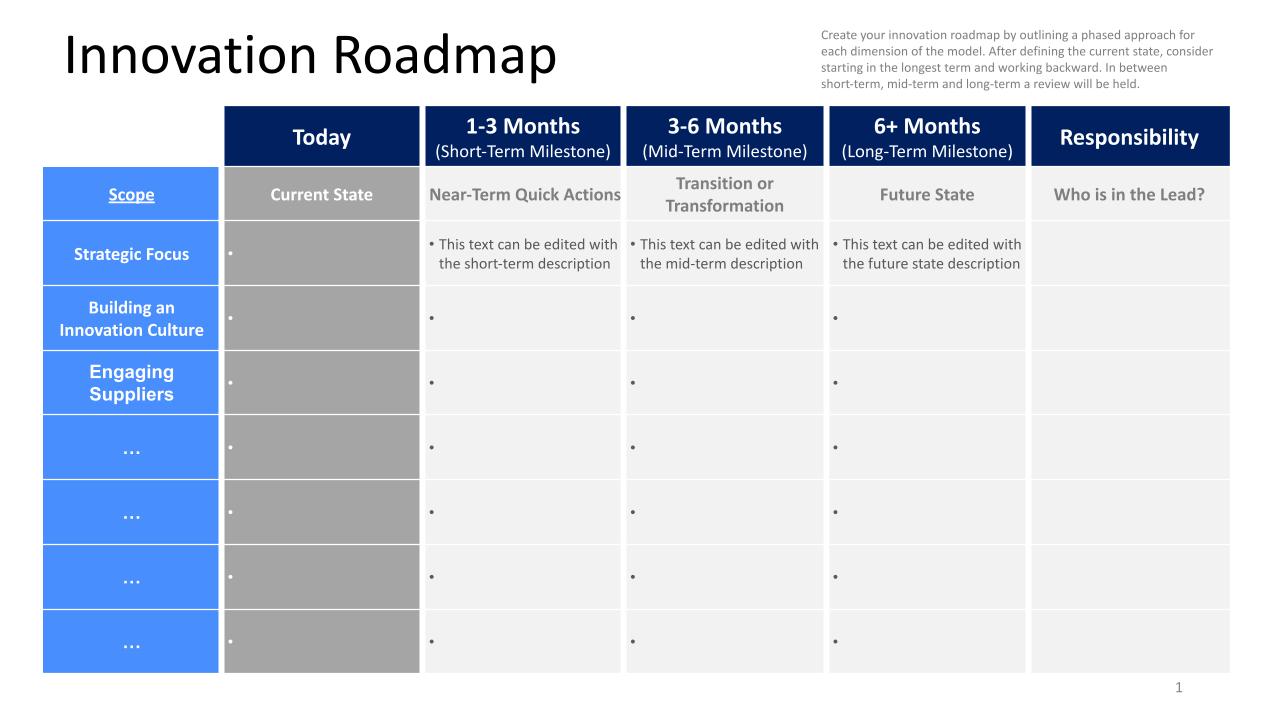
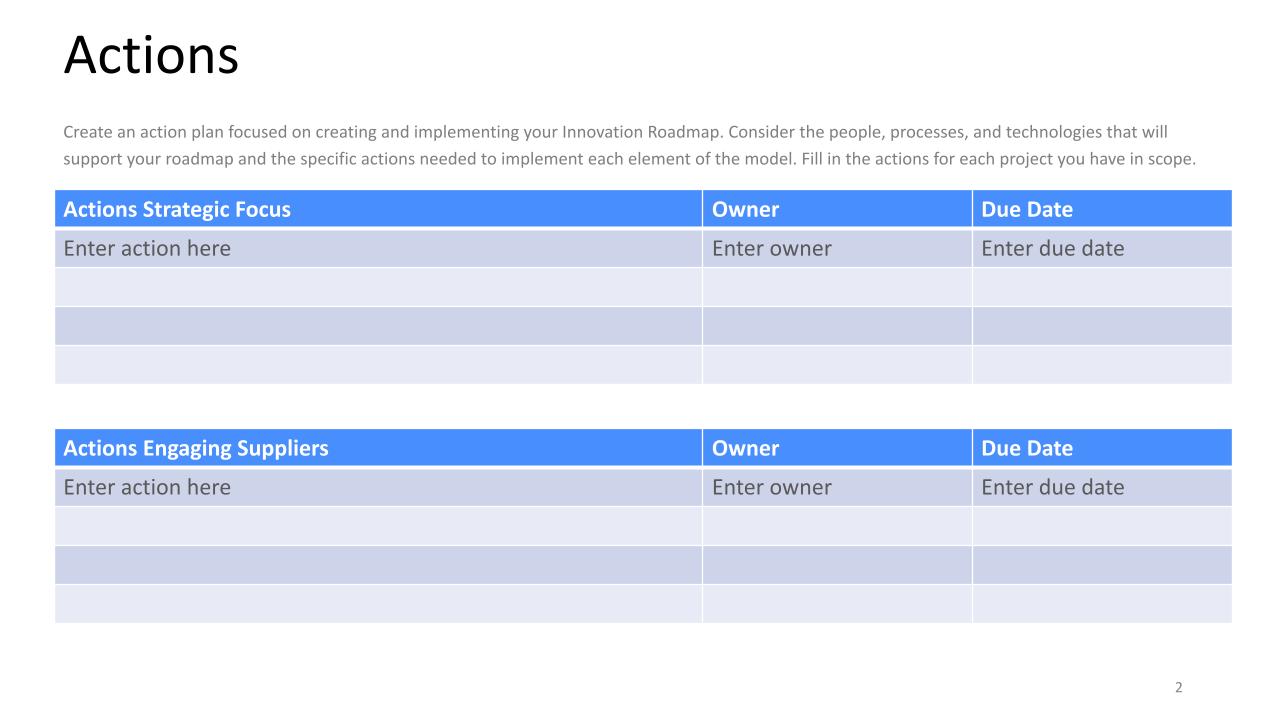
The goal of the roadmap is to turn intent into action. Pick 1–2 high-impact projects, assign owners, set clear checkpoints, and learn fast.
How to use the template:
Duplicate the “Innovation-Roadmap-Template” and fill in owners, dates, and KPIs. Keep each phase outcome-based.
Month 0: Pick projects and set targets
- Choose one process and one supplier-facing idea. Define success in one sentence.
Example: “Cut PO cycle time by 25%” and “Pilot recycled packaging with Supplier A on one SKU.”
Months 1–2: Design and prepare
- Map steps, data, and risks. Line up tools and people.
Example: Configure e-invoicing in the ERP sandbox; agree on packaging specs and MOQ with Supplier A.
Month 3: Run a small pilot
- Test with a narrow scope. Measure two to three metrics only.
Example: Enable e-invoicing for one business unit; ship 1,000 units with the new packaging.
Month 4: Review and fix
- Compare results to the target. Keep what works, adjust what does not.
Example: If e-invoicing cut approvals by 22%, not 25%, tighten approver rules; if packaging scuffs, increase board grade.
Month 5: Expand carefully
- Add one more unit or category. Document the playbook.
Example: Roll e-invoicing to a second BU; extend recycled packaging to a second SKU.
Month 6: Decide and scale
- Present a one-page result: benefits, costs, risks, and next steps.
Example: Approve company-wide e-invoicing rollout; set a target for 40% of portfolio in recycled packaging within 12 months.
Cadence and ownership
- Weekly 30-minute standup for blockers and decisions.
- Monthly checkpoint with KPIs and a go, adjust, or stop decision.
- One named owner per stream. Co-owners provide input, not approvals.
Keep it light, one page per pilot. One dashboard with three metrics: outcome, adoption, and risk. Archive lessons learned after each phase so the next pilot starts faster.
Common Pitfalls and Practical Safeguards
1. Vague goals
Set outcome metrics upfront, such as time saved, error rate reduced, adoption rate, or CO₂ per unit.
2. Too big, too soon
Start with a thin slice of a process or one product line to prove value.
3. No owner
Assign a single accountable person per pilot and publish the name and next milestone.
4. Stale cadence
Keep the monthly review sacred and decide to go or stop, or iterate every time.
5. Pilot graveyard
Capture learnings and handoffs and define criteria for scaling before the pilot starts.
Conclusion
Implementation is a system, not a slogan. Build a clear foundation, nurture a culture that rewards learning, center the work in procurement’s daily operations, and run a disciplined plan with owners, KPIs, and reviews. When these pieces work together, innovation moves from slides to sustained advantages in cost, speed, supplier partnership, and sustainability.
Frequentlyasked questions
What is the quickest way to start?
Pick one process bottleneck and one supplier opportunity. Launch two small pilots with clear owners and a target outcome in four to six weeks.
How should success be measured?
Combine efficiency metrics such as cycle time and accuracy, adoption metrics such as usage and satisfaction, and strategic metrics such as savings, risk reduction, and sustainability impact.
Who should own innovation in procurement?
Business ownership sits with procurement leaders. A small cross-functional task force supports execution, removes blockers, maintains the roadmap, and reviews.
About the author
My name is Marijn Overvest, I’m the founder of Procurement Tactics. I have a deep passion for procurement, and I’ve upskilled over 200 procurement teams from all over the world. When I’m not working, I love running and cycling.