


Written by Marijn Overvest | Reviewed by Sjoerd Goedhart | Fact Checked by Ruud Emonds | Our editorial policy
AI Limitations in Procurement – What AI Can and Can’t Do

As taught in the AI Implementation Course For Procurement Directors / ★★★★★ 4.9 rating
- AI can only speed up analysis by processing data, drafting text, and supporting research. Strategic decisions and relationships remain human.
- AI does not have full context and can produce errors because it relies on patterns, not verified facts.
- AI can confuse instead of helping when used without clear goals, policies, training, and leadership.
What are AI Limitations in Procurement?
AI works best on high-volume and repetitive tasks. It analyzes spending data, tracks supplier performance, identifies market trends, and reviews contracts. It drafts summaries, prepares supplier messages, and flags risks before negotiations.
AI does not replace judgment. People must make strategic decisions, manage supplier relationships, and apply context.
AI lacks full context and true understanding. It follows patterns, not facts, which can cause errors. People must review its outputs, especially for legal, financial, or reputational decisions.
AI creates value only with a proper setup. Clear goals, strict data rules, usage policies, training, and leadership support are required. Without these, AI creates confusion.
When implemented well, AI serves as a reliable assistant. It saves time on routine work while people make the final decisions.
What AI Can Do for Procurement
AI works best with high volume and repeated tasks. It can process and structure large data sets, spend patterns, supplier performance signals, market movements, and dense contract text, at a speed no human can match.
It automates routine outputs such as report summaries, first-draft supplier emails, and flagging clauses or anomalies for review. As a research assistant, AI helps scan supplier databases, compare pricing, and surface risk indicators ahead of negotiations.
One procurement leader in Croatia framed the practical win clearly: offload the repetitive work (tables, RFIs, rewriting emails) so people can spend more time on strategy.
What AI Can’t Do and Why Humans Still Matter
AI doesn’t understand the relationship history with a supplier, internal politics, or subtle negotiation dynamics. It can suggest talking points, but it won’t read the room. It also lacks real-world awareness unless connected to current, trustworthy sources; left unchecked, it may use outdated or incomplete information.

Most importantly, it can hallucinate or misinterpret. Treat outputs as drafts and leads, not final truth: keep a human reviewing important communications, decisions, and anything with legal, financial, or reputational impact.
Common Mistakes When Adopting AI in Procurement
Most problems with AI in procurement come from how it’s introduced, not what the technology can do. Utilize the list below to avoid common rollout mistakes and apply simple fixes. This helps keep adoption clear, safe, and useful.
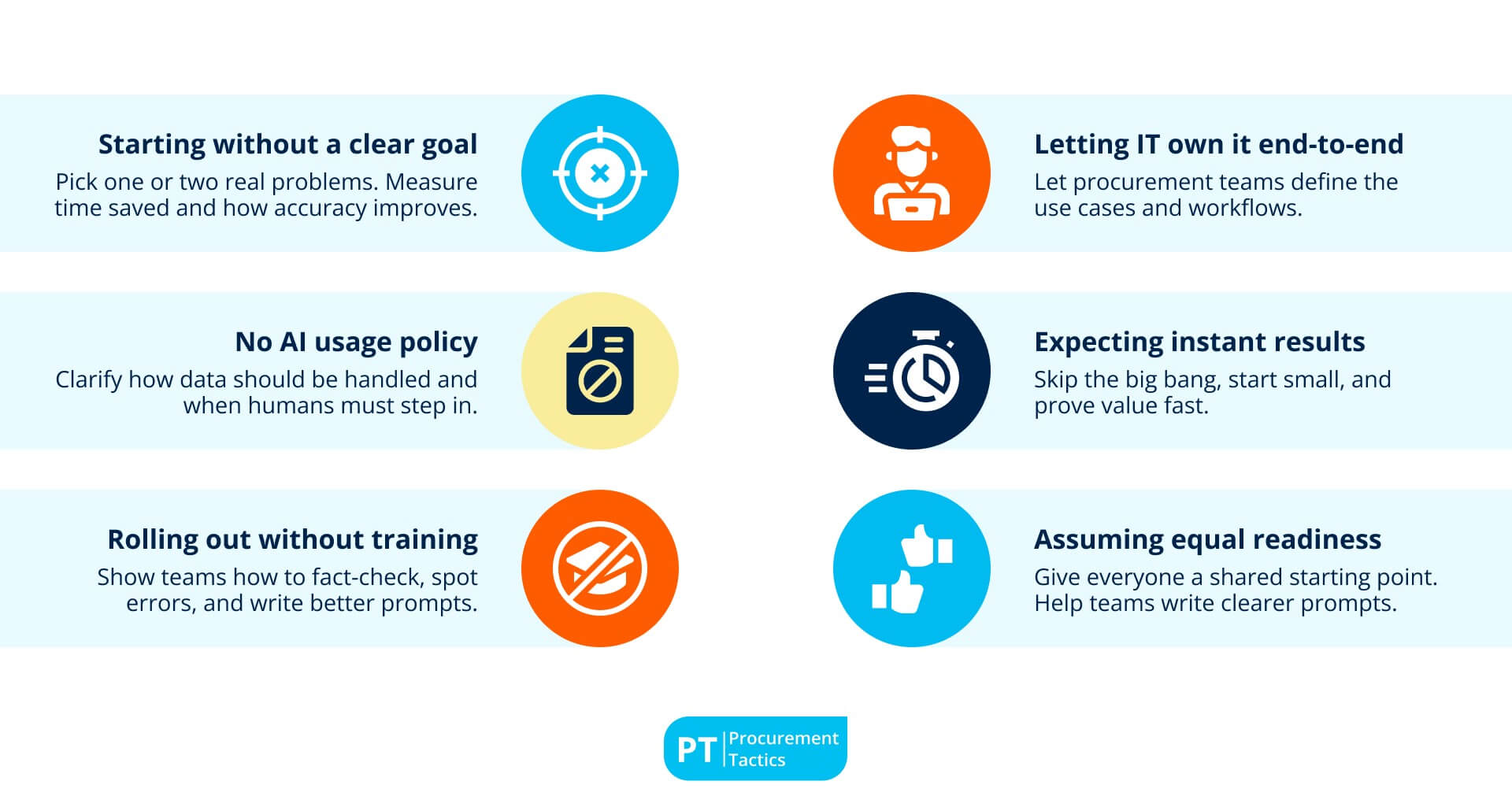
1. Starting without a clear goal
Pick one or two real problems, like creating contract summaries or generating reports. Measure how much time you save or how accuracy improves. Focus drives results.
2. No AI usage policy
Define what people can and can’t do with AI. Clarify how data should be handled and when humans must step in. This keeps output consistent and secure.
3. Rolling out too fast without training
AI works best when people know how to use it. Show teams how to fact-check, spot errors, and write better prompts. One good prompt can save hours.
4. Letting IT own it end-to-end
Let procurement teams define the use cases and workflows. IT should support, not steer. This keeps the tools aligned with real needs.
5. Expecting instant results
Skip the big bang. Start small. Prove value fast. As trust builds, expand to more areas.
6. Assuming equal readiness
Not everyone is tech-savvy. Give everyone a shared starting point. Help teams write clearer prompts. A U.S. manager said results improved fast when teams stopped asking vague questions and got specific.
AI can speed up procurement work like analysis, drafting, and research. But it cannot replace human judgment, experience, or relationships.
Conclusion
To get real value, teams should set clear goals, decide how AI will be used, and train people to use it effectively. Every output needs to be checked, and prompts should be clear and specific.
Start small with low-risk tasks. Run short pilots and measure results such as time saved, accuracy, or useful insights. Expand only where AI proves helpful. For high-stakes decisions involving financial, legal, or reputational matters, a person must stay in charge.
Think of AI as a smart assistant. With good rules and strong leadership, it can help teams work faster and smarter. It will remain valuable over time instead of becoming just another passing trend.
Frequentlyasked questions
What are the main AI limitations in procurement?
AI in Procurement excels at speed and pattern analysis, but it lacks full context, can be wrong, and doesn’t manage relationships—so humans must verify outputs and make strategic decisions.
Which tasks are best suited for AI in Procurement?
Data-heavy, repeatable work: spend analysis snapshots, supplier and market research, contract and report summaries, first-draft RFQs/SOWs, and risk-indicator monitoring—always finished with human review.
Which tasks should we avoid giving to AI in Procurement?
High-stakes, context-rich work such as final negotiation strategy, supplier relationship decisions, long-term category strategy, and anything requiring persuasion, empathy, or organizational politics awareness.
About the author
My name is Marijn Overvest, I’m the founder of Procurement Tactics. I have a deep passion for procurement, and I’ve upskilled over 200 procurement teams from all over the world. When I’m not working, I love running and cycling.