

Written by Marijn Overvest | Reviewed by Sjoerd Goedhart | Fact Checked by Ruud Emonds | Our editorial policy
AI Risks in Procurement — How to Prevent AI Failures

As taught in the AI Implementation Course For Procurement Directors / ★★★★★ 4.9 rating
What are AI risks in procurement?
- AI risks in procurement are inaccurate outputs that happen when models misread data, miss context, or rely on outdated information, which can lead to flawed supplier, contract, or spend decisions.
- Risks appear when teams enter sensitive data into unsecured tools. Protecting data and demanding transparency keep procurement safer.
- When teams treat AI as the final decision-maker, human judgment weakens. The best approach is balance: let AI provide insights while people make the final call.
What are AI Risks in Procurement?
AI can speed up analysis and drafting, but it does not understand organizational context, legal nuance, or relationship dynamics the way people do.
Risks emerge when models are trained on incomplete or biased history, when confidential contract or pricing data is pasted into public tools, or when teams accept AI suggestions without review.
The result can be inaccurate recommendations, data exposure, bias in supplier selection, and compliance violations.
5 Common Risks in AI-Driven Procurement
Here are the five most common ways AI goes wrong in procurement; and what that looks like in practice:
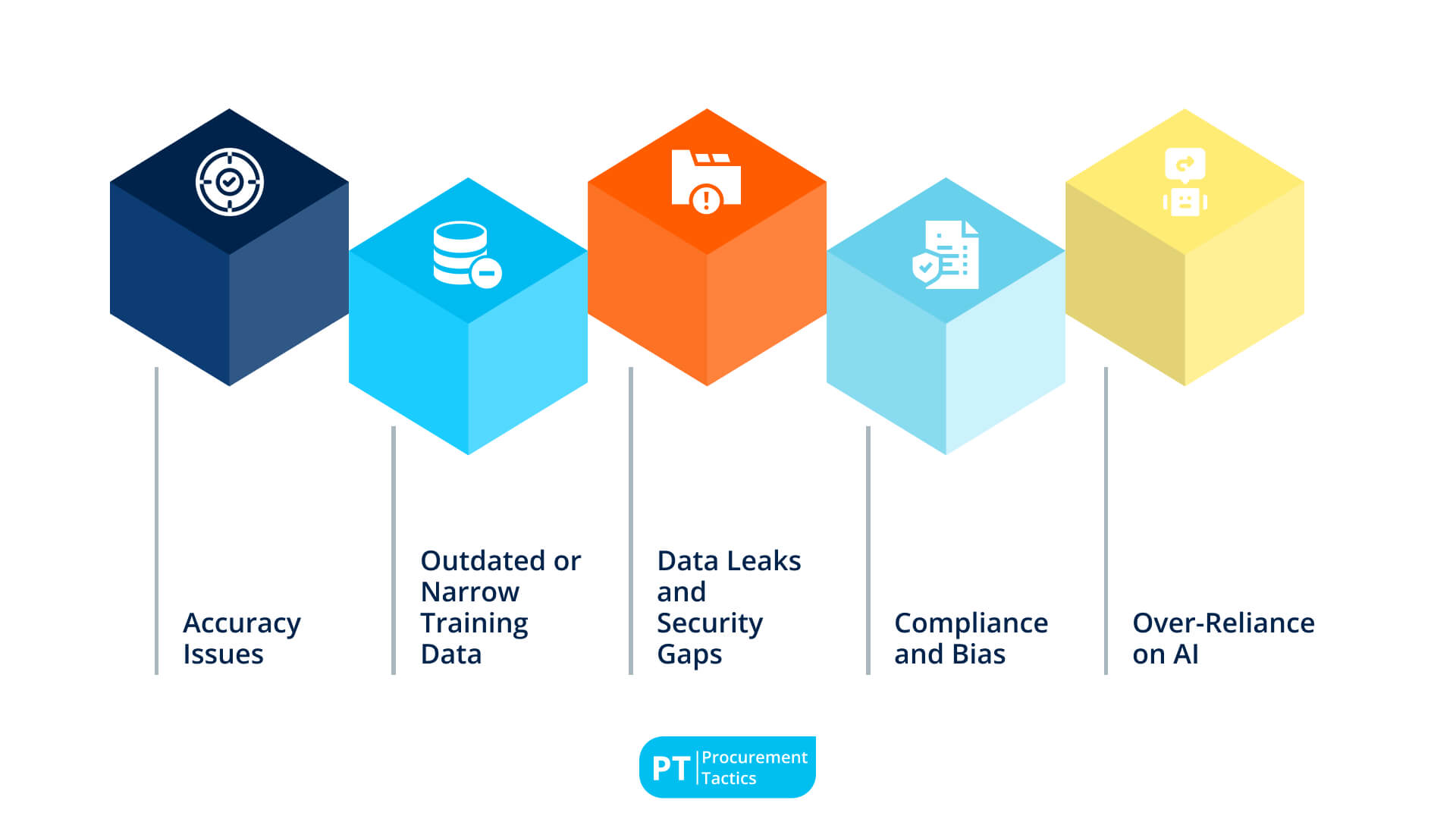
1. Accuracy Issues
AI processes large volumes quickly but lacks human context. It may misread supplier metrics, pricing signals, or contract clauses. These errors lead to weak contracts, poor supplier vetting, or flawed spend analysis.
Constrained models may also ignore part of a long input. To reduce risk, confirm whether the tool processed all data and review key sections yourself.
2. Outdated or Narrow Training Data
Models learn from history, not from today’s market. Outdated inputs can distort results. Always verify important recommendations before acting.
3. Data Leaks and Security Gaps
Entering sensitive pricing or contract terms into public tools can expose critical data. Use enterprise-grade solutions, follow company security rules, and avoid putting confidential information in unsecured systems.
4. Compliance and Bias
AI can reinforce old favoritism or misread legal text. This creates fairness issues and compliance violations. Professionals must review all legal and procurement outputs before finalizing.

5. Over-Reliance on AI
AI should support, not replace, human judgment. When teams defer to AI alone, critical thinking weakens and errors rise. Keep people in control of final decisions.
Real-world failures underline these risks. A well-known hiring model learned to downrank women because it was trained on a biased history. Similar bias can enter supplier selection if you do not audit inputs and outputs. Financial forecasting tools have also produced costly errors when teams skipped verification. The lesson is the same: monitor, fact-check, and keep a human in the loop.
5 Practices against Legal and Compliance Risks in AI-Driven Procurement
While AI can help us move faster, it doesn’t automatically follow the rules. Problems arise when teams believe AI outputs are always correct or legal. Here’s how to prevent legal and compliance risks in AI-driven procurement:
1. Require human review and clear reasoning
Do not use AI-generated supplier recommendations or contract text in isolation. A person should review the output before decisions are made and be able to explain the logic if a supplier asks why they were not selected.
2. Audit for bias on a regular cadence
Models trained on outdated or limited data can unfairly rank suppliers, for example, downranking newer vendors or favoring certain regions without valid grounds. Build in routine checks, even quarterly, to catch and correct patterns early.
3. Protect sensitive data and follow privacy rules
If AI touches contracts, pricing, or other confidential information, handle it per internal policy and applicable regulations. If you are unsure what data an AI tool may access, ask. Involve IT and Legal to define allowed sources and how data is stored and processed.
4. Use policy to set guardrails and approvals
An AI policy should state when Legal review is required, when IT must sign off, and where human judgment must remain in the loop. This governance reduces risk and makes AI easier to manage over time.
5. Align early with Legal, Compliance, and IT
Loop these teams in before rollout. Early involvement lowers risk, builds internal trust, and makes adoption easier because everyone understands how AI will be used and governed.
9 Tips to Prevent AI Failures in Procurement
Use this checklist to reduce risk before it happens:
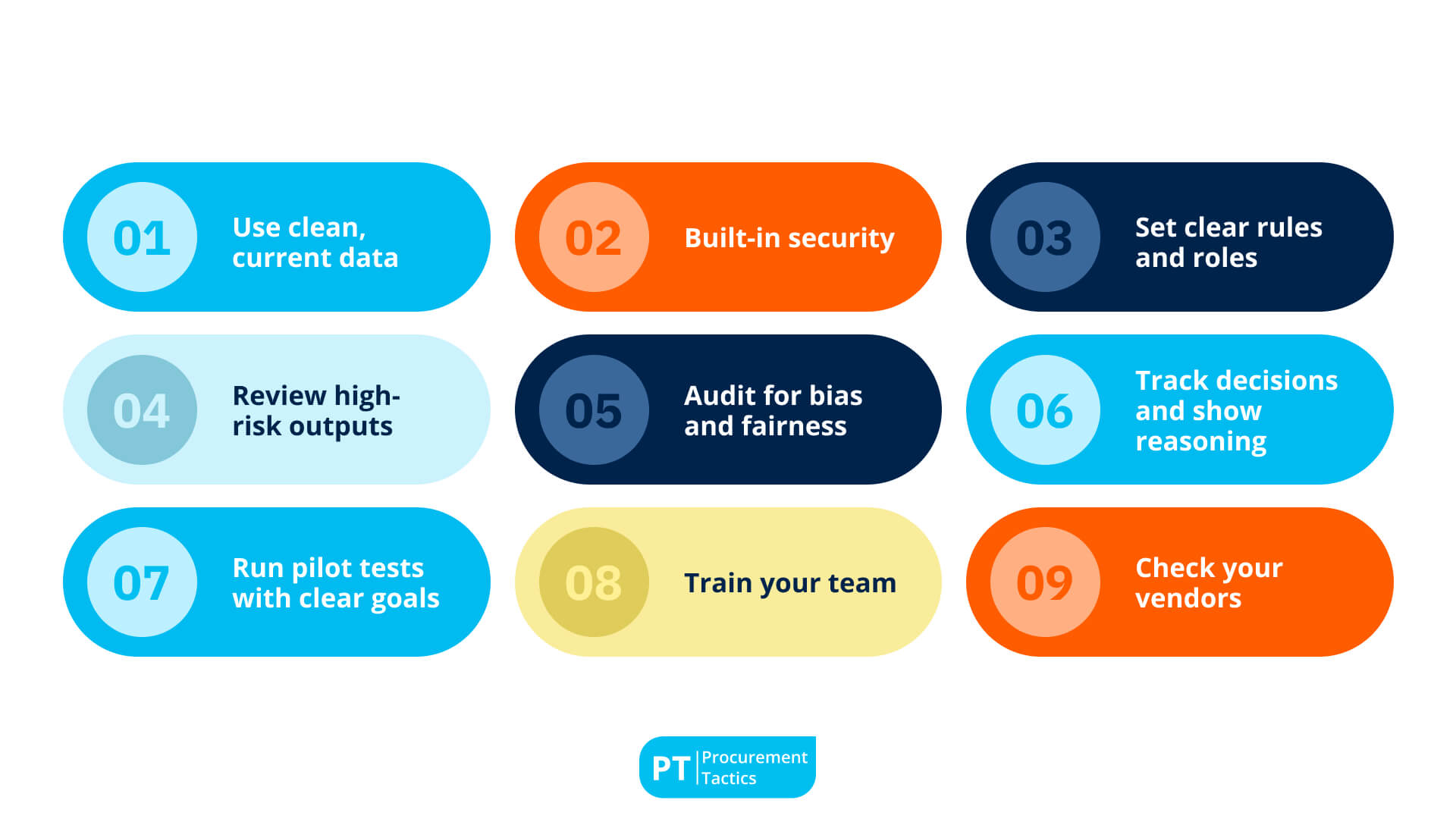
1. Use clean, current data
Keep datasets up to date and complete. Validate key fields (supplier IDs, prices, dates), reconcile duplicates, and refresh reference lists so models are not learning from stale information.
2. Built-in security
Prefer enterprise deployments with SSO, role-based access, encryption, and audit logs. Never paste confidential pricing or contract text into public tools; restrict sensitive inputs by policy.
3. Set clear rules and roles
Document what AI may and may not do, when human approval is required, and who signs off on high-impact outputs (supplier awards, contract clauses, pricing). Make escalation paths explicit.
4. Review high-risk outputs
Require human checks for supplier scores, award recommendations, price suggestions, and any contract language. Treat outputs as drafts and verify assumptions before acting.
5. Audit for bias and fairness
Run scheduled reviews (e.g., quarterly) on rankings and decisions. Investigate anomalies such as consistent downranking of new vendors or regional skew, then adjust data, prompts, or rules.
6. Track decisions and show reasoning
Log and record important decisions and the inputs used. Where feasible, capture a short human rationale explaining why a recommendation was accepted or rejected.
7. Run pilot tests with clear goals
Start with time-boxed trials. Measure accuracy, cycle time saved, error rates, and user feedback; scale only when targets are met and risks are under control.
8. Train your team
Teach prompt writing, fact-checking, and when to escalate to Legal or IT. A precise prompt and a two-minute verification often prevent hours of rework.
9. Check your vendors
Perform due diligence on security, data handling, retention/deletion, and model behavior. Confirm where data is stored, who can access it, and how updates or rollbacks are managed.
Conclusion
AI should support procurement professionals, not replace them. It helps teams work faster and make quicker decisions, but it also brings real risks. These include inaccurate results, data exposure, legal and compliance issues, bias in recommendations, and too much dependence on automation.
The solutions are clear and practical: keep people involved in reviews, protect sensitive data, check outputs for fairness, follow well-defined policies, and bring in Legal and IT from the start. With these controls in place, AI becomes a reliable tool that speeds up work and improves decision-making—without putting trust, data, or compliance at risk.
Frequentlyasked questions
What are the biggest AI risks in procurement?
Inaccurate outputs from missing context or outdated data, data leaks from using public tools, compliance and bias issues in recommendations and contracts, and over-reliance on automation.
How do we stay compliant when using AI in procurement?
Keep a human reviewer for supplier choices and contract text, run routine bias audits, protect sensitive data, and operate under a clear AI policy with Legal and IT checkpoints.
Can AI pick suppliers on its own?
No. AI can suggest options, but a person must review the logic, document the reasoning, and confirm it aligns with policy and law.
About the author
My name is Marijn Overvest, I’m the founder of Procurement Tactics. I have a deep passion for procurement, and I’ve upskilled over 200 procurement teams from all over the world. When I’m not working, I love running and cycling.