


Written by Marijn Overvest | Reviewed by Sjoerd Goedhart | Fact Checked by Ruud Emonds | Our editorial policy
Category Management Strategy Definition, Tips + Examples
Table of contents
- What is Category Management Strategy?
- How to Create a Category Management Strategy
- 5 Examples of Effective Category Management Strategy
- How does Category Management Strategy Work?
- Benefits of Category Management
- Challenges in Category Management
- Best Practices for Successful Implementation
- Conclusion
- Frequently asked questions
- Category management strategy is a structured approach to procurement that organizes similar products and services into defined categories and manages each one as a separate business area.
- Category management strategy relies on analyzing spend data, building tailored plans for each category, and managing supplier relationships to improve efficiency and performance.
- This structured approach helps organizations cut costs, increase value, and align procurement decisions with overall business objectives.
What is Category Management Strategy?
Category management strategy is a structured approach to procurement that organizes similar products and services into defined categories and manages each one as a separate business area. Instead of treating every purchase as an isolated transaction, category management views procurement holistically, focusing on total value, not just price.
In this model, each category (for example, IT equipment, professional services, or travel) has its own goals, budget, and performance indicators. A category manager oversees the full lifecycle of that category: from analyzing spend data and understanding market trends to developing sourcing strategies and managing suppliers.
This approach enables organizations to leverage data insights to identify consolidation opportunities, strengthen supplier relationships, and develop category-specific strategies that align with their business objectives. It’s not just about buying smarter, it’s about building a procurement ecosystem that delivers efficiency, innovation, and long-term value.
How to Create a Category Management Strategy
Building a strong category management strategy means moving from isolated purchasing to a structured, insight-driven, and collaborative approach. The following steps provide a clear guide for how organizations can create and implement an effective strategy.
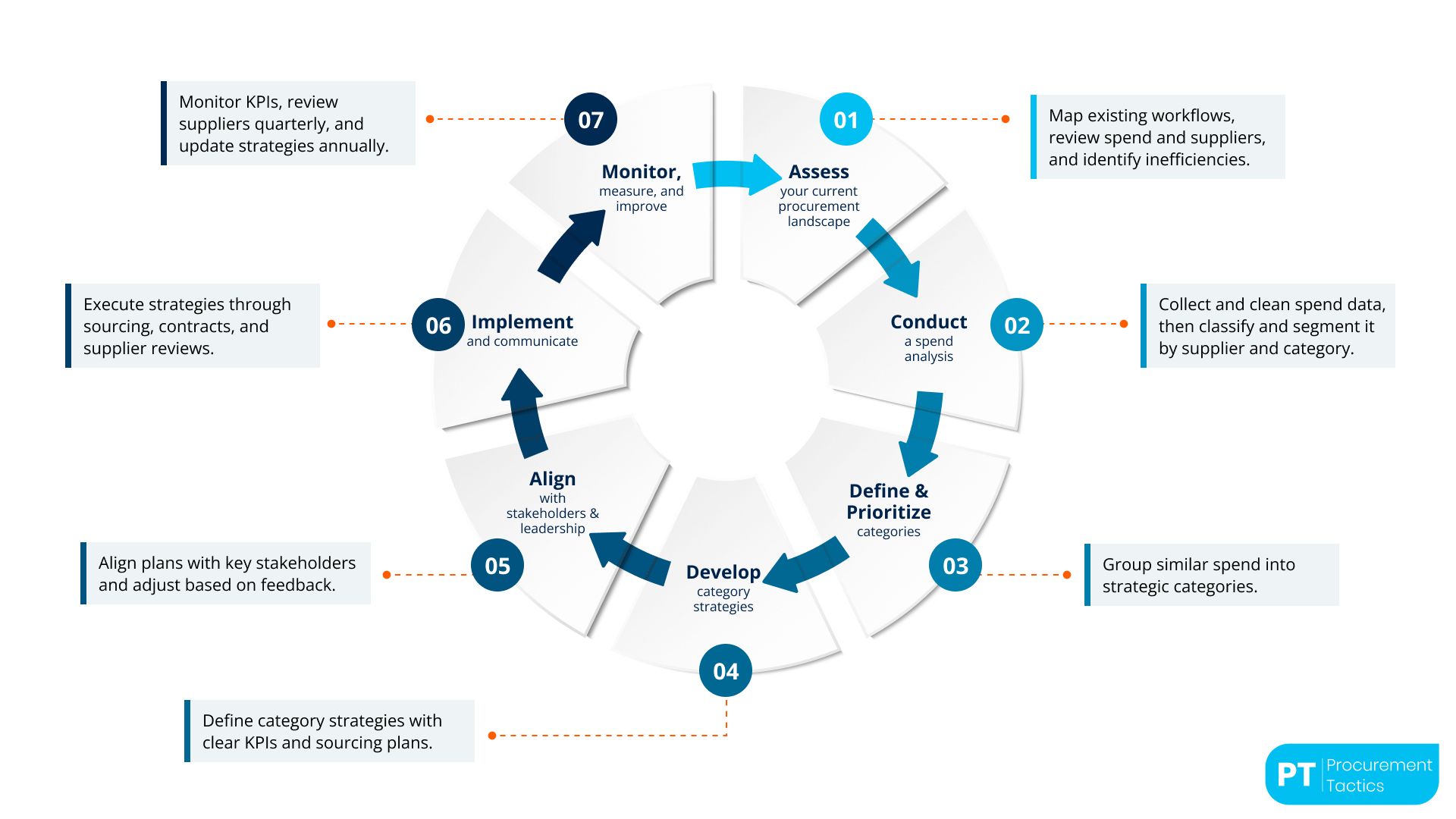
1. Assess Your Current Procurement Landscape
The first step is understanding how procurement currently operates, which processes exist, who is involved, and how decisions are made. To do this, map your procurement workflows, identify who buys what, compile a full list of suppliers and contracts, and look for inefficiencies such as duplicate purchases or inconsistent pricing. This baseline sets the foundation for all category decisions.
2. Conduct a Spend Analysis
Spend analysis helps reveal where money goes and which categories matter most. Gather spend data from ERP systems, finance, AP, and purchasing cards. Clean and standardize supplier names, classify spend, and segment it by supplier, item type, and cost center. The goal is to identify fragmented spend, high-volume opportunities, and areas where consolidation or strategic sourcing could create value.
3. Define and Prioritize Categories
Once you understand your spend, group similar goods and services into strategic categories such as IT, logistics, marketing, or facilities. Assign spend volumes to each category and prioritize them based on spend level, supply risk, and business importance. Organizations typically start with three to five high-impact categories before expanding to others.
4. Develop Category Strategies
Each priority category needs a tailored strategy aligned with business goals. This includes defining objectives and KPIs, segmenting suppliers (strategic, core, transactional), analyzing market trends and risks, and choosing the right sourcing approach, such as competitive bidding, framework agreements, or long-term partnerships.
5. Align with Stakeholders and Leadership
Category strategies must reflect the needs of internal stakeholders. Share your insights and plans with finance, operations, and end users, gather their feedback on expectations and risks, and adjust strategies accordingly. Leadership approval ensures alignment and makes implementation easier.
6. Implement and Communicate
Turn each strategy into action through sourcing events, contract updates, and supplier reviews. Communicate progress through dashboards and category review meetings so stakeholders remain informed. Track both quick wins and long-term improvements to demonstrate the value of the strategy.
7. Monitor, Measure, and Improve
Category management is a continuous cycle. Monitor KPIs regularly, review supplier performance quarterly, and refresh category strategies each year based on new data, market changes, and business priorities. Document lessons learned and apply improvements across all categories as the model matures.

5 Examples of Effective Category Management Strategy
1. Unilever – Sustainable Procurement and Supplier Consolidation
What they do:
Unilever, one of the world’s largest consumer goods companies, faced growing complexity in managing thousands of suppliers across multiple categories, from packaging materials to logistics services.
To address inefficiencies and meet its sustainability goals, Unilever introduced a global category management framework. The company grouped similar spend areas, reduced supplier fragmentation, and embedded environmental metrics into every sourcing decision.
How It Works:
Each major category (raw materials, packaging, transport) has a dedicated team responsible for spend analysis, supplier performance, and sustainability tracking.
Data-driven insights identify overlapping contracts, which are then consolidated under global framework agreements managed through a centralized system.
Why It’s Effective:
- Reduced administrative complexity and improved cost efficiency by 10–15%.
- Simplified sustainability reporting and reduced packaging waste by 25%.
- Strengthened supplier accountability through consolidated contracts.
2. Siemens – Global Category Standardization
What they do:
As a multinational industrial manufacturer, Siemens struggled with inconsistent procurement practices across its regional units. Each division was sourced independently, creating duplication and missed synergies.
To solve this, Siemens launched a global category management initiative aimed at unifying sourcing frameworks for IT, energy, and facility management categories.
How It Works:
Central category councils defined sourcing playbooks and standardized supplier frameworks, while local procurement teams executed within these guidelines.
A digital spend dashboard provided real-time visibility into supplier performance and contract status across more than 80 countries.
Why It’s Effective:
- Achieved over €300 million in cost reductions within three years.
- Improved global compliance and supplier consistency.
- Enhanced leverage in negotiations through consolidated global volumes.
3. British Airways – Service Categories Optimization
What they do:
British Airways had long managed its core operational categories, fuel, catering, and maintenance, in isolation. Each department handled its suppliers separately, leading to inconsistent pricing and performance.
The airline restructured its procurement organization around category management principles to improve coordination and reduce service disruptions.
How It Works:
Cross-functional category teams brought together experts from procurement, finance, and operations.
Each team developed a category plan that included supplier segmentation, performance KPIs, and contingency measures for critical services like refueling and catering.
Why It’s Effective:
- Increased operational reliability and reduced supplier overlap.
- Improved crisis readiness and business continuity.
- Boosted supplier satisfaction through structured performance reviews.
4. Maersk – Logistics and Equipment Category Integration
What they do:
Maersk, a global logistics and shipping giant, operates multiple supplier networks for ports, containers, and transport, often managed separately by regional branches. This created inefficiencies and limited visibility across the supply chain.
To address this, Maersk implemented a category management system that unified logistics, transportation, and equipment procurement under a single strategy.
How It Works:
The company centralized supplier data into a single procurement platform, categorized suppliers based on spend and risk, and developed category-specific contracts.
Regular category review meetings focused on supplier performance, cost trends, and capacity planning.
Why It’s Effective:
- Reduced logistics costs by 8% across global operations.
- Improved delivery reliability through better supplier coordination.
- Enabled faster response to supply disruptions.
5. Foxconn – Global Diversification and Category Resilience
What they do:
Foxconn, one of the world’s largest electronics manufacturers, historically depended heavily on its production and supplier base in China.
This geographic concentration created major vulnerabilities during border closures, logistical bottlenecks, and pandemic-related shutdowns.
To enhance supply chain resilience, Foxconn launched a global diversification strategy that redistributed sourcing and assembly operations to Vietnam, India, and Mexico.
How It Works:
The company reorganized its category structure by region, introducing local supplier networks and balancing procurement volumes across continents.
It also invested in automated quality-control systems to maintain consistent product standards and implemented blockchain-based traceability for high-value electronic components.
This system allows each part to be digitally tracked from the supplier to the assembly line.
Why It’s Effective:
- Maintained supply continuity during transport and border disruptions.
- Improved transparency and authenticity through blockchain tracking.
- Turned global diversification into a strategic advantage for flexibility and compliance.
How does Category Management Strategy Work?
Category management works by organizing similar goods and services into strategic categories and managing each one through a structured, data-driven process. It starts with analyzing spend to understand where money goes, which suppliers are involved, and where inefficiencies or consolidation opportunities exist.
Once the spend landscape is clear, organizations group similar items into logical categories such as IT, logistics, or marketing. For each category, procurement teams develop tailored strategies that define goals, supplier portfolios, sourcing approaches, risk assessments, and performance metrics.
Finally, category management relies on strong supplier relationships and alignment with business priorities. Category managers work closely with internal stakeholders and key suppliers to implement strategies, monitor performance, and ensure that sourcing decisions support overall organizational goals, from cost savings and efficiency to innovation and sustainability.
Benefits of Category Management
When implemented effectively, category management becomes more than a procurement method; it’s a driver of efficiency, innovation, and long-term value. Here are the key benefits organizations typically achieve:
Challenges in Category Management
While category management delivers strong benefits, implementing it successfully isn’t always easy. Many organizations face structural, cultural, and data-related challenges along the way. Understanding these obstacles helps teams prepare and build a realistic strategy.
Best Practices for Successful Implementation
Building an effective category management strategy requires structure, collaboration, and continuous improvement. The table below outlines key practices and how to apply them in daily procurement operations.
Conclusion
Category management strategy helps organizations move beyond basic purchasing and develop a smarter, more structured way of managing spend. By grouping similar goods and services into strategic categories, procurement gains stronger visibility, better control, and the ability to drive long-term value instead of focusing only on short-term savings.
A mature category management strategy gives teams the tools to understand their spending, build targeted plans, and work more effectively with suppliers and stakeholders. It improves efficiency, reduces risk, and ensures that procurement supports wider business priorities such as resilience, sustainability, and innovation.
While the approach requires reliable data, cross-functional collaboration, and disciplined execution, the return is significant. Companies that invest in category management build stronger supplier partnerships, unlock continuous improvement, and create a procurement function that acts as a strategic partner, not just an operational necessity.
Frequentlyasked questions
What is category management strategy?
A category management strategy is a structured procurement approach that groups similar goods and services into categories, each managed as a mini business unit with its own goals, KPIs, and supplier strategies. The purpose is to increase efficiency, reduce costs, and align procurement with business objectives.
What are the main benefits of a category management strategy?
The main benefits of a category management strategy include greater efficiency, improved cost savings and spend control, stronger supplier partnerships, better alignment with business goals, and enhanced risk management.
What are the main challenges organizations face when implementing a category management strategy?
The main challenges include poor-quality or incomplete spend data, resistance to change from departments used to independent purchasing, siloed teams with limited cross-functional collaboration, skill gaps within procurement, and a short-term focus that makes it difficult to sustain long-term category strategies.
About the author
My name is Marijn Overvest, I’m the founder of Procurement Tactics. I have a deep passion for procurement, and I’ve upskilled over 200 procurement teams from all over the world. When I’m not working, I love running and cycling.