


Written by Marijn Overvest | Reviewed by Sjoerd Goedhart | Fact Checked by Ruud Emonds | Our editorial policy
Component Sourcing — Definition, Process + Examples
- Component sourcing is the process of identifying, qualifying, and purchasing electronic components needed to manufacture a product.
- Global shortages, counterfeit risks, and supply chain disruptions make proactive sourcing essential. Early supplier engagement, lifecycle tracking, and diversified sourcing channels are key defenses.
- Digital tools and sustainable sourcing practices are reshaping the future of electronics manufacturing.
What is Component Sourcing?
Component sourcing is the process of identifying, qualifying, and purchasing electronic components needed to manufacture a product. It covers everything from simple resistors and capacitors to complex semiconductors, sensors, and integrated circuits.
At its core, component sourcing is about ensuring that every part used in production meets quality, performance, and compliance requirements, and that it arrives on time, at the right cost. It involves selecting trusted suppliers, managing inventory levels, verifying authenticity, and monitoring lifecycle status to prevent disruptions.
Companies that manage component sourcing proactively gain a competitive edge through better cost control, supply continuity, and product reliability.
The Electronic Component Sourcing Process
Below are seven steps that ensure the process is structured, efficient, and compliant with modern electronics manufacturing standards.
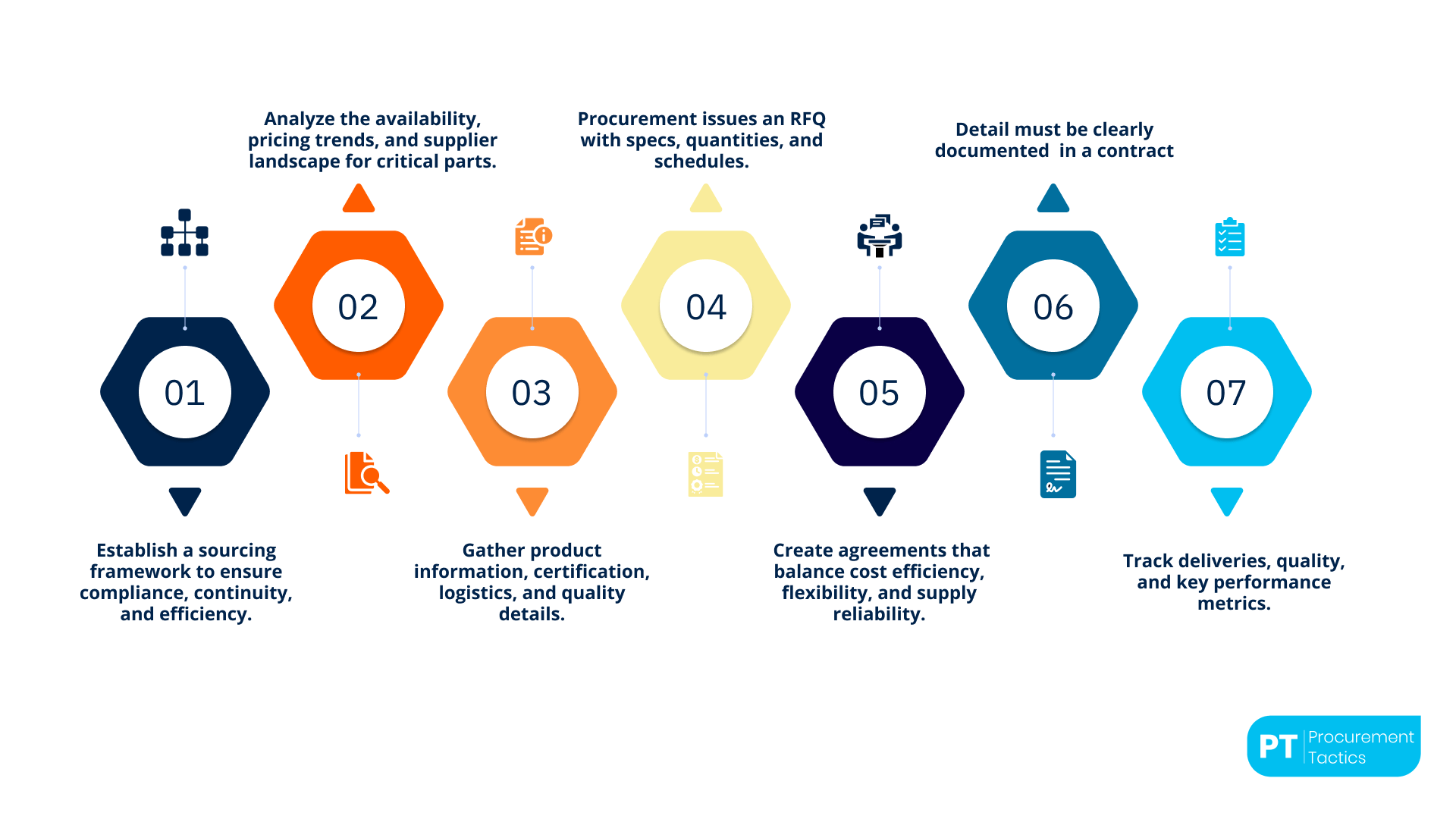
1. Sourcing Methodology
Before searching for specific components, organizations must define a clear sourcing framework. This involves identifying which product categories are covered (for example, semiconductors, sensors, connectors, or passive components), setting quality and compliance requirements, and forming a cross-functional team that includes engineers, quality control specialists, and procurement professionals.
The goal is to create a sourcing roadmap that supports design continuity, minimizes production delays, and ensures that every purchased component meets performance, safety, and lifecycle expectations.
2. Market Research
Market research in component sourcing means analyzing the availability, pricing trends, and supplier landscape for critical parts. Procurement teams review manufacturer lead times, inventory levels, authorized distribution networks, and potential substitutes for high-demand or obsolete components.
For instance, when sourcing microcontrollers, it’s essential to verify if the supplier provides full traceability, RoHS and REACH compliance, and updated lifecycle data. Comprehensive market research helps avoid shortages, counterfeit risks, and unplanned design changes.
3. Request for Information (RFI)
At this stage, buyers send RFIs to potential suppliers to collect details about their product range, certifications, logistics capabilities, and quality systems. Suppliers may also be asked to provide insight into their sourcing channels, whether they buy directly from original component manufacturers (OCMs) or through authorized distributors.
Engineering teams simultaneously confirm which part numbers, tolerances, and technical parameters are acceptable. Based on RFI responses, procurement can shortlist suppliers with proven reliability and transparent sourcing practices.
4. Request for Quotation (RFQ)
Once the shortlist is finalized, the procurement team issues an RFQ that includes exact part numbers, quantities, delivery schedules, and warranty expectations. In component sourcing, cost is important, but it must never compromise quality or continuity of supply.
For example, a supplier offering a slightly higher price but guaranteed 12-week delivery may be preferable to one offering discounts without firm delivery dates. The RFQ stage ensures that both technical and commercial factors are fully aligned before negotiations begin.
5. Negotiation Phase
Negotiation in component sourcing goes beyond price reduction. It covers lead times, logistics support, payment terms, warranty coverage, and replacement policies for end-of-life (EOL) parts.
A well-structured negotiation may include questions such as: “If we commit to quarterly orders, can you maintain stable pricing and reserve inventory?” or “Can you provide consignment stock for high-turnover components?” The goal is to create agreements that balance cost efficiency, flexibility, and supply reliability.
6. Contracting Phase
Once terms are agreed upon, every detail must be clearly documented. Contracts should specify approved part numbers, manufacturer names, quality and testing procedures, shelf-life conditions, and packaging standards (for example, ESD or moisture sensitivity levels).
Using digital Contract Lifecycle Management (CLM) tools or ERP-integrated modules allows companies to track contract validity, supplier performance, and component compliance across multiple projects. Clear documentation prevents sourcing errors and strengthens traceability for audits.
7. Supplier Relationship Management (SRM)
The sourcing process doesn’t end once the components are purchased. Continuous supplier management is critical. SRM in electronics involves monitoring delivery accuracy, performing incoming-quality inspections, reviewing non-conformance reports, and tracking key metrics such as on-time delivery rate, defect rate, and responsiveness.

Building long-term partnerships with reliable suppliers, especially authorized distributors and manufacturers, ensures consistent access to genuine components, faster resolution of quality issues, and a more resilient supply chain.
6 Real-World Examples of Component Sourcing
The examples below reveal what effective component sourcing looks like in practice. Let’s dive right in.
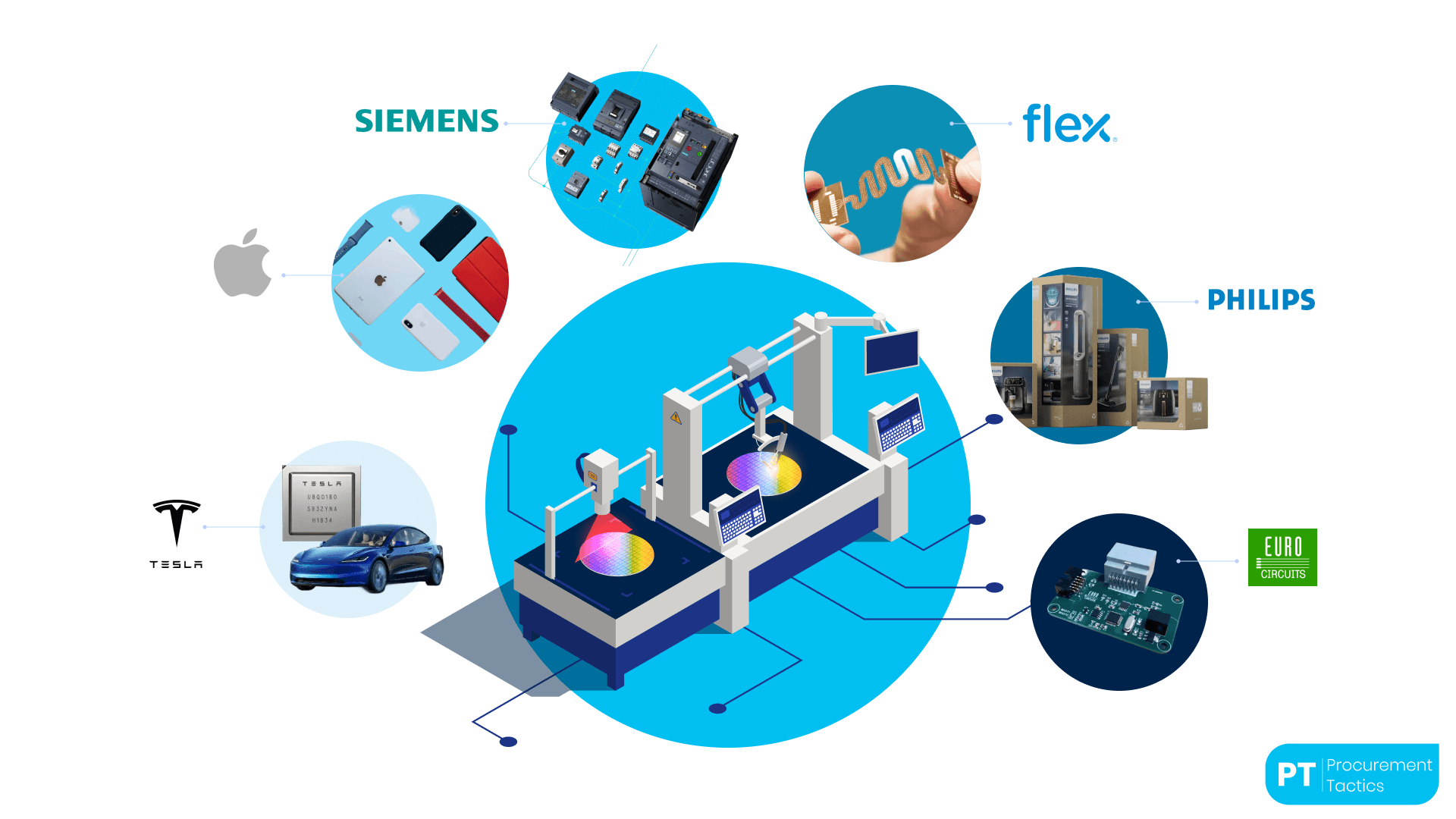
1. Tesla: Flexible Multi-Sourcing During the Global Chip Shortage
What they did:
When the 2020–2022 semiconductor shortage disrupted nearly every major automaker, Tesla managed to keep its production lines running. Instead of pausing manufacturing or waiting for specific microcontrollers to arrive, Tesla re-engineered several electronic control units (ECUs) to support chips from multiple manufacturers.
How it works:
Tesla’s vehicles are built around a software-defined architecture. This flexibility allowed engineers to rewrite firmware so that different microcontrollers could perform the same function without major hardware redesign.
Procurement teams worked directly with engineering and suppliers to qualify alternative parts and secure new component allocations within weeks rather than months.
Why it’s effective:
By integrating procurement, design, and software teams, Tesla reduced dependence on any single supplier and minimized factory downtime.
This agile sourcing model turned a global crisis into a competitive advantage, allowing Tesla to increase deliveries while competitors suffered double-digit production losses.
2. Apple: Strategic Supplier Integration and Lifecycle Management
What they do:
Apple invests billions of dollars each year in strategic supplier partnerships, locking in access to critical components years ahead of launch. The company has long-term agreements with TSMC for chip fabrication, Murata for passive components, and Broadcom for wireless modules, among others.
How it works:
Apple maintains a closed ecosystem where engineering, operations, and procurement share the same digital supplier database.
Lifecycle analytics are integrated into every stage of product development, ensuring that selected parts will remain available throughout the product’s lifespan.
Apple even helps fund supplier R&D to secure next-generation technologies before competitors can access them.
Why it’s effective:
This deep integration minimizes supply-chain risk, stabilizes pricing, and ensures that production capacity scales seamlessly during global launches.
By combining long-term sourcing with lifecycle intelligence, Apple consistently delivers complex products on time and at enormous scale.
3. Siemens: Digital Transparency and Predictive Sourcing
What they do:
Siemens digitized its entire component sourcing workflow to improve visibility and compliance. Facing challenges with global component variability, Siemens introduced an integrated procurement platform connecting suppliers, engineering systems, and logistics partners.
How it works:
The digital system consolidates real-time data on stock levels, part quality, and lead times across hundreds of categories.
AI-driven algorithms flag potential supply risks, for instance, when a component is approaching end-of-life or a supplier shows delayed shipments.
The system also automates documentation for RoHS and REACH compliance, cutting manual work and audit errors.
Why it’s effective:
Predictive sourcing lets Siemens act before disruptions occur. Procurement teams can secure replacement parts, renegotiate delivery schedules, or activate secondary suppliers long before a shortage hits.
This combination of transparency and foresight reduced sourcing delays by more than 30 percent across multiple divisions.
4. Flex (Flextronics): Regional Sourcing for Global Stability
What they do:
Flex, one of the world’s largest Electronics Manufacturing Services (EMS) providers, redesigned its sourcing model to reduce dependency on long international supply chains. The company implemented a “regional sourcing” strategy across its global network of factories.
How it works:
Each production region, the Americas, Europe, and Asia-Pacific, manages a localized pool of component suppliers.
Flex also created “strategic sourcing hubs” near manufacturing sites, capable of rapidly distributing high-turnover parts such as connectors, sensors, and power modules.
Procurement decisions are supported by regional demand forecasting and digital inventory tracking.
Why it’s effective:
Regional sourcing shortens logistics routes, reduces shipping emissions, and avoids customs delays.
When the Suez Canal blockage and pandemic border closures disrupted global trade, Flex’s localized model allowed continuous production while competitors waited for delayed shipments.
The approach improved lead-time reliability and advanced the company’s sustainability goals simultaneously.
5. Philips: Circular and Sustainable Component Sourcing
What they do:
Philips embedded sustainability and circular-economy principles into every stage of its component sourcing process. The company aims for 100 percent of its key suppliers to meet strict environmental and ethical standards by 2025.
How it works:
Suppliers are evaluated not only on price and quality but also on energy efficiency, material recyclability, and carbon footprint per component.
Philips established a closed-loop recovery system for surplus and end-of-life parts used in medical and consumer electronics.
Returned products are dismantled, components are tested and recertified, and usable parts are reintegrated into new devices.
Why it’s effective:
Circular sourcing reduces waste, secures additional component streams, and supports compliance with EU sustainability directives.
It also strengthens Philips’ brand reputation as a leader in responsible manufacturing while delivering measurable cost savings through material reuse.
6. Eurocircuits: Transparent PCB Assembly and Component Sourcing
What they do:
Eurocircuits, a European PCB manufacturer, developed an open-data sourcing platform that gives customers direct insight into component availability and pricing during design and production.
How it works:
The platform connects Eurocircuits’ assembly system with databases of major authorized distributors like Digi-Key and Mouser.
Customers can instantly view stock levels, lead times, and alternative components while uploading their Bill of Materials (BOM).
If a component becomes unavailable, the system automatically suggests replacements with the same footprint or specifications.
Why it’s effective:
This transparency drastically shortens sourcing cycles and minimizes last-minute redesigns.
Small and medium manufacturers benefit from professional-grade supply-chain visibility, ensuring faster turnaround, reduced procurement errors, and better cost predictability.
Common Challenges in Component Sourcing
Even the most experienced procurement teams face obstacles when sourcing electronic components. Supply chain volatility, counterfeit risks, and lifecycle issues can all disrupt production. The table below highlights the most common challenges and practical ways to overcome them.
Best Practices and Strategies for Successful Component Sourcing
1. Build a Multi-Tier Supplier Network
Relying on a single distributor or manufacturer increases vulnerability to shortages and disruptions. Successful organizations develop multi-tier networks that include primary suppliers for core components and secondary partners for backup capacity.
This diversification ensures continuity even when global supply lines tighten. Supplier mapping and periodic risk assessments help identify critical dependencies before they become bottlenecks.
2. Integrate Engineering and Procurement Early
Strong collaboration between engineers and procurement professionals prevents sourcing conflicts later in production. Engineers should consider part availability, lifecycle status, and cost during design, while procurement provides insights into supplier reliability and logistics feasibility. Early alignment shortens sourcing cycles, reduces redesign costs, and ensures that selected components remain available throughout the product’s lifespan.
3. Use Digital Tools for Visibility and Decision-Making
Manual spreadsheets can’t keep up with the pace of modern supply chains. Companies now rely on digital procurement systems and PLM (Product Lifecycle Management) tools that provide real-time visibility of inventory, lead times, and compliance data.
4. Apply Total Cost of Ownership (TCO) Thinking
Focusing solely on unit price can lead to hidden expenses such as expedited shipping, testing failures, or rework costs. The TCO approach looks at the full financial impact of each component: purchase price, logistics, inspection, warranty, and replacement. By considering all these factors, procurement teams make sourcing decisions that are cost-effective in the long run, not just on paper.
5. Monitor Lifecycle and Obsolescence Proactively
Every component has a limited production window. Without monitoring lifecycle status, companies risk costly redesigns or last-minute scrambles for obsolete parts. Implementing lifecycle management tools allows teams to anticipate end-of-life (EOL) notices, evaluate alternatives, and coordinate “last-time buys.” Proactive lifecycle management keeps production stable and compliant even as technologies evolve.
Why Component Sourcing Matters
In electronics manufacturing, product quality and reliability depend on the components behind them. A single missing or faulty part can delay production, increase costs, or damage brand reputation.
That’s why component sourcing is more than purchasing; it’s a strategic function linking design, engineering, and supply chain resilience. When managed effectively, it ensures parts are genuine, compliant, and available throughout the product lifecycle.
With rising risks like semiconductor shortages, geopolitical tensions, and counterfeit parts, proactive sourcing has become essential. Companies that invest in digital tools, market intelligence, and sustainable supplier partnerships gain the visibility and stability needed for consistent production and customer trust.
Conclusion
Component sourcing has evolved from a transactional procurement activity into a strategic discipline that directly influences innovation, cost efficiency, and operational resilience. As the global electronics market becomes more volatile and interconnected, successful sourcing now depends on three things: visibility, collaboration, and adaptability.
Companies that invest in supplier diversification, digital transparency, and proactive lifecycle management can anticipate risks instead of reacting to them. Furthermore, effective component sourcing isn’t about finding the cheapest part; it’s about building a reliable, responsive, and future-proof supply chain.
Frequentlyasked questions
What is component sourcing in electronics manufacturing?
Component sourcing is the process of identifying, evaluating, and purchasing the electronic parts needed for production, from semiconductors and sensors to resistors and capacitors. It ensures that all parts meet required specifications, quality standards, and delivery timelines.
Why is component sourcing so important today?
Because supply chains are global and fragile. Shortages, geopolitical risks, and counterfeit components can disrupt entire production lines. Strategic sourcing helps companies secure a reliable supply, maintain quality, and avoid costly downtime.
What are the biggest current challenges in component sourcing?
The most common issues include semiconductor shortages, price volatility, counterfeit risks, and end-of-life component obsolescence. Proactive monitoring, multi-sourcing strategies, and early supplier engagement help mitigate these risks.
About the author
My name is Marijn Overvest, I’m the founder of Procurement Tactics. I have a deep passion for procurement, and I’ve upskilled over 200 procurement teams from all over the world. When I’m not working, I love running and cycling.