

Written by Marijn Overvest | Reviewed by Sjoerd Goedhart | Fact Checked by Ruud Emonds | Our editorial policy
Decentralized Purchasing — Explained + Best Practices
- Decentralized purchasing is a procurement model that distributes buying authority to individual departments or locations, enabling faster decision-making and tailored sourcing based on local requirements.
- Decentralized purchasing empowers project teams and regional offices to approve and execute purchases independently, thereby reducing bureaucratic steps and shortening lead times.
- Decentralized purchasing operates under a unified corporate policy framework, allowing local managers to apply regional market insights for more cost-effective and responsive procurement.
What is Decentralized Purchasing?
Decentralized purchasing assigns procurement authority to individual departments or locations, empowering local managers to approve and carry out purchases based on their specific needs, whether acquiring supplies suited to regional markets or tools needed urgently for projects, while still following overarching corporate policies and compliance requirements.
This approach reduces bureaucracy and approval time, fosters stronger relationships with regional vendors, and uses local market expertise to optimize costs and improve delivery speed.
Centralized vs Decentralized Purchasing
Types of Decentralized Purchasing
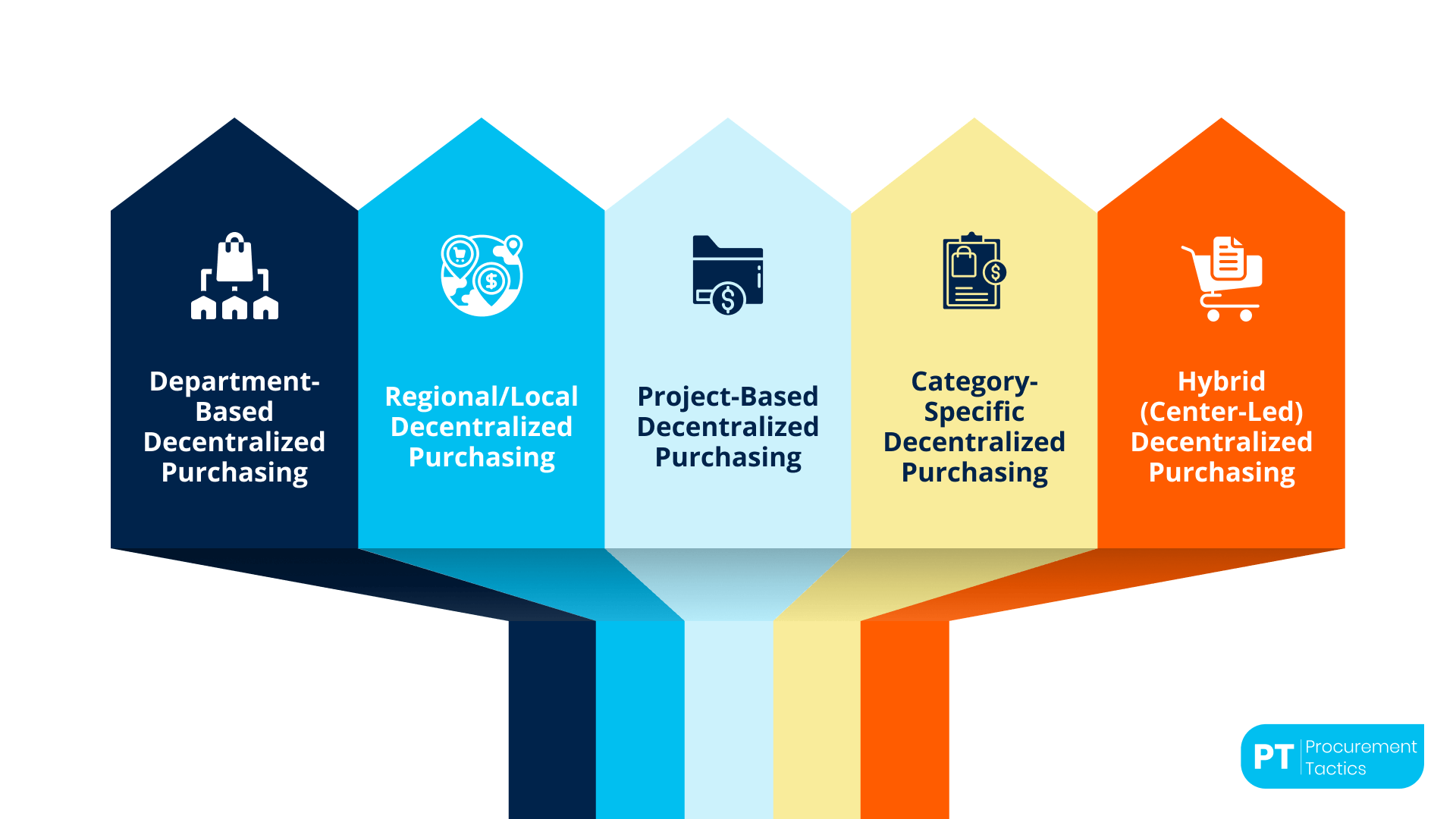
1. Department-Based Decentralized Purchasing
In this model, individual functional units (e.g., Marketing, IT, Facilities) take full responsibility for sourcing and purchasing the goods or services they need.
Department heads define requirements, negotiate with suppliers, and approve orders within their own budget limits, enabling faster turnaround and closer alignment with team objectives.
2. Regional/Local Decentralized Purchasing
Purchasing authority is assigned to geographic entities, such as country offices, regional centers, or individual sites.
Regional purchasing teams leverage local market knowledge to comply with area-specific regulations, shorten delivery times, and build stronger relationships with nearby suppliers, often resulting in lower transportation costs and better service levels.
3. Project-Based Decentralized Purchasing
Procurement decisions are delegated to temporary, project-focused teams (e.g., an R&D initiative, construction project, or major marketing campaign).
Project managers secure materials and services directly, ensuring that critical deadlines and unique specifications are met without awaiting central approval.
4. Category-Specific Decentralized Purchasing
Purchasing responsibility is allocated by spend category rather than by department or region.
For example, one team might specialize in IT hardware acquisitions, another in raw-material sourcing, and a third in professional services.
Category experts negotiate optimal terms and standards within overarching corporate guidelines.
5. Hybrid (Center-Led) Decentralized Purchasing
Also known as the “center-led” model, this approach blends centralized and decentralized elements: strategic or high-value categories (e.g., large raw-material purchases) remain under a central team’s control, while routine, low-risk, or highly localized purchases (e.g., office supplies) are decentralized.
This balance delivers local agility alongside the scale benefits and governance of centralized buying.
Benefits of Decentralized Purchasing

Limitations of Decentralized Purchasing
Best Practices for Decentralized Purchasing
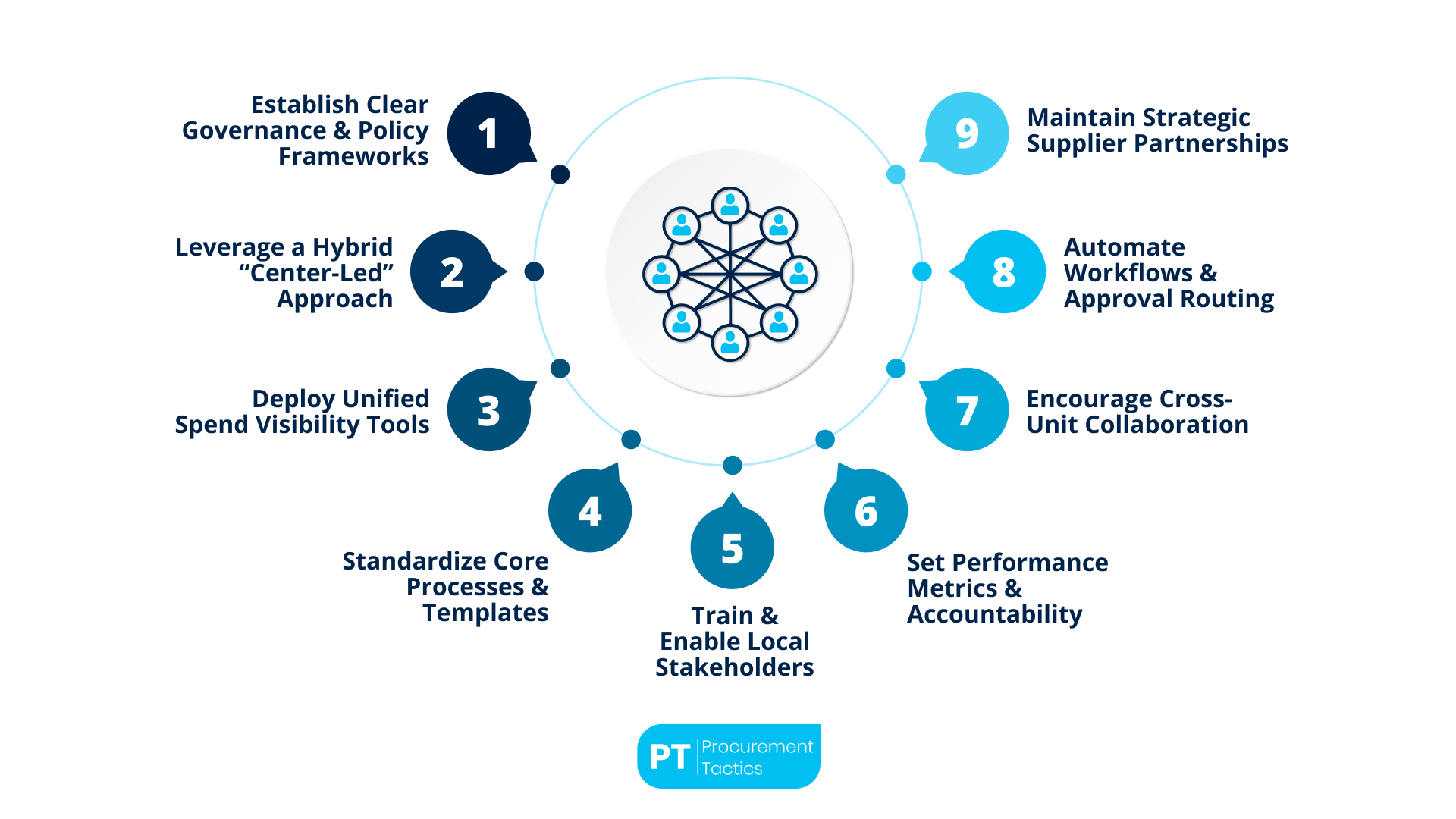
1. Establish Clear Governance & Policy Frameworks
Start by documenting detailed purchasing policies that outline who can buy what, under which circumstances, and with what approvals.
Define spending thresholds (e.g., orders under \$5,000 can be approved locally; anything above requires a central sign-off) and mandatory steps such as vendor due diligence and contract review.
This clarity eliminates ambiguity, ensures compliance, and provides audit trails without slowing down routine buys.
Real-Life Example of Establishing Clear Governance & Policy Frameworks:
At Siemens, any purchase over €10,000 must pass through a centralized e-approval workflow that enforces vendor due diligence and budget checks, ensuring local teams know exactly when to involve Procurement.
2. Leverage a Hybrid “Center-Led” Approach
Identify high-impact categories (such as strategic raw materials, IT infrastructure, or professional services) that benefit most from centralized negotiation and risk oversight.
Delegate routine, low-value, or highly localized purchases (e.g., office supplies, local event services) to regional teams. This division of labor allows central experts to focus on complex, high-value deals while local teams maintain agility for everyday needs.
Real-Life Example of Leverage a Hybrid “Center-Led” Approach:
Unilever centralizes its global packaging and raw-materials sourcing to capture volume discounts, while empowering regional marketing teams to independently buy promotional items for local campaigns.
3. Deploy Unified Spend Visibility Tools
Implement a cloud-based procurement or expense-management platform that collects all purchase requests, orders, and invoices into one dashboard.
Use real-time reporting to spot off-policy spending, track budget burn rates, and analyze category-level trends across regions.
Central teams can then quickly intervene on anomalies, while local managers gain insight into their performance metrics.
Real-Life Example of Deploying Unified Spend Visibility Tools:
Coca-Cola rolled out Coupa across all its bottling plants; every purchase, from pallets of bottles in Mexico to cleaning supplies in Germany, feeds into one dashboard for real-time spend analytics.
4. Standardize Core Processes & Templates
Create a library of standardized requisition forms, contract templates, and supplier-evaluation scorecards that every unit must use.
Include guidance notes directly in the templates (e.g., mandatory fields, scoring criteria) so that decentralized teams still follow best practices without reinventing the wheel.
This consistency reduces errors, accelerates reviews, and simplifies training for new buyers.
Real-Life Example of Standardize Core Processes & Templates:
GE Healthcare provides every business unit with a standard “Purchase Requisition” form that includes mandatory fields for risk rating and sustainability scoring, eliminating form-related errors.
5. Train & Enable Local Stakeholders
Roll out a structured training program covering negotiation fundamentals, category-specific market insights, and platform usage.
Provide on-demand e-learning modules alongside quarterly live workshops or “office hours” with central procurement experts.
Empowered with both knowledge and support, local buyers will make smarter decisions and feel invested in the organization’s overall performance.
Real-Life Example of Train & Enable Local Stakeholders:
Microsoft’s Central Procurement runs quarterly “Procurement Academy” workshops for its regional IT teams, covering negotiation tactics and platform best practices, boosting their confidence in autonomous buying.
6. Set Performance Metrics & Accountability
Define clear KPIs for each decentralized unit, such as percentage of on-policy purchases, average cost savings per order, supplier delivery performance, and internal customer satisfaction scores.
Review these metrics monthly or quarterly during business reviews, and publicly recognize top-performing teams. This data-driven accountability fosters healthy competition and continuous improvement.
Real-Life Example of Set Performance Metrics & Accountability:
At Amazon, each fulfillment center is tracked on “on-policy spend” and “cost-avoidance” KPIs; top-performing centers receive recognition and budget increases at annual reviews.
7. Encourage Cross-Unit Collaboration
Establish a “buyers’ council” or virtual community forum where local procurement leads share success stories, vendor contacts, and market intelligence.
Hold periodic knowledge-sharing sessions focused on emerging suppliers, innovative sourcing strategies, or lessons learned from cost-reduction initiatives.
This peer network breaks down silos and accelerates best-practice adoption across the organization.
Real-Life Example of Encouraging Cross-Unit Collaboration:
3M hosts a monthly “Buyer Forum” webinar where procurement leads from R&D, manufacturing, and sales share successful supplier innovations, leading to joint category-level contracts.
8. Automate Workflows & Approval Routing
Configure your e-procurement system so that routine requisitions auto-approve within predefined limits, while deviations (e.g., budget overages, new suppliers, unusual categories) automatically route to the appropriate central stakeholder.
Leverage conditional logic (e.g., if spend > \$10K and supplier not in approved list, send to legal) to enforce policies without manual intervention. Automation minimizes human error and speeds up exception handling.
Real-Life Example of Automate Workflows & Approval Routing:
Johnson & Johnson’s JAGGAER system auto-approves office-supply orders under $2,500 but automatically routes any new-vendor requests or higher-value buys to Legal and Finance.
9. Maintain Strategic Supplier Partnerships
Even as day-to-day ordering decentralizes, central procurement should own the relationship management for global key suppliers.
Negotiate master agreements, volume discounts, and service-level commitments centrally, then allow local teams to issue orders under those terms.
This ensures that the organization retains its scale leverage and consistent risk controls while benefiting from local responsiveness.
Real-Life Example of Maintaining Strategic Supplier Partnerships:
Starbucks’ Global Coffee Procurement team negotiates master supply agreements with major coffee growers, while local store managers place daily orders directly under those terms, combining scale leverage with store-level flexibility.
Conclusion
Decentralized purchasing empowers organizations to respond quickly to local needs by granting decision-making authority directly to departments, regions, or project teams. This model reduces bureaucratic delays and leverages regional expertise to improve service levels, supplier diversity, and cost efficiency through timely action.
However, without strong oversight and aggregation of spend data, decentralization can erode purchasing power, fragment visibility, and introduce compliance risks, often leading to higher unit costs, redundant orders, and inconsistent quality across the enterprise.
To strike the right balance, many companies adopt a center-led hybrid approach: central teams retain control over strategic, high-value categories and master agreements, while local units handle routine or highly contextual buys within clearly defined policy frameworks.
By combining clear governance, unified spend-visibility tools, standardized processes, targeted training, and automated approval workflows, organizations can harness the agility of decentralized purchasing while preserving scale economies, risk management, and cohesive supplier relationships.
Frequently asked questions
What is decentralized purchasing?
Decentralized purchasing distributes buying authority to individual departments or locations, enabling faster decisions and tailored sourcing based on local needs.
What advantage stands out about decentralized purchasing and why?
The standout advantage of decentralized purchasing is faster decision-making, as local teams can approve and execute purchases immediately without waiting for central sign-off.
What is the best practice in decentralized purchasing and why?
The best practice in decentralized purchasing is establishing clear governance and policy frameworks, because defined spending thresholds and approval matrices ensure compliance and visibility while preserving local autonomy.
About the author
My name is Marijn Overvest, I’m the founder of Procurement Tactics. I have a deep passion for procurement, and I’ve upskilled over 200 procurement teams from all over the world. When I’m not working, I love running and cycling.