

Written by Marijn Overvest | Reviewed by Sjoerd Goedhart | Fact Checked by Ruud Emonds | Our editorial policy
10 Best Procurement Cost Reduction Strategies
- Procurement cost reduction is not just about cutting expenses; it’s about creating long-term efficiency and value across the supply chain.
- Effective strategies combine data visibility, supplier collaboration, and technology to eliminate waste and improve decision-making.
- Sustainable savings come from a strategic mindset, not one-time cost cuts. Organizations that align procurement goals with business strategy achieve higher resilience and competitiveness.
What is Procurement Cost Reduction?
Procurement cost reduction is a structured approach to lowering total purchasing expenses without compromising quality, service, or supplier performance. It’s about optimizing the entire procurement process, from sourcing to payment, to ensure that every dollar spent delivers maximum value.
This includes better contract management, supplier consolidation, digital tools for spend analysis, and smarter decision-making based on data. The goal is to build an efficient, transparent, and resilient procurement system that continuously identifies and removes waste.
The 10 Best Procurement Cost Reduction Strategies
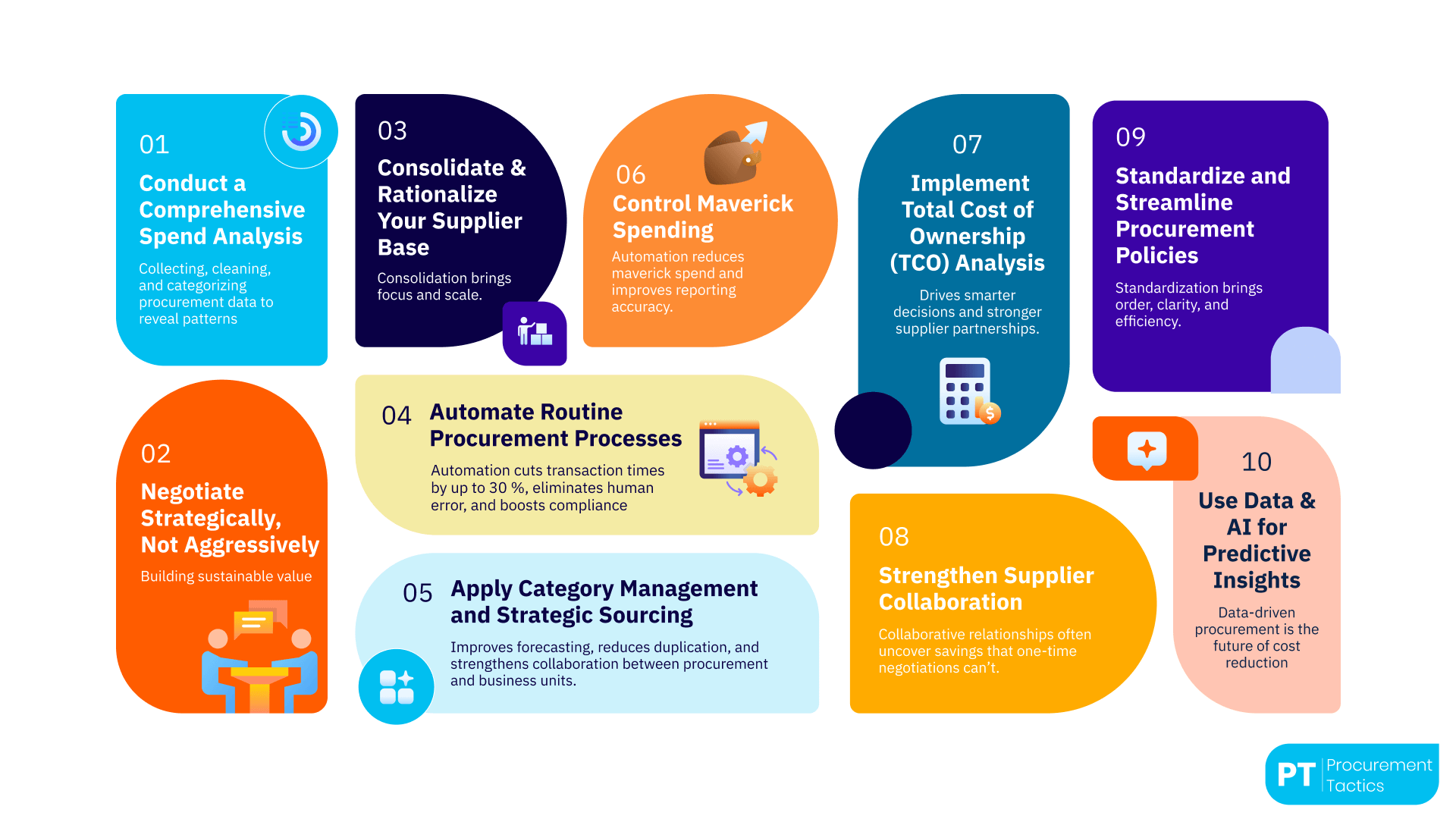
1. Conduct a Comprehensive Spend Analysis
Spend analysis is the foundation of every cost-reduction effort. Without visibility, there’s no control. It involves collecting, cleaning, and categorizing procurement data to reveal patterns that drive smarter decisions.
How to apply it:
Start by consolidating all data from ERP systems, purchase orders, and invoices. Classify spend by supplier, category, and region. Use digital tools such as Sievo, Coupa, or SAP Ariba to automate data cleaning and visualization. Once the data is organized, procurement can identify duplicate suppliers, unmanaged categories, and off-contract purchases.
Why it’s effective:
Organizations that implement advanced spend analytics uncover 5–10 % in hidden savings during the first year. It also helps align procurement with finance and operations, allowing better forecasting and budget accuracy.
2. Negotiate Strategically, Not Aggressively
Negotiation is more than getting the lowest price; it’s about building sustainable value. Good negotiators look beyond cost and balance price, service, risk, and innovation.
How to apply it:
Use your spend analysis to identify leverage points. Know your supplier’s market position, capacity, and alternatives. Prepare scenarios, not ultimatums, and aim for long-term benefits like extended warranties, flexible payment terms, or co-innovation. Update contracts regularly and ensure both sides have clear performance KPIs.
Why it’s effective:
According to PwC, optimizing existing contracts can unlock up to 7 % savings even without switching suppliers. Strategic negotiation strengthens relationships and reduces risk while creating value that extends beyond the deal table.
3. Consolidate and Rationalize Your Supplier Base
A large supplier network might look diversified, but it often hides inefficiencies and higher administrative costs. Consolidation brings focus and scale.
How to apply it:
Review your spend data to find overlapping suppliers across regions or business units. Prioritize those who meet quality, compliance, and sustainability standards. Then, negotiate framework agreements with a smaller set of trusted partners. Keep at least one backup supplier for critical categories to avoid over-dependence.
Why it’s effective:
Supplier rationalization reduces costs by 10–20 % and streamlines operations. It also improves data visibility and makes supplier performance easier to track, freeing procurement teams to focus on innovation instead of firefighting.
4. Automate Routine Procurement Processes
Manual processes are slow, error-prone, and expensive. Each email, spreadsheet, or approval adds a hidden cost. Automation is therefore one of the fastest and most measurable ways to reduce procurement expenses.
How to apply it:
Automate repetitive tasks such as purchase-order creation, invoice matching, supplier onboarding, and contract reminders. Use integrated platforms like SAP Ariba, Coupa, or Jaggaer, which connect sourcing, contracting, and payment in one digital workflow. Set up auto-approvals for low-value purchases and digital signatures for speed.
Why it’s effective:
Automation cuts transaction times by up to 30 %, eliminates human error, and boosts compliance. It frees your team to focus on high-value work like supplier strategy and cost forecasting. Over time, the savings multiply through consistency and transparency.
5. Apply Category Management and Strategic Sourcing
Category management treats procurement as a business driver rather than a support task. It groups similar purchases, IT, logistics, or marketing, into categories that are analyzed and managed strategically.
How to apply it:
Start by identifying spend patterns within each category. Then, develop tailored sourcing strategies: standardize specifications, bundle demand, or negotiate long-term framework contracts. Integrate supplier performance reviews and market benchmarking to maintain competitiveness.
Why it’s effective:
Effective category management can deliver up to 12 % savings, according to PwC. It improves forecasting, reduces duplication, and encourages collaboration between procurement and business units. The result is a more resilient and strategically aligned procurement function.

6. Control Maverick Spending
Even the best savings plan fails if employees don’t follow it. Maverick spends, off-contract or non-compliant buying, quietly drains 10–15 % of the procurement budget.
How to apply it:
Implement digital approval workflows and spend dashboards that flag out-of-policy purchases in real time. Make the buying process simple and fast so users don’t feel the need to bypass it. Train departments to understand how compliance protects both savings and supplier relationships.
Why it’s effective:
Automated compliance and user-friendly systems reduce unauthorized spend and improve accuracy in reporting. This ensures that negotiated prices and discounts actually reach the bottom line.
7. Implement Total Cost of Ownership (TCO) Analysis
Focusing only on the purchase price can be misleading. The cheapest product today may become the most expensive tomorrow. TCO analysis reveals the full financial impact of a purchase over its lifecycle.
How to apply it:
Evaluate all direct and indirect costs, maintenance, training, logistics, downtime, and disposal. Collaborate with technical and financial teams to build cost-comparison models that reflect long-term value.
Why it’s effective:
Automotive and manufacturing firms that use TCO-based sourcing have achieved up to 25 % lower total costs. This approach encourages smarter decision-making and strengthens supplier partnerships focused on innovation and efficiency.
8. Strengthen Supplier Collaboration
Suppliers are not just cost points, they’re potential partners in innovation. Collaborative relationships often uncover savings that one-time negotiations can’t.
How to apply it:
Share demand forecasts, jointly develop cost-saving projects, and establish quarterly business reviews. Encourage suppliers to suggest process or design improvements that lower costs for both sides.
Why it’s effective:
Efficio Consulting reports that clients practicing joint planning with suppliers achieve 10 % higher savings and faster problem resolution. Collaboration also supports sustainability and resilience, key priorities in modern procurement.
9. Standardize and Streamline Procurement Policies
Inconsistent policies create confusion, delay approvals, and inflate costs. Standardization brings order, clarity, and efficiency.
How to apply it:
Develop a unified procurement policy across all regions and departments. Use standardized templates for RFPs, contracts, and supplier evaluations. Introduce clear approval thresholds and defined KPIs that link procurement results to business goals.
Why it’s effective:
Standardized processes reduce cycle times, improve auditability, and ensure fairness in supplier selection. They also make it easier to compare performance across teams and measure cost-saving results accurately.
10. Use Data and AI for Predictive Insights
Data-driven procurement is the future of cost reduction. Artificial intelligence and analytics give procurement teams the ability to predict trends, risks, and opportunities before they happen.
How to apply it:
Leverage AI-powered tools like Ramp or Sievo to track supplier performance, forecast demand, and monitor market shifts. Predictive dashboards highlight early signs of cost escalation, allowing proactive action, not crisis management.
Why it’s effective:
According to Concord, companies using AI in procurement reduced operational costs by 8–15 % in the first year. Data transforms procurement from reactive cost control into strategic value creation.
Combine these strategies into an integrated roadmap. Start with visibility (spend analysis) and end with intelligence (AI insights). Each step builds on the last, turning procurement into a continuous engine for savings and performance.
3 Real-World Examples of Procurement Cost Reduction
Theory matters, but practice proves the point. Here’s how leading organizations turned procurement cost reduction strategies into measurable results.
1. Unilever – Supplier Consolidation and Indirect Spend Optimization
What they did:
Unilever, one of the world’s largest consumer goods companies, manages thousands of suppliers across 190 countries. Over four years, it launched a global procurement transformation program to reduce indirect spend, including categories such as marketing, logistics, travel, and facility services that often escape tight control.
The company conducted a full spend analysis to identify duplication, off-contract purchases, and underused contracts. It then consolidated suppliers, standardized product and service specifications, and negotiated long-term framework agreements to leverage global volume.
How it works:
By centralizing procurement processes and using unified digital tools, Unilever improved spend visibility and eliminated duplication. Category managers collaborated across regions to bundle demand and negotiate larger, more efficient contracts.
Why it’s effective:
Supplier consolidation improved efficiency, increased compliance, and unlocked volume-based discounts. This approach reflects spend analysis, supplier negotiation, and consolidation, proving that visibility and collaboration drive measurable savings.
2. Efficio Consulting – Holistic Procurement Transformation
What they did:
A multinational manufacturer partnered with Efficio Consulting to redesign its entire procurement model after years of decentralized buying and rising costs. Efficio began by mapping every spend category, identifying inefficiencies and overlaps across 30 business units.
They introduced a centralized procurement framework supported by category playbooks, supplier performance dashboards, and savings-tracking tools. Procurement, finance, and operations jointly defined savings targets and KPIs to ensure alignment.
How it works:
Efficio applied deep spend analytics to identify inefficiencies and supplier overlaps. The client restructured its supplier base, optimized contracts, and introduced a global governance framework. Procurement, finance, and operations worked together toward a unified cost-reduction goal.
Why it’s effective:
Cross-functional alignment created transparency, accountability, and measurable savings. The project shows how integrating supplier performance management and contract optimization can transform procurement from a support function into a strategic growth driver.
3. Automotive Industry – Total Cost of Ownership (TCO) Strategy
What they did:
Automotive manufacturers often face pressure to reduce costs without sacrificing reliability. Several leading OEMs launched TCO-based sourcing programs to evaluate suppliers beyond unit price, considering lifecycle costs such as maintenance, logistics, energy use, and downtime.
Procurement teams worked with engineering and finance departments to create cost models that reflected the total value of ownership. Suppliers were encouraged to propose design or material innovations that would reduce costs over time.
How it works:
Through strategic sourcing and category management, procurement teams evaluated every cost driver, maintenance, logistics, warranty, and downtime. They used TCO models to compare suppliers not just by price, but by long-term performance and reliability.
Why it’s effective:
This approach encouraged innovation, improved supplier collaboration, and reduced hidden lifecycle costs. It demonstrates how focusing on category management and strategic sourcing can deliver sustainable cost reduction and stronger supplier partnerships.
Why Cost Reduction Matters in Procurement
Cost reduction is no longer a “nice-to-have.” In a world of volatile prices, inflation, and global supply chain instability, it has become a strategic necessity.
Procurement teams now face the challenge of balancing savings with stability and sustainability. Every decision, from supplier selection to contract terms, affects the company’s bottom line and resilience.
Visibility is key. Without knowing where and why money is spent, procurement can’t effectively identify opportunities for savings. When organizations use spend data to drive strategy, they can reduce costs by up to 15%, while also improving supplier performance and risk control.
Conclusion
Procurement cost reduction is not a one-time initiative; it’s a continuous journey toward smarter, more efficient operations. The ten strategies outlined above show that the biggest savings don’t come from aggressive cost-cutting but from visibility, collaboration, and innovation.
When organizations build procurement systems that are data-driven, automated, and strategically aligned with business goals, they unlock sustainable value. Supplier partnerships grow stronger, processes become faster, and every dollar spent creates a measurable impact.
In today’s volatile economy, procurement leaders are expected to deliver both savings and resilience. Those who adopt a holistic, technology-enabled approach will move beyond short-term cost control to long-term value creation.
The future of procurement belongs to teams that think strategically, act collaboratively, and use data to drive every decision. Because in modern business, cost reduction isn’t about spending less, it’s about spending better.
Frequentlyasked questions
What are the most effective procurement cost reduction strategies?
The most effective strategies include spend analysis, supplier negotiation, consolidation, process automation, category management, and policy compliance. Together, they build a structured approach that delivers both short-term savings and long-term value.
How can technology reduce procurement costs?
Digital tools automate routine tasks, improve spend visibility, and ensure compliance. Platforms like SAP Ariba, Coupa, and Sievo use analytics and AI to identify hidden savings opportunities, track supplier performance, and reduce manual errors, saving both time and money.
What’s the biggest mistake companies make when cutting procurement costs?
Focusing only on price. Cost reduction should never compromise quality, supplier stability, or long-term relationships. The best results come when procurement balances efficiency with collaboration, risk management, and continuous improvement.
About the author
My name is Marijn Overvest, I’m the founder of Procurement Tactics. I have a deep passion for procurement, and I’ve upskilled over 200 procurement teams from all over the world. When I’m not working, I love running and cycling.