

Written by Marijn Overvest | Reviewed by Sjoerd Goedhart | Fact Checked by Ruud Emonds | Our editorial policy
21 Best Procurement Software of 2026
What is a Procurement Software?
-
Procurement software is a powerful tool that simplifies how procurement managers manage buying supplies or services, making daily tasks easier and faster.
-
These software streamline workflows, helping teams work more smoothly and boosting efficiency across operations.
-
Learning how procurement software functions, along with its possible drawbacks, helps companies get the most value from it, making sure they make informed, effective decisions.
Let’s take a look at the 21 best procurement software solutions in 2026. These software are designed to make procurement easier and more efficient.
The 21 Most Popular Procurement Software to Use in 2026
1. Zycus
Zycus is a comprehensive source-to-pay platform designed to streamline and centralize procurement processes. Its AI-powered tools and analytics capabilities enable procurement teams to automate repetitive tasks and make data-driven decisions. Accessible via mobile, Zycus allows users to manage procurement operations efficiently from anywhere.
Why choose Zycus?
- Zycus allows you to centralize your procurement operations, empowering you to control the entire process with ease and efficiency, all from a single, integrated platform.
- It is the world’s first Generative AI-powered S2P platform designed to deliver 10X faster and more efficient procurement.
- Its Merlin GenAI Suite automates repetitive tasks, allowing procurement teams to focus on strategic initiatives.
Pricing:
- Starts at $59 per user/month
Ratings and Reviews:
- G2: 3.6/5 (13 reviews)
- Capterra: 4.3/5 (12 reviews)

2. Kissflow Procurement Cloud
Kissflow Procurement Cloud provides an end-to-end solution that simplifies procurement workflows with a user-friendly interface. It centralizes vendor information, making supplier management more effective, and supports seamless integration with ERP and accounting tools. Customizable workflows enable businesses to tailor the software to meet their specific procurement needs.
Why choose Kissflow Procurement Cloud?
- An end-to-end procurement solution to help with your procurement process.
- Improved vendor relationships, thanks to the software’s ability to collect all vendor and supplier data into one platform. This makes it easier for users to set up their own metrics.
- The product software is easy to integrate with other accounting tools, ERP systems, and other business software.
Pricing:
- Starts at $1,990/month
Ratings and Reviews:
- G2: 4.3/5 (520+ reviews)
- Capterra: 4.3/5 (10+ reviews)

3. WTP Buynamics
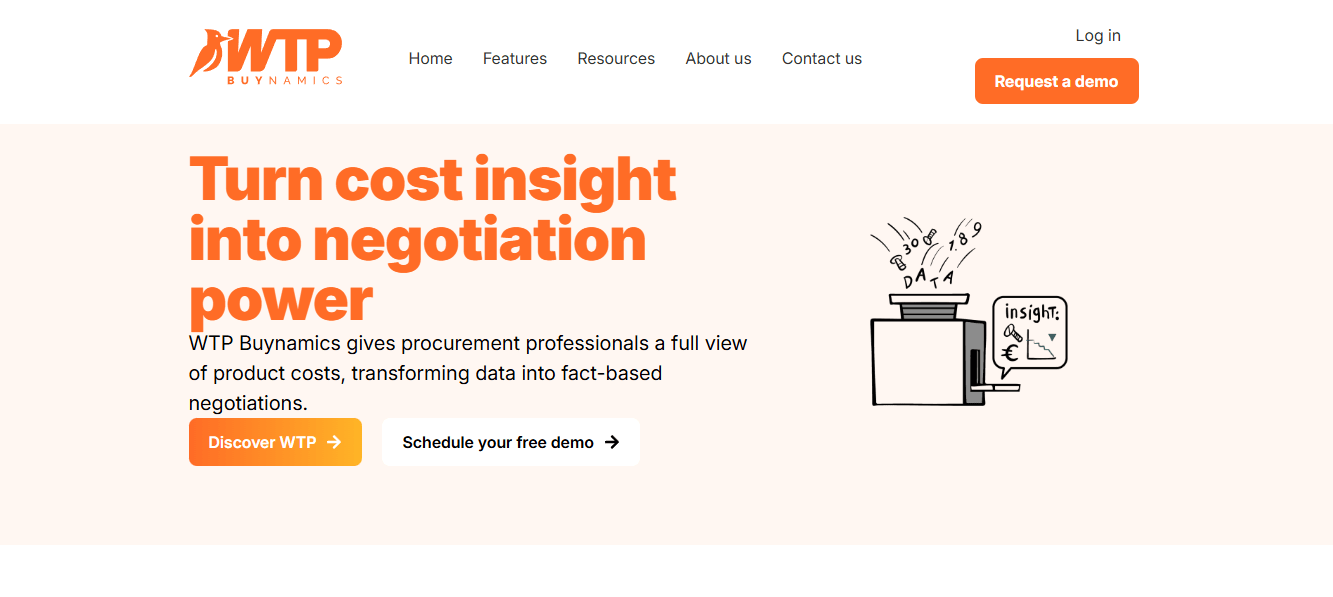
WTP Buynamics is a procurement cost-transparency and negotiation-support tool that helps buyers understand “should-cost” and commodity-driven price movements. It’s built to give fast, fact-based insights you can use in supplier discussions, including cost breakdowns and historical commodity price trends.
WTP Buynamics’ What’s The Price (WTP) supports procurement teams in understanding what a product should cost before entering sourcing or negotiations. Instead of focusing on transactional workflows, WTP provides fact-based cost intelligence built on real-time commodity prices, industry-specific cost structures, labor, energy and freight rates, and sustainability data.
Using top-down cost modeling, procurement teams can break down products into their underlying cost drivers, such as materials, labor, manufacturing overhead, margins, and logistics. This allows buyers to quickly verify supplier quotes, identify inflated pricing, and quantify realistic negotiation targets early in the procurement process.
WTP is commonly used to prepare negotiations, evaluate tenders, and respond to price increase requests with clear, data-backed arguments. By replacing static Excel models with scalable, real-time cost insights, procurement teams move from negotiating on price to negotiating on cost.
It’s best for organizations that want to strengthen negotiation preparation, evaluate tenders objectively, and challenge supplier pricing with transparent, fact-based cost models.
Why choose WTP Buynamics?
- Faster fact-based negotiations: You can get cost insights and commodity history for a product in minutes, so you don’t negotiate “blind.”
- Broad market data coverage: Tracks 3,000+ raw materials and supports industry cost drivers across many countries, helping you challenge price increases with benchmarks.
- Practical negotiation outputs: Includes features like a concise “one-pager” reference you can take into supplier meetings.
Pricing:
- WTP Buynamics offers custom quotes, making the platform suitable for both SMEs and enterprise organizations. Detailed pricing is available upon request.
Ratings and Reviews:
- G2: 0.0/5 (0 reviews)
- Capterra: 4.1/5 (9 reviews)
4. Coupa
Coupa is a cloud-based procurement platform designed to manage expenses, sourcing, and supplier collaboration. It provides real-time visibility into spending, with advanced analytics for data-driven decisions. Coupa’s robust integration capabilities make it a versatile tool for optimizing procurement workflows and enhancing supplier relationships.
Why choose Coupa?
- User-friendly interface with easy navigation and minimal learning curve.
- Real-time visibility into procurement activities for better decision-making.
- Mobile-friendly and integrates seamlessly with ERP systems.
Pricing:
- Contact for pricing
Ratings and Reviews:
- G2: 4.2/5 (260+ reviews)
- Capterra: 4.2/5 (80+ reviews)

5. SMART by GEP
GEP SMART is a robust procurement platform that covers the entire source-to-pay lifecycle, utilizing AI to optimize procurement operations. Its intuitive interface and lifecycle guide support every procurement stage, from sourcing to payment. The platform identifies opportunities for savings and promotes efficiency without sacrificing quality.

Why choose SMART by GEP?
- Control and visibility allow procurement managers to keep track of purchases and the approval process.
- The product’s lifecycle guide helps users navigate the entire source-to-pay lifecycle with its smart tools for sourcing and procurement. Every step of the way, it identifies opportunities to help you get more savings without sacrificing supply quality.
- The program boasts powerful artificial intelligence and machine learning to help the user with procurement tasks.
Pricing:
- Contact for pricing
Ratings and Reviews:
- G2: 4.4/5 (20+ reviews)
- Capterra: 4.6/5 (7 reviews)

6. Bellwether
Bellwether provides a simplified procurement solution with strong file and vendor management capabilities, integrating well with document management and accounting systems. It organizes procurement data in a centralized hub, allowing users to set custom metrics for better supplier management. Bellwether is a practical choice for businesses seeking straightforward procurement automation.
Why choose Bellwether?
- Great file management. The software integrates with a document management system that makes your procurement process easier.
- Improved vendor relationships, thanks to the software’s ability to collect all vendor and supplier data into one platform. This makes it easier for users to set up their own metrics
- The program boasts of powerful artificial intelligence and machine learning to help the user with procurement tasks.
Pricing:
- Contact for pricing
Ratings and Reviews:
- Capterra: 4.7/5 (78 reviews)
- Software Connect: 8.3/10 (3 user reviews)

7. PairSoft (formerly Paramount Workplace)
PairSoft, formerly known as Paramount WorkPlace, offers a complete procurement and accounts payable automation solution with integrated document management. Born from the merger with PaperSave and Webiplex DocuPeak, PairSoft provides a 360-degree view of spend management, simplifying processes from purchase orders to invoices. PairSoft integrates seamlessly with ERP systems and enhances efficiency through advanced AP automation and centralized data management.
Why choose PairSoft?
- 360 degree View of Data gives the user all the important data that is important for the company’s procurement process.
- It not only keeps tabs on purchase orders, requests, and invoices, but also records expenses, labor costs, and budgets
- The program boasts powerful artificial intelligence and machine learning to help the user with procurement tasks.
Pricing:
- Contact for pricing
Ratings and Reviews:
- G2: 4.2/5 (20+ reviews)
- Capterra: 4.3/5 (50+ reviews)

8. Procurify
Procurify is a mobile-enabled procurement platform that simplifies purchase management, expense filing, and workflow automation. Its intuitive interface makes it easy for agile teams to track and manage procurement tasks on the go. With tools for budgeting and approval workflows, Procurify supports efficient procurement management from start to finish.
Why choose Procurify?
- Procurify is equipped with a variety of tools that optimize your eProcurement tasks. These include purchase management, expense filing, and workflow automation. It also has a great budgeting toolkit that simplifies the planning and management of expenses.
- The software also comes with its own native mobile application for iOS and Android devices. This allows you to access your system wherever and whenever you want, which makes it great for agile teams who are always out and about.
- A centralized procurement space, where the user can take charge of the procurement process with just a simple push of a few buttons.
Pricing:
- Starts at $499 per month
Ratings and Reviews:
- G2: 4.6/5 (170+ reviews)
- Capterra: 4.5/5 (140+ reviews)

9. Precoro
Precoro is an end-to-end procurement solution known for its user-friendly interface and powerful integration with accounting tools like QuickBooks and Xero. It centralizes procurement operations, streamlining everything from purchase orders to approvals. Precoro’s intuitive design helps organizations improve purchasing efficiency and vendor management.
Why choose Precoro?
- An end-to-end procurement solution to help with your procurement process.
- A centralized procurement space, where the user can take charge of the procurement process with just a simple push of a few buttons.
- The product software is easy to integrate with other accounting tools, ERP systems, and other business software.
Pricing:
- For smaller teams: $35/month per user for less than 20 users
- For larger teams: Contact for pricing
Ratings and Reviews:
- G2: 4.7/5 (120+ reviews)
- Capterra: 4.8/5 (200+ reviews)

10. Ivalua
Ivalua offers a highly configurable source-to-pay suite that adapts to diverse business needs across procurement processes. Known for its robust analytics and supplier management capabilities, it supports businesses in making strategic, data-driven decisions. Ivalua’s flexibility and advanced reporting tools make it suitable for companies seeking an adaptable procurement solution.
Why choose Ivalua?
- Highly configurable and adaptable across industries.
- Advanced analytics for data-driven decision-making.
- Comprehensive source-to-pay functionality with strong supplier management.
Pricing:
- Contact for pricing
Ratings and Reviews:
- G2: 4.7/5 (120+ reviews)
- Capterra: 4.8/5 (200+ reviews)

11. JAGGAER
JAGGAER is a versatile procurement platform that spans the entire source-to-pay spectrum, designed for both small and large enterprises. It integrates easily with ERP systems and focuses on supplier collaboration and spend analysis. With a robust set of analytics and automation features, JAGGAER helps teams optimize procurement for strategic savings and improved vendor relationships.
Why choose JAGGAER?
- Complete procurement solution for businesses of all sizes.
- Strong supplier management and collaboration capabilities.
- Seamless ERP integration for efficient data flow.
Pricing:
- Contact for pricing
Ratings and Reviews:
- G2: 4.4/5 (27+ reviews)
- Capterra: 4.2/5 (2+ reviews)
12. Team Procure
Team Procure is built for mid-sized organizations looking for a powerful but easy-to-use procurement solution. It bridges the gap between manual purchasing and heavyweight enterprise systems by centralizing requests, purchase orders, approvals, RFQs, supplier management, and budget tracking into one streamlined platform.
What sets Team Procure apart is its balance of accessibility and advanced features. While teams can get up and running quickly, the platform also supports strategic sourcing. Its eAuction solution is currently offered as a standalone, enterprise-grade product, with plans to integrate it into the cloud platform in the future.
Team Procure currently provides basic RFQ capabilities with matrix evaluations, while advanced RFQs and a negotiation room will be included in its upcoming release.
Its upcoming release will further expand supplier collaboration and customization, making it a strong contender for companies that want control and innovation without the complexity of larger ERP systems.
Why choose Team Procure?
- Complete procurement coverage: requests, POs, approvals, RFQs, supplier management, inventory, budgets, and spend analysis.
- Easy rollout with minimal training, designed for mid-sized teams.
- Supplier Portal with onboarding workflows, built-in chat, and document collection (to be released in the upcoming product update).
- Basic RFQ capabilities with matrix evaluations; advanced RFQs and negotiation room will be part of the next release. eAuctions are available now as a standalone enterprise solution.
- Transparent pricing with a free trial, no long-term contracts, and onboarding support included.
- Highly rated customer support, praised for responsiveness and helpfulness.
Pricing:
- Starts at $250/month (3 users)
- 14-day free trial
- No long-term contract required
Ratings and Reviews:
- G2: 5/5 (3+ reviews)
- Capterra: 4.7/5 (3+ reviews)

13. SAP Ariba
SAP Ariba is a cloud-based source-to-pay platform designed for large and global organizations that manage complex procurement networks. It enables connectivity with millions of suppliers through the Ariba Network, thereby improving transparency and collaboration. The platform offers advanced tools for strategic sourcing, contract management, and spend control. It is particularly strong in the areas of compliance, risk management, and global procurement standards.
Why choose SAP Ariba?
- SAP Ariba enables companies to connect with a global network of millions of suppliers, significantly improving transparency, collaboration, and access to offers.
- The platform is deeply integrated with SAP ERP systems, allowing seamless data exchange and standardization of procurement processes at a global level.
- Thanks to advanced tools for spend control, risk management, and regulatory compliance, SAP Ariba is an ideal choice for large and complex organizations.
Pricing:
- Contact for pricing
Ratings and Reviews:
- G2: 4.1/5 from ~707 reviews
- Capterra: 3.8/5 from ~85 reviews
14. NetSuite Procurement (Oracle)
NetSuite Procurement is part of the Oracle NetSuite ERP system and is designed for companies seeking centralized procurement within a single ERP platform. It enables automation of purchase requests, purchase orders, and supplier management. The system provides real-time insight into spending and budgets, improving financial control. It is particularly suitable for growing companies seeking a scalable, ERP-integrated solution.
Why choose Oracle NetSuite Procurement?
- NetSuite Procurement enables centralized procurement management within a single ERP environment, eliminating the need for additional, separate systems.
- The solution provides full visibility into costs, budgets, and commitments in real time, enabling more accurate financial planning and control.
- It is especially suitable for growing companies seeking a scalable and standardized solution that evolves alongside the business.
Pricing:
- Contact for pricing
Ratings and Reviews:
- G2: 4.2/5 from ~1,700+ reviews
- Capterra: 4.2/5 from ~1,760+ reviews
15. Oracle Procurement Cloud
Oracle Procurement Cloud is an advanced enterprise solution that covers the entire source-to-pay cycle in a cloud environment. The platform uses AI and machine learning to optimize sourcing decisions and analyze spending. It enables a high level of automation, standardization, and control of procurement processes. It is intended for large organizations that require high reliability, security, and global support.
Why choose Oracle Procurement Cloud?
- Oracle Procurement Cloud uses artificial intelligence and advanced analytics to improve sourcing decisions and identify savings opportunities.
- The platform enables a high level of automation and standardization of procurement processes, reducing manual work and operational errors.
- Thanks to integration with the Oracle ERP Cloud ecosystem, the solution is particularly suitable for large organizations with complex global operations.
Pricing:
- From approximately $650/user/month (according to some sources)
Ratings and Reviews:
- G2: industry sources list 4.0/5 across platforms
- Capterra: Capterra score not found publicly
16. Zapro
Zapro is a modern cloud procurement software that relies on artificial intelligence to automate procurement workflows. It focuses on simplifying approvals, supplier management, and predictive spend analytics. The platform is designed to be easy to use, even for teams without deep IT expertise. It is particularly attractive to organizations seeking a flexible and agile solution.
Why choose Zapro?
- Zapro uses AI technologies to automate key procurement workflows, including approvals, supplier management, and spend analysis.
- An intuitive user interface enables rapid system adoption without the need for extensive employee training.
- As a cloud solution, Zapro provides flexibility and scalability, making it suitable for companies seeking an agile and modern procurement environment.
Pricing:
- Contact for pricing
Ratings and Reviews:
- G2: some independent sources list high G2 approval (4.3/5)
- Capterra: overall estimated 4.4/5 (not consistent with 200+ reviews)
17. ProcurementExpress.com
ProcurementExpress.com is software focused on simple and fast control of procurement and budgets. It enables tracking of purchase requests, approvals, and spending in real time. It stands out for its ease of implementation and minimal need for user training. It is intended for small and medium-sized teams seeking clarity and control without complex features.
Why choose ProcurementExpress.com?
- ProcurementExpress.com is designed to simplify procurement processes and ensure clear, real-time budget control.
- The system enables quick creation of requests, approvals, and spend tracking without complex modules and configurations.
- Thanks to fast implementation and ease of use, it is particularly suitable for small and medium-sized teams.
Pricing:
- Contact or starter plan (often “per user”)
Ratings and Reviews:
- G2: 4.6-4.7/5 on G2 and other aggregator lists
- Capterra: 4.7/5 from hundreds of reviews (360+ reviews)
18. Basware
Basware is a well-known solution for e-procurement and accounts payable (AP) automation. The platform provides visibility into high spend, compliance control, and optimization of invoicing processes. It is often used in medium and large organizations with complex financial flows. Its strength lies in connecting procurement and finance within a single P2P system.
Why choose Basware?
- Basware combines e-procurement and accounts payable automation into a single P2P platform.
- The solution offers a high level of spend visibility, invoice tracking, and strict compliance control, ensuring adherence to both internal and external rules.
- It is often chosen by medium and large organizations seeking a strong link between procurement and finance.
Pricing:
- Contact for pricing
Ratings and Reviews:
- G2: It appears in enterprise review lists but doesn’t have a clear public page on G2 with review counts
- Capterra: It appears in enterprise review lists but doesn’t have a clear public page on Capterra with review counts
19. Proactis
Proactis is a procurement platform focused on strategic sourcing, supplier management, and spend control. It helps organizations standardize processes and improve compliance with internal and external regulations. The system offers tools for spend analysis and supplier performance tracking. It is particularly useful in the public sector and large organizations with strictly defined procedures.
Why choose Proactis?
- Proactis helps organizations standardize sourcing processes and improve spend control through clearly defined rules and procedures.
- The platform provides tools for supplier performance tracking and spend analysis, enhancing strategic decision-making.
- It is particularly suitable for organizations with high compliance requirements, including the public sector.
Pricing:
- Contact for pricing
Ratings and Reviews:
- G2: It appears in enterprise review lists but doesn’t have a clear public page on G2 with review counts
- Capterra: It appears in enterprise review lists but doesn’t have a clear public page on Capterra with review counts
20. Tradogram
Tradogram is a flexible procurement software designed for small and medium-sized enterprises. It enables management of RFQ/RFP processes, purchase orders, and budgets within a single system. The interface is simple and customizable, allowing for quick user adoption. Tradogram is often chosen as a lightweight alternative to large enterprise solutions.
Why choose Tradogram?
- Tradogram offers a simple and flexible procurement solution tailored to the needs of small and medium-sized enterprises.
- The system enables efficient management of RFQ/RFP processes, purchase orders, and budgets in a single environment.
- Thanks to fast implementation and an accessible interface, it represents an excellent alternative to complex enterprise systems.
Pricing:
- From ~$195/month + plans with additional features (~$375)
Ratings and Reviews:
- G2: exact G2 overall star and review count unavailable publicly
- Capterra: 4.5/5 on Capterra and other aggregator lists
21. Tipalti
Tipalti is primarily known as a platform for payment automation and accounts payable processes, but it also includes important P2P functionalities. It supports supplier management, PO matching, and global payments. It is particularly strong in international environments with multiple currencies and tax requirements. It is often used in combination with ERP systems to complete the P2P cycle.
Why choose Tipalti?
- Tipalti automates payment and accounts payable processes, significantly reducing manual work and the risk of errors.
- The platform supports global operations through multi-currency management, tax requirements, and international suppliers.
- By combining AP automation with P2P functionalities, Tipalti complements ERP systems and completes the procurement cycle.
Pricing:
- Contact for pricing
Ratings and Reviews:
- G2: 4.7/5 (120+ reviews)
- Capterra: 4.8/5 (200+ reviews)
Why is There a Need For Procurement Software?
In the years before the pandemic started, procurement experts already believed that the time was right for the procurement process to go digital. For years now, there have been hundreds of software and online tools released for procurement teams to use.
This type of software varies in design and function. These tools can be bought for a good price or can be developed by SaaS businesses that offer digital solutions for sourcing needs.
The need for procurement software has never been greater because of the recent health issues caused by the COVID-19 pandemic. Because most businesses are forced to close down their factories and warehouses, they also have no choice but to keep their working force assigned to the safety of their homes as well.
Procurement software allows a procurement team to continue the process; all it takes is an online connection for the team to connect, discuss, and carry out their duties.
Advantages and Disadvantages of Using Procurement Software
Procurement Expert’s Advice on Procurement Software
For this article, we asked an experienced procurement expert to share her insights to help answer common questions about Procurement Software.
Faiza Iftikhar
Co-Founder, Procura
Pakistan
LinkedIn Profile: linkedin.com/in/faiza-iftikhar
1. Can you give us an example of how to use procurement software effectively?
- Select the right software.
- Ensure seamless data integration.
- Centralize supplier data.
- Analyze spending for cost reduction.
- Implement e-procurement.
- Manage contracts within the software.
- Utilize analytics for insights.
- Foster supplier collaboration.
- Monitor compliance.
- Continuously optimize processes for efficiency and savings.
2. What do most procurement professionals get wrong about using procurement tools?
Many procurement professionals underutilize procurement software, missing out on potential cost savings and efficiency improvements. Inadequate data integration and training are common pitfalls.
3. What tips can you give procurement professionals utilizing procurement tools?
For effective procurement software usage:
- Choose the right software.
- Ensure data quality.
- Train your team well.
- Integrate with existing systems.
- Utilize advanced features.
- Encourage supplier collaboration.
- Enforce compliance.
- Leverage analytics.
- Keep the software updated.
- Continuously improve processes.
Conclusion
In the evolving landscape of business, the adoption of procurement software has become not just a necessity but a strategic imperative. The aftermath of the COVID-19 pandemic has accelerated the digital transformation of procurement processes, leading to a surge in the use of diverse software solutions.
These tools not only streamline operations but also play a significant role in enabling remote work, fostering collaboration, and ensuring the continuity of procurement processes.
As businesses continue to navigate the challenges and opportunities in the digital era, the adoption of procurement software emerges as a transformative force, empowering organizations to stay agile, efficient, and responsive to the dynamic demands of the modern business landscape.
Frequentlyasked questions
What is procurement software?
Procurement software is a program designed to help procurement managers in the procurement of supplies and/or services.
How does Procurement Software benefit organizations?
Procurement software provides numerous advantages, including time savings, cost reduction, enhanced data accuracy, and improved supplier relationships. By centralizing procurement tasks, the software allows procurement teams to focus on strategic initiatives, like cost-saving opportunities, vendor negotiations, and compliance with procurement policies.
Can Procurement Software be customized for different industries?
Yes, most procurement software solutions are highly customizable and can be adapted to the specific needs of various industries, such as manufacturing, healthcare, retail, and IT. Many software platforms allow users to create custom workflows, data fields, and approval processes that align with industry-specific procurement requirements.
About the author
My name is Marijn Overvest, I’m the founder of Procurement Tactics. I have a deep passion for procurement, and I’ve upskilled over 200 procurement teams from all over the world. When I’m not working, I love running and cycling.