

Written by Marijn Overvest | Reviewed by Sjoerd Goedhart | Fact Checked by Ruud Emonds | Our editorial policy
What is a Reverse Auction in Procurement? Explained + Examples
As taught in the E-Auction Course For Procurement Professionals / ★★★★★ 4.9 rating
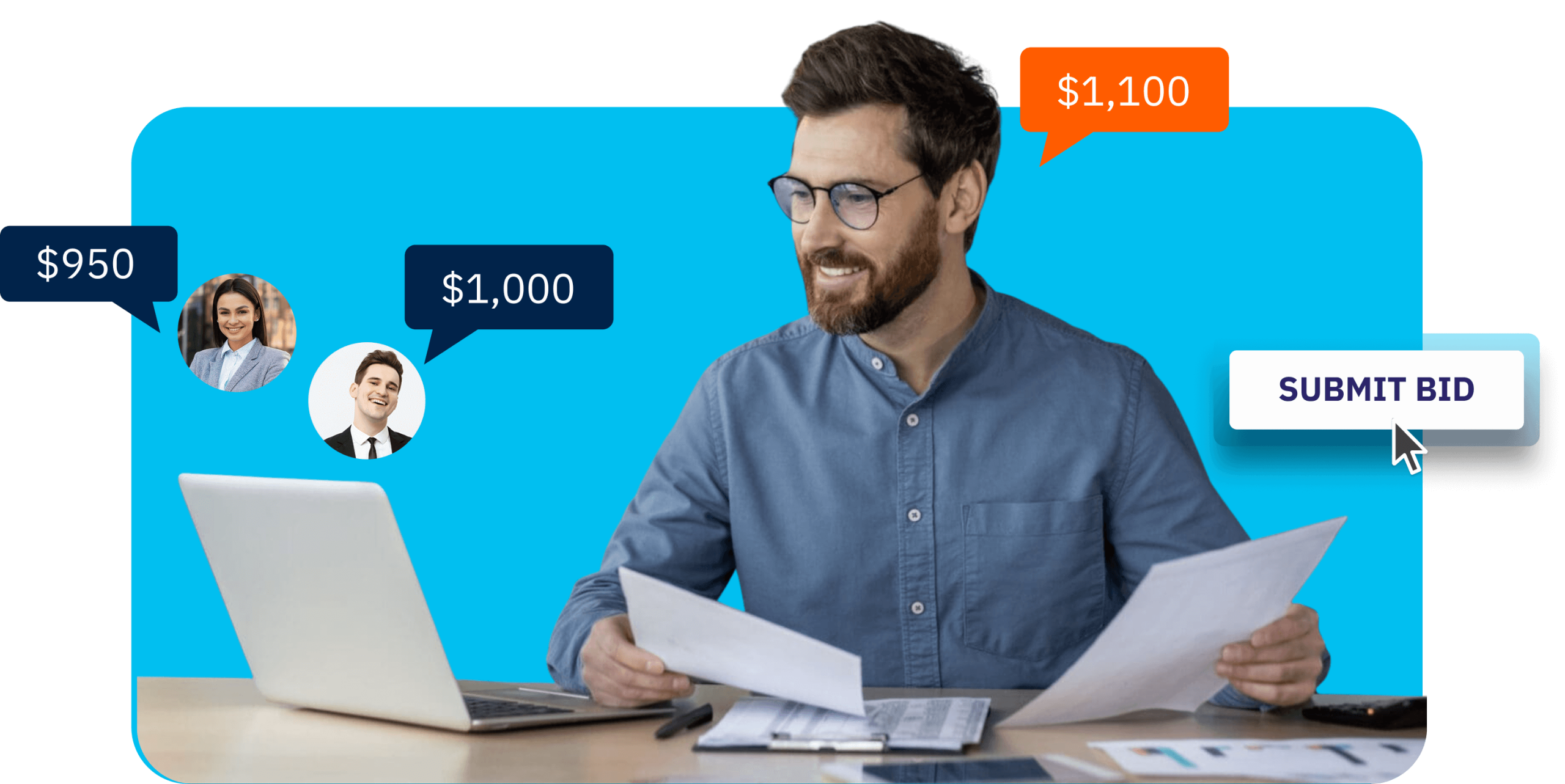
- A reverse auction in procurement is an online sourcing event where suppliers, not buyers, competitively bid prices downward to win a contract.
- In a reverse auction, a single buyer posts specifications, and the lowest acceptable bid from multiple qualified vendors secures the deal.
- By flipping traditional auction roles, a reverse auction lets the buyer drive real-time competition that uncovers the market’s rock-bottom price.
What is a Reverse Auction in Procurement?
A reverse auction is an e-sourcing mechanism in which one buyer posts its requirements and multiple qualified suppliers bid downward in real time, each trying to offer the lowest price to win the business. In essence, it flips the logic of a traditional (forward) auction. Here, it is the sellers, not the buyers, who compete against one another on price, and the contract is awarded to the lowest acceptable bid.
Because bidding is conducted on dedicated online platforms, reverse auctions create a transparent, time-boxed marketplace that can deliver rapid cost savings, broaden the supplier pool (helping smaller vendors enter the fray), and generate rich data for post-event analysis. They are especially popular in government and large-enterprise procurement for commodity-like goods and standardized services.
However, a single-minded focus on price can strain supplier relationships or risk quality shortfalls, and the format works best when several vendors can meet identical specifications. Careful pre-qualification of suppliers and clear evaluation criteria are therefore critical to balance cost, quality, and long-term value.
Process of a Reverse Auction
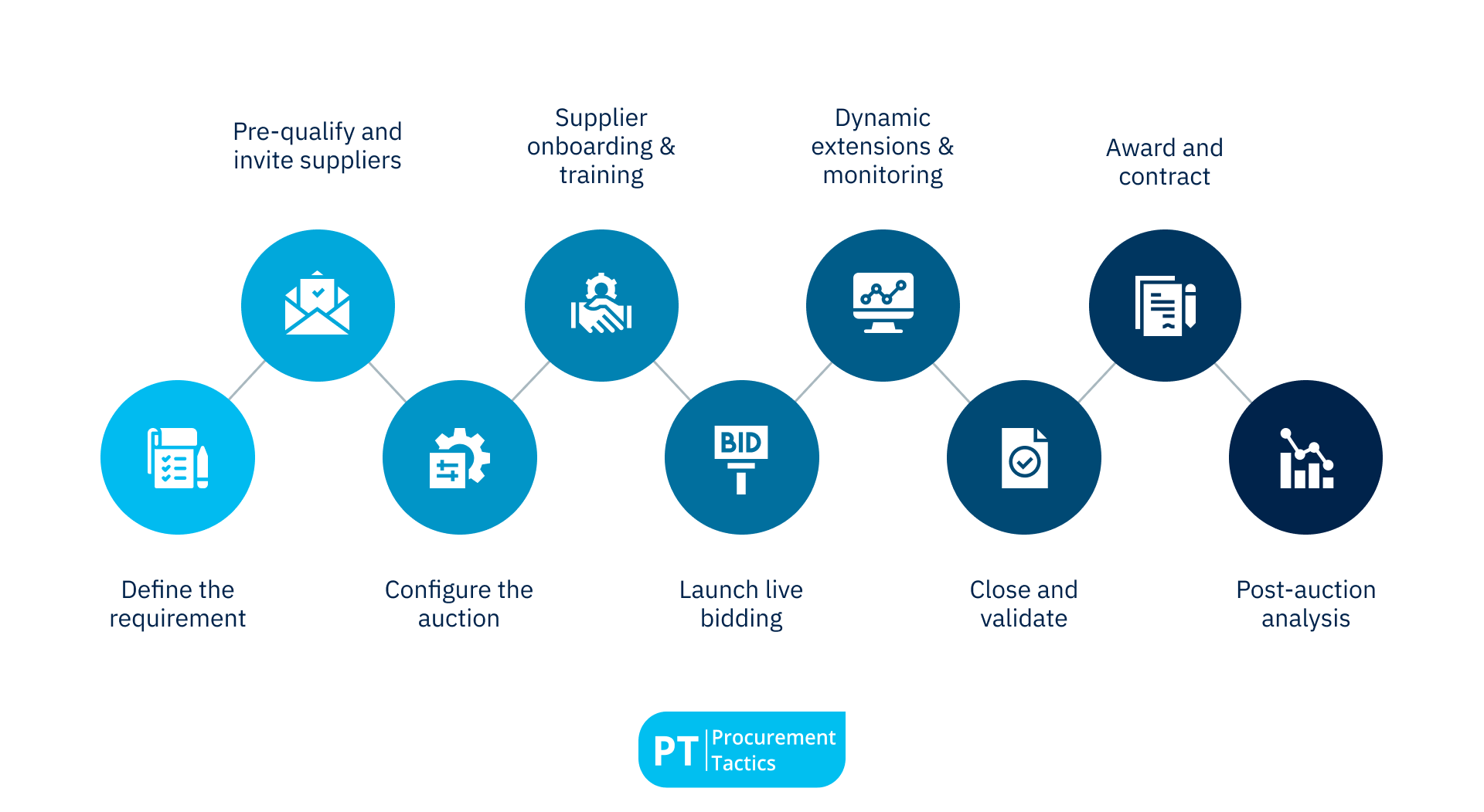
1. Define the requirement
The buyer works closely with internal stakeholders (e.g., operations, quality, logistics) to translate business needs into precise, measurable specifications.
This includes detailed product or service descriptions, exact quantities or volumes, desired quality or performance standards, acceptable tolerance ranges, delivery schedules, and payment terms.
The buyer also selects the most appropriate auction format (such as single-lot, multi-lot, or cascading), based on factors like supplier diversity, risk, and market competitiveness.
2. Pre-qualify and invite suppliers
Potential vendors are evaluated against a checklist of criteria, including financial stability, certifications (e.g., ISO, ESG), past performance, production capacity, and geographic reach.
This screening may involve issuing a request for information (RFI) or reviewing third-party audit reports.
Only those meeting minimum thresholds are formally invited, receiving a personalized invitation packet that outlines the auction timeline, technical requirements, compliance obligations, and bidding protocols to ensure transparency and fairness.
3. Configure the auction
In the chosen e-sourcing platform, the buyer configures all key parameters: setting an opening price (often the incumbent’s rate or market benchmark), determining the minimum decrement by which bids must decrease, defining lot breakdowns (if multiple items or services are grouped), and establishing precise start and end timestamps.
Soft-close rules (auto-extensions) are set to prevent “bid sniping” and ensure all participants have adequate reaction time, while any confidentiality settings (e.g., anonymized bidding) are applied.
4. Supplier onboarding & training
Invited suppliers register on the auction portal, complete profile validation, and verify that their user credentials work correctly.
The buyer’s sourcing team may host a live webinar or distribute a quick-start guide and screencast demonstrating how to navigate the interface, submit bids, monitor standings, and use built-in messaging.
A short mock auction, using test data and dummy bids, lets suppliers practice, ask questions, and troubleshoot any technical issues before the live event.
5. Launch live bidding
At the scheduled start time, the platform goes live and notifies all suppliers simultaneously. Participants submit successive bids, each one lower than the previous, with the system instantly updating the visible leaderboard (unless a sealed format is chosen).
Real-time updates encourage healthy competition while time-remaining indicators and bid-history charts help suppliers calibrate their next moves. The buyer’s team watches activity, stands by to answer procedural questions, and ensures adherence to the pre-defined rules.
6. Dynamic extensions & monitoring
To prevent “last-second” bidding tactics from unfairly closing out competitors, any bid placed within the final countdown triggers a short, predefined extension (e.g., +3 minutes). This “soft close” mechanism repeats as needed until bidding truly subsides.
Throughout the event, the buyer tracks bid patterns and can pause or suspend the auction if technical issues arise or if any supplier attempts to breach protocol (e.g., collusion signals).
7. Close and validate
Once the time expires without further extensions, the system locks bidding automatically. The auction report is generated, highlighting the lowest compliant bid for each lot.
The buyer’s team performs a rapid compliance check, verifying that the winning bid meets all technical, quality, delivery, and payment criteria, and flags any anomalies (e.g., bid outside allowable decrement).
8. Award and contract
The buyer enters direct negotiations with the provisional winner to confirm final terms: exact delivery schedules, invoicing procedures, penalties for non-performance, and any value-added commitments (warranties, after-sales support).
Once agreed, the buyer issues a formal contract or purchase order reflecting the auctioned price and conditions. Suppliers who did not win are also notified promptly, preserving goodwill and clarifying reasons for non-selection if requested.
9. Post-auction analysis
After the contract is signed, the sourcing team reviews the auction’s performance metrics: total savings achieved versus market benchmarks, bidding velocity, number of active participants, and any unusual patterns (e.g., bid jumps).
Lessons learned are documented, such as optimal lot sizes or more effective pre-qualification filters, to refine future auctions. A structured feedback loop with suppliers helps improve mutual understanding and fosters long-term relationship building.
Examples of Reverse Auction
1. United States Federal Agencies (FY 2016)
Mattress manufacturer Simmons turned to online marketplace SupplierMarket.com to source 8.5 million lb of polyethylene film used to wrap finished mattresses.
In a single three-hour reverse auction, eight pre-qualified suppliers drove the price down, immediately saving US$417,000 for the coming year.
Encouraged by both the cash and cycle-time gains, Simmons quickly extended the model to corrugated packaging, where follow-on events shaved nearly 20 % off previous costs.
The episode became an early landmark, proving that even in customised industrial materials, buyers could aggregate demand and use real-time bidding to unlock rapid savings.
2. Birmingham City Council, United Kingdom (2014-present)
Facing severe budget pressure in adult social care, Birmingham adopted SProc.Net—an e-marketplace that lets up to 100 accredited care providers bid in rapid “auction-style” windows for each care package.
Council data cited in national press reveal that the switch cut spending on care by “almost a fifth” while still allowing quality criteria (e.g., Care Quality Commission ratings) to be embedded alongside price.
The case illustrates how local governments can open previously relationship-based services to transparent market competition, though critics warn that an over-emphasis on lowest cost could jeopardise care quality if safeguards are weak.
3. Brazilian A-4 Utility-Scale Solar Auction (2019)
Brazil’s energy regulator ANEEL employed a descending-price reverse auction to award long-term power-purchase agreements for new solar capacity.
Developers first signalled interest at a benchmark tariff cap of BRL 276/MWh; successive bidding rounds pushed the price to a record-low BRL 64.99 ($ 16.9) per MWh, at the time the cheapest unsubsidised solar electricity ever contracted globally.
Only suppliers prepared to lock in that tariff level remained in play, ensuring the government secured 204 MW of capacity at world-leading economics.
The auction underscores how the Dutch-style reverse format can reveal true market-clearing prices in capital-intensive infrastructure.
Reverse Auction vs Traditional Auction
Types of Reverse Auctions
1. Open (or Open-Outcry) Reverse Auction
In the open format, every supplier sees the current lowest bid in real time and can undercut it until the clock runs out.
The full price visibility drives aggressive competition and is ideal for clearly specified, commodity-like spend where price is the dominant decision factor.
Because bids and rankings are public, the buyer gains a transparent market benchmark, but quality and margin pressures can intensify if too few vendors remain active.
2. Ranked Reverse Auction
Here, suppliers see only their rank (1st, 2nd, 3rd, etc.) rather than the actual bid values, so they know whether to improve without knowing exactly how far off they are.
The approach keeps price tension high while protecting commercial confidentiality and limiting the risk of “race-to-the-bottom” price spirals.
Buyers often favour this style for strategically important categories where they want competitive pricing but still need room to weigh non-price factors before award.
3. Dutch Reverse Auction
The buyer (or platform) starts the event at a relatively high benchmark price and systematically reduces it at fixed intervals until one supplier accepts the offer.
This “first-to-click” dynamic rewards quick decision-making and can close an event in minutes, making it popular for spot buys and time-sensitive orders.
The flip side is that only one fast-acting vendor may engage, so the buyer should pre-qualify enough suppliers and set a sensible floor price to avoid overpayment or non-award.
4. Japanese Reverse Auction
All invited suppliers must accept an initial start price. The platform then lowers the price in pre-set steps at regular intervals, and any supplier that cannot meet the new level drops out.
The process continues until only one supplier remains or the minimum threshold is reached, creating a clear, orderly descent that eliminates “sniping” and encourages thoughtful internal approvals before each decrement.
It works best when several vendors can comfortably meet the specification and are prepared to stay engaged through multiple rounds.
Advantages of Reverse Auction
Disadvantages of Reverse Auction
Conclusion
Reverse auctions flip the dynamics of a traditional auction: one buyer publishes a clearly defined need, multiple suppliers submit successively lower bids in real time, and the contract goes to the lowest acceptable offer. Because events run on dedicated e-sourcing platforms, they deliver fast, transparent price discovery, widen the supplier pool, and generate robust spend analytics. Buyers most often deploy them for commodity-like goods or standardized services where several vendors can meet identical specifications, and case studies (from U.S. federal agencies to Brazil’s solar-energy procurements) show double-digit cost savings and compressed cycle times.
Yet the very features that create those savings can also become pitfalls if not managed carefully. A narrow focus on price may undermine quality, strain supplier relationships, and prove ineffective when only a few qualified vendors exist or when requirements are complex and tailor-made. Platform fees, onboarding effort, and the risk of bid collusion add further caveats. The practical takeaway is clear: reverse auctions are a powerful, data-rich tool in the sourcing arsenal when applied to the right categories with rigorous pre-qualification and balanced evaluation criteria; used indiscriminately, they can erode long-term value and supplier goodwill.
Frequentlyasked questions
What is a reverse auction?
A reverse auction is an online sourcing event where suppliers, not buyers, competitively bid prices downward to win a contract.
What is the one main advantage of a reverse auction?
The chief advantage of reverse auctions is the swift, often double-digit cost reduction it delivers by driving suppliers to bid prices down in real time.
What is the one main disadvantage of a reverse auction?
The chief disadvantage of reverse auctions is that a laser focus on the lowest bid can erode quality and strain long-term supplier relationships.
About the author
My name is Marijn Overvest, I’m the founder of Procurement Tactics. I have a deep passion for procurement, and I’ve upskilled over 200 procurement teams from all over the world. When I’m not working, I love running and cycling.