


Written by Marijn Overvest | Reviewed by Sjoerd Goedhart | Fact Checked by Ruud Emonds | Our editorial policy
Selecting the Right E-auction Platform

As taught in the E-Auction Course for Procurement Professionals / ★★★★★ 4.9 rating
- To select the right e-auction, you must focus on your near-term needs, such as auction formats, supplier onboarding, and reporting requirements.
- To select the right e-auction, you must evaluate platforms objectively by scoring them from 1 to 5 using clear evidence like screenshots, sample exports, or pilot results.
- To select the right e-auction, you must run a short pilot to test event build speed, supplier registration success, export quality, and key integrations, and choose the platform that minimizes coordination effort while ensuring clean data and strong governance.
Why Selecting an E‑Auction Platform is Actually a Negotiation
Selecting an e-auction platform is essentially a negotiation. There’s no universal best tool, the right choice depends on your needs. SAP Ariba works well for SAP-driven, global, and complex sourcing. Coupa is strong for fast deployment and analytics. Jaggaer supports flexible, multi-lot events. GEP SMART offers an integrated, data-driven suite. Mercell is ideal for compliance-heavy public-sector tenders. If your company already uses a mandated platform, you can skip selection or review this as guidance.
Treat the selection like a short sourcing sprint. Focus only on what you need in the next 90 days, such as onboarding speed, event setup, or compliance reporting. Answer practical questions about formats, usability, reporting, integrations, security, and budget. Then score platforms from 1–5 based on evidence such as screenshots or pilot results.
Finally, validate vendor claims with a simple checklist: required auction formats; fast event creation; easy supplier onboarding; clean reporting and exports; existing integrations; strong governance and security; and transparent pricing.
Overview of the 5 Leading Platforms For E-Auction

1. SAP Ariba
SAP Ariba is a mature platform built around a large global supplier network, deep SAP ERP integration, and advanced analytics/AI. It supports multiple auction types, including reverse, combinatorial, and multi‑round events. Ariba is best suited to large enterprises already operating on SAP, managing complex global sourcing, and prioritizing supplier collaboration and long‑term strategic sourcing.

2. Coupa
Coupa stands out for its user‑friendly interface and quick adoption, combining flexible auction formats with AI‑driven spend analytics and real‑time dashboards. It’s a strong fit for medium to large companies that want fast deployment, strong visibility into spend, and easy‑to‑use sourcing tools that minimize training and change‑management overhead.

3. Jaggaer
Jaggaer offers high flexibility and scalability with robust supplier management and support for complex scenarios such as combinatorial and multi‑round auctions. It’s particularly well-suited to education, government, and manufacturing organizations with multi‑lot or complex procurement needs, and to teams that require strong evaluation workflows and contract management.

4. GEP SMART
GEP SMART is a unified, cloud‑based sourcing suite with an intuitive design that integrates supplier and contract management alongside advanced analytics and reporting. It’s a strong choice for large global enterprises seeking an all‑in‑one platform with powerful analytics to support strategic, data‑driven procurement.
5. Mercell
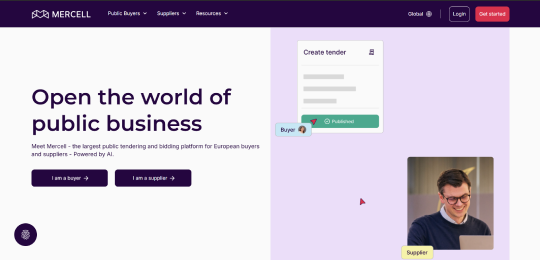
Mercell focuses on electronic tendering for both private and public sectors, combining transparency with a user‑friendly interface. It supports multi‑lot and multi‑round auctions and excels in compliance and regulatory reporting. Mercell is an excellent option for European companies and public‑sector organizations operating in regulated markets where transparency and compliance are critical.
Preparation Notes and Criteria: What You Really Need
Treat platform selection like a negotiation and start by making the implicit explicit. Write down the answers to the following questions before choosing a platform.
Translate these notes into a simple, evidence‑based comparison.
Before you commit, test the platform in practice. Check that the auction formats you need run smoothly and support soft-close extensions. Confirm you can build events quickly with templates, cloning, batch uploads, decrements, and reserve prices. Ensure supplier onboarding is easy with a mock event, multilingual guidance, and a responsive helpdesk.
Verify exports are clean, bid logs, savings, and CSV/API feeds that flow into Excel or BI without manual cleanup. Make sure it integrates with your IT today via SSO and can push awards into ERP/P2P. Look for built-in governance: ISO‑aligned security, full audit trails, approvals, and guardrails. And require transparent pricing with no hidden supplier fees and strong SLAs.
By writing down needs, scoring with evidence, and testing end‑to‑end, you create a structured and defensible choice: a platform that lowers coordination costs, lifts data quality, and embeds governance, so events are cleaner, participation is higher, and decisions are easier to trust.
Validation in Practice: Pilot and Checklist
Validation ensures that an e-auction platform works effectively in real sourcing situations. The goal is to test how the tool performs in practice, how well it supports key processes, and whether it meets the required performance standards. A structured pilot with clear criteria provides evidence for an objective and confident platform decision.
1. Plan the validation
Choose one or two real use cases you expect to source in the next 90 days. Define a simple pilot objective such as faster event setup, better supplier participation, or cleaner reporting.
Set measurable success criteria in advance: event setup time (target ≤ 60 minutes), supplier self-registration success (≥ 90%), support for required formats, and clean exports that can go directly into Excel or BI tools.
Keep the pilot short (2 to 4 weeks) and assign clear roles (category owner, operational lead, IT for integrations, and a vendor support contact).
2. Test event creation and supplier onboarding
Check how quickly and easily events can be built using templates, cloning, batch uploads, decrement rules, and reserve prices. Make sure approvals are simple and auction rules are communicated clearly.
In parallel, simulate supplier onboarding with a mock event: invite a small group of suppliers, confirm that invites land in their inbox, see how quickly they register and place a first bid, and track any helpdesk issues.
3. Check data, integrations, and governance
After the pilot, export key data, bid logs, ranking history, savings, award information, and make sure everything imports cleanly into Excel or Power BI.
Verify integrations that matter today: stable SSO and award sync to ERP/P2P within 24 hours. Confirm governance features such as a complete audit trail, sensible approval flows, guardrails, and certifications like ISO 27001.
4. Review commercial details and decide objectively
Ask for transparent pricing, clear SLAs, and a concrete training plan. Compare pilot results with your initial criteria.
If the tool meets the targets and gaps are small and fixable, it passes. If not, note the gaps and move on; don’t let sunk-cost bias influence the decision.
5. Document the results
Prepare a short pilot report with screenshots, export samples, mock-event notes, and before/after KPIs. Together with the checklist, this makes your decision consistent, defendable, and repeatable.
The purpose of validation is not to chase features, but to confirm that the platform truly reduces effort, improves data quality, and supports better decisions in your environment.
Real‑world Example of E-Auction
Unison Marketplace (formerly FedBid) helped U.S. federal buyers run reverse auctions, delivering approximately 10% annual savings on over $ 500 million (2006–2010), utilizing ranked but anonymous feedback and a performance-based fee model that reinforced participation, compliance, and trust. Platform choice isn’t about feature length; it’s about incentives, trust, and transaction costs.
The right tool lowers supplier friction, improves data quality, and hardwires governance; a poor fit does the opposite. Don’t guess, test, so you end up with a platform that suppliers will use, your team can run confidently, and your organization can trust. We’ll turn capability into a design for an effective e‑auction.
Conclusion
Selecting an e‑auction platform should be run as a structured mini sourcing project: clearly define near‑term needs, document criteria, gather evidence through a pilot (build speed, onboarding, exports, integrations), score objectively, and choose the solution that lowers coordination costs, improves data quality, and embeds governance, rather than relying on untested feature lists.
Frequentlyasked questions
How do we validate a platform quickly?
Run a 2–4 week pilot with real categories and measure build time, supplier self‑registration rate, and export/report quality.
What is most critical for a successful supplier onboarding?
Frictionless registration, clear auction rules, a mock event path, and responsive multilingual support.
How do we know the platform is ready to scale?
If the pilot shows fast event setup, ≥90% self‑registration success, clean automated exports, and stable SSO/ERP integrations, it is scale‑ready.
About the author
My name is Marijn Overvest, I’m the founder of Procurement Tactics. I have a deep passion for procurement, and I’ve upskilled over 200 procurement teams from all over the world. When I’m not working, I love running and cycling.