


Written by Marijn Overvest | Reviewed by Sjoerd Goedhart | Fact Checked by Ruud Emonds | Our editorial policy
Stakeholder Feedback — Tips to Make Effective Feedback

As taught in the Internal Stakeholder Management Course / ★★★★★ 4.9 rating
- Effective feedback in stakeholder management is specific to observable behaviors and outcomes, so expectations are clear and alignment is maintained.
- Effective feedback is actionable and objective, linking suggested improvements to shared goals without personal judgment.
- Effective feedback is timely, honest, and respectful, building trust and accountability while preventing small issues from escalating.
Why Feedback Matters with Internal Stakeholders
After active listening, the next step is giving and receiving feedback. Done right, feedback helps teams improve, prevents repeated mistakes, and reinforces alignment across departments, keeping people engaged, accountable, and supported. Though often called a “gift,” it can feel otherwise when comments are vague, last‑minute, or unclear, so knowing how to deliver and receive feedback the right way is crucial for procurement professionals managing internal stakeholders.
In procurement, professionals often work across departments without formal authority, so feedback becomes a key tool for influencing outcomes and steering collaboration toward shared goals. It clarifies expectations, builds trust through honest and respectful dialogue, and fosters accountability and learning so small issues don’t escalate into major problems. Above all, it’s not about criticizing, it’s about co‑creating better ways of working and maintaining alignment across teams.
The “Feedback Sandwich” Structure
The “feedback sandwich” is a simple structure for delivering feedback that reduces defensive reactions and frames the conversation as supportive rather than judgmental. It begins with a positive observation that acknowledges something that went well or showed good intent, setting a constructive tone.
Then it moves to a specific suggestion for improvement focused on behavior or outcome, not the person. It closes with encouragement that reinforces belief in the individual’s potential and a willingness to support growth.
This format matters because vague feedback, eleventh-hour critiques, and fuzzy asks drain momentum, especially across teams where formal authority is limited. The sandwich approach blends recognition, a precise improvement, and reinforcement so people stay engaged, accountable, and supported. It sharpens expectations, builds trust through respectful delivery, and prevents small issues from snowballing. Used well, it is not about criticizing, it is about co-creating better ways of working.
The 5 Principles of Effective Feedback
Based on leadership development research, these five principles make feedback clear, useful, and easier to act on.
1. Be specific
Vague feedback doesn’t help people improve; describe exactly what worked or what didn’t.
Examples: “In the presentation to the finance team, the cost breakdown slide was especially helpful. It made the savings potential clear and supported the business case.” “In yesterday’s stakeholder meeting, the KPI slide included old data. That led to confusion and delayed the decision-making.”
2. Make it actionable
Good feedback should help the person know what to do next.
Example: “For the next supplier meeting, try reviewing the contract terms in advance so you’re ready to address specific questions during the call.”
3. Stay objective
Focus on what happened, not on assumptions or personality traits.
Example: “In the meeting, a few important deadlines were missed in your update. That created confusion for the team about next steps.”
4. Be honest
Don’t avoid difficult feedback; deliver it respectfully.
Example: “I want to give you honest feedback because I know you’re working hard on this project. One area for improvement is the communication of updates to stakeholders. Some of them have said they feel out of the loop.”
5. Establish objectives
Before you give feedback, know what you want to achieve.
Example: “I’d like to give you some feedback so we can improve how we collaborate with Legal. The goal is to speed up reviews and reduce back-and-forth in future contracts.”
Asking for Feedback the Right Way
Below are the things to avoid when asking for feedback. Steering clear of these pitfalls will help you get more specific, actionable responses.
1. What’s your feedback on the project?
This question is too vague and unfocused, so the recipient may not know whether you mean timelines, results, communication, or team dynamics. It often produces a generic answer or no answer at all. Avoid using it because it does not guide the other person toward a specific, useful reflection.
Example: From the last sprint, name one area that needs the most improvement, such as timelines, communication, or scope, and one change we will make next week.
2. What areas of our KPI review sessions are working well for you?
This invites specific reflection and acknowledges that some elements are already effective. It helps surface what should be preserved or amplified. Use it during ongoing performance or KPI alignment to reinforce what supports shared goals.
Example: Choose the one element that helps you most, trend highlights, exception alerts, or the owner and due date list, and tell me what we should keep exactly as it is.
3. What could we improve in how project updates are shared during meetings?
This targets a single behavior (the update process) without sounding critical. It opens space for actionable suggestions about format, timing, or clarity. Use it when you want to refine how information flows in regular stakeholder touchpoints.
Example: Would a three-slide RAG format with status, risks and decisions, and actions with owners make updates clearer? If not, suggest one specific change.
4. What’s unclear or ineffective in our communication about supplier specifications?
This shows openness to improvement and care for clarity, reducing later misunderstandings. It draws attention to gaps in detail, structure, or terminology that may slow decisions. Use it when aligning cross‑functional teams around requirements.
Example: Point to a line where tolerances or test methods are ambiguous and propose the exact wording that would remove the ambiguity.
5. What does good look like for you?
Asked at the start of a collaboration, it establishes shared expectations early. It creates a baseline for later progress reviews and helps prevent misalignment on quality or success criteria. Use it to co‑create a reference point before execution accelerates.
Example: By March 31, state one KPI target, one quality bar, and one sentence you would want to hear from a key stakeholder as proof of success.
Receiving Feedback: Techniques, Reflection Template, and Checklist
Receiving feedback with openness and curiosity is the other half of effective improvement. Instead of reacting immediately, let the input sink in so emotion does not override comprehension.
Ask for clarification with prompts like “Could you give an example?” or “What would you have expected instead?” Say thank you; even critical feedback requires effort and trust from the giver. Reflect afterward; you do not have to agree with everything, but most of it becomes useful when examined with an open mind.
Build this into the rhythm of your work: pause to consider whether you only address feedback when problems arise or whether it’s naturally embedded in meetings and check‑ins. Invite input on your own behavior and working style, not just on deliverables.
Simple questions to colleagues, such as “How do you experience feedback in our team?” and “Is it timely, specific, and constructive?” help surface patterns. A healthy feedback culture starts with these small conversations rather than large procedural changes.
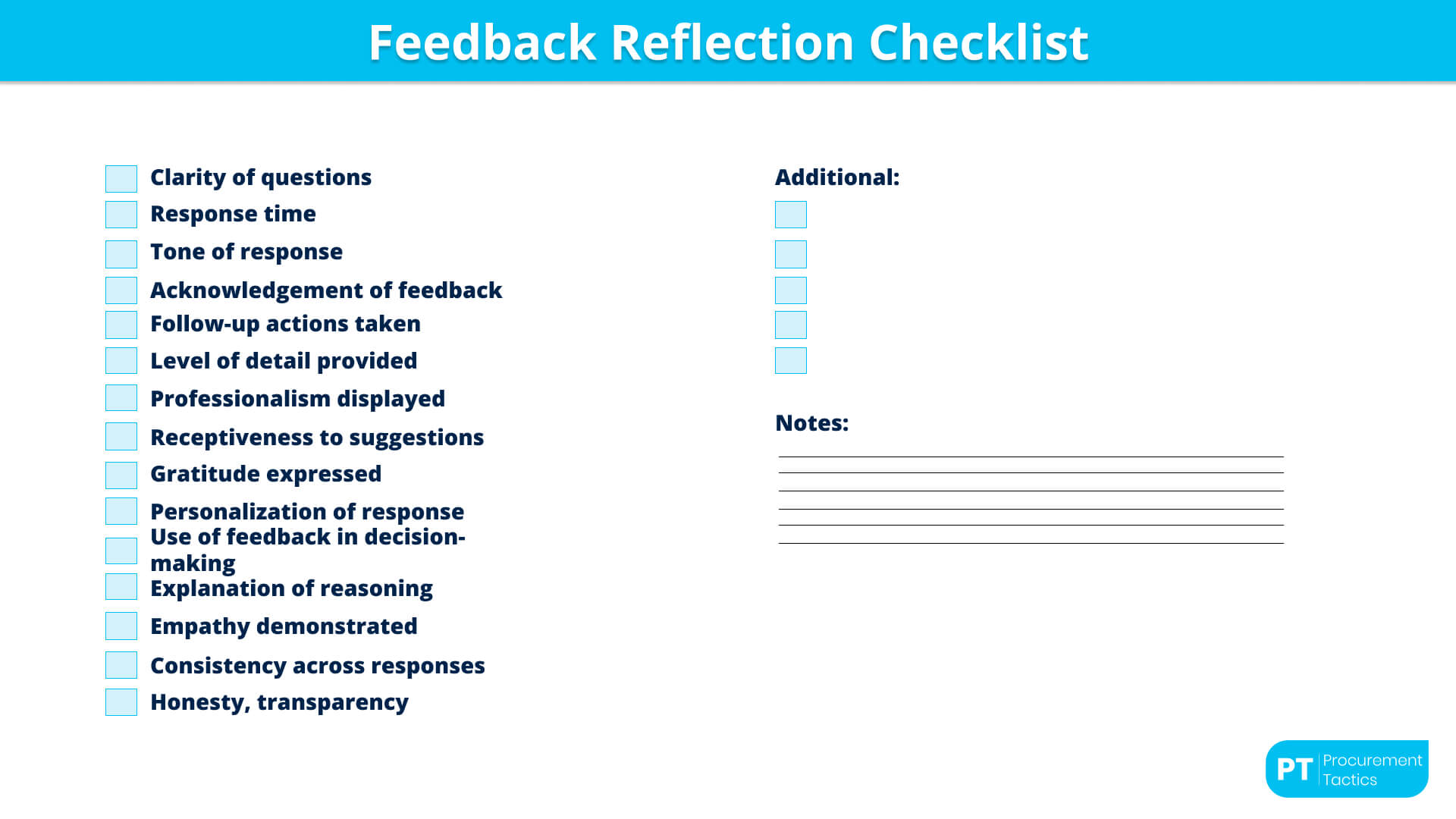
The Feedback Reflection Template supports preparation for sensitive or important conversations. Use it to jot down concise notes before engaging:
Alongside the template, a checklist helps assess the quality of feedback you give, receive, or observe.
Conclusion
Feedback isn’t about being right; it’s about being helpful. Done well, it clarifies expectations, builds trust, and fosters accountability and learning so small issues don’t escalate.
For procurement teams working across departments without formal authority, feedback is a practical tool to influence outcomes and co‑create better ways of working.
By keeping it specific, actionable, objective, and honest, anchored to clear objectives, you turn conversations into continuous improvement.
Frequentlyasked questions
How do I give feedback without authority?
Anchor on shared goals, be specific and neutral, and offer support resources, credibility replaces hierarchy.
What if the stakeholder is defensive?
Pause, restate intent (“Goal is to make approvals faster”), focus on observable facts, invite their perspective, and narrow scope to one change.
How often should I give feedback?
Continuously in micro-doses: brief adjustments weekly + structured review at key milestones. Avoid only crisis-driven responses.
About the author
My name is Marijn Overvest, I’m the founder of Procurement Tactics. I have a deep passion for procurement, and I’ve upskilled over 200 procurement teams from all over the world. When I’m not working, I love running and cycling.