


Written by Marijn Overvest | Reviewed by Sjoerd Goedhart | Fact Checked by Ruud Emonds | Our editorial policy
Sustainable Supply Chain Analysis — Embracing Sustainability
Sustainable supply chain analysis involves evaluating how sustainable your suppliers and your processes that both pertain to how transparent your supply chain is. However, how do you do it?
In this article, we will discuss what a sustainable supply chain is. We will also tell you how you can analyze your supply chain and how you do an initial risk assessment.
Once you are done reading this article, you will have a deeper understanding of sustainable supply chains. Additionally, you will know how to analyze your supply chain activities, especially sustainable procurement for you to achieve sustainability.
Sustainability in the Supply Chain
Nowadays, many multinational companies pledge to work only with suppliers that follow environmental and social standards. Thus, sustainability is now being integrated into many industries around the world.
Sustainability in the supply chain is defined as the efforts of companies to take into consideration the environmental and social impact of their products through the supply chain.
From sustainable sourcing, production, storage, and delivery, it monitors if these processes may cause harm to the environment and society.
The sustainable supply chain aims to decrease environmental harm from factors like energy usage, water consumption, and waste production. It also aims to have a positive impact on the environment and communities around its operations, especially procurement activities.
Furthermore, A sustainable supply chain is one that fully adopts ethical and environmentally responsible practices into a competitive and successful model.
Importance of Sustainable Supply Chain
The nature of the supply chain involves energy-intensive production and transportation as goods are made and moved around the world. Thus, companies can make a difference by adopting sustainability in their supply chain.
The complex system of the supply chain can hinder visibility into crucial operational considerations such as the distance of a supplier’s factory and labor conditions.
Adopting sustainability in the supply chain is the key not just taking responsibility to protect the environment but also improving productivity and optimizing cost.
CERTIFICATE COURSES
Related courses about this subject

1. Negotiation Course
Learn from industry experts who negotiated billion $ deals

2. Procurement Strategy Course
Take the lead with our proven 5-step procurement strategy

3. Sustainable Procurement Course
Maintain high profitability while moving toward sustainability
How to Adopt Sustainability in Supply Chain?
1. Tracking sustainability metrics
By tracking sustainability metrics in your supply chain, you can monitor different areas of your operation that encourage environmental and social responsibility among suppliers.
Also, companies can use artificial intelligence and pre-defined rules to ensure that their products are not shipped out unnecessarily.
2. Identify sustainable issues
For you to build a robust supply chain, you must identify sustainable issues in your supply chain.
By doing this, you can first try to break down the supply chain into various segments and check if there are processes that need improvement. You can focus on slowly adopting a circular supply chain where the raw materials are recycled back into the production process.
3. Managing sustainable procurement
Managing sustainable procurement is an important factor in adopting sustainability in your supply chain.

Adopting sustainability in your procurement model will help you to understand day-to-day involvement with your suppliers. Thus, companies must be aware of sustainable procurement tools to fully adopt sustainability in procurement.
Sustainable Supply Chain Analysis
Supply chain transparency leads to the optimization of processes in the chain and thus has a positive influence on the value for customers and the competitive strength of an organization.
However, to start with, you must first analyze your supply chain by starting to create an inventory of products and services you purchase, produce, and sell.
For each item, you must determine where it is manufactured and which suppliers you utilize. If you produce and sell products, you must identify the chain that follows your organization.
Furthermore, for composite products, you must identify the most important raw materials or semi-finished products and their origin. If possible, determine how and by whom the products will be transported.
Initial Risk Assessment of Sustainability in Supply Chain
For you to identify sustainability issues associated with each part of the supply chain, you must solicit advice from stakeholders across various functions as well as from external sources.
Thus, your initial risks assessment must include answers to these questions:
- What and where are you sourcing?
- What are your key products and services? What do you generally know about the potential risks and impacts of your products and services in the environment?
- Is your company sourcing directly or through third parties? How many third parties are involved in your sourcing activities?
- In which sectors or countries, directly linked with the company’s operations, are the main risks of adverse impact on people, environment, or governance most present? For example, are there any geopolitical issues?
- What is the company’s visibility beyond direct suppliers? How can it be improved?
By identifying and answering these questions, you can determine the risks you can face in the entirety of your supply chain. Thus, you will know how to mitigate or reduce the impacts of these risks and lessen the chance of disruptions in your supply chain.
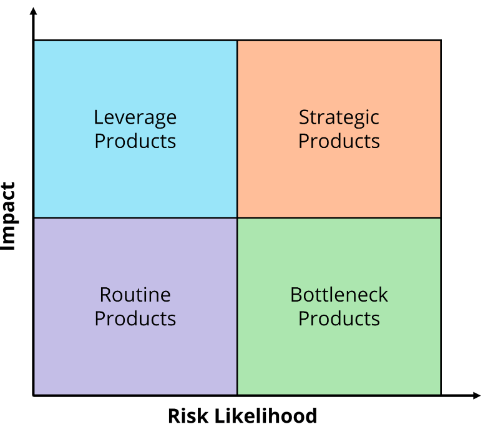
It is important to classify all your purchases into four main categories. These are leverage, strategic, routine, and bottleneck purchases.
As you can see in the picture above, there are two words outside the arrows which are impact and risk likelihood.
The impact is the volume of purchase, the percentage of total purchase cost, the impact on product quality or the growth of the company, impact on people & environment.
On the other hand, the risk likelihood is about the availability of products, the number of suppliers or the competitiveness of the demand, risk due to climate change or changing regulations, violations of human rights like slavery in cocoa bean plantations, etc.
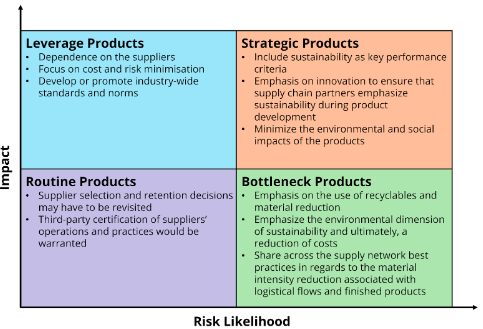
The impact is the volume of purchase, the percentage of total purchase cost, the impact on product quality or the growth of the company, impact on people & environment.
On the other hand, the risk likelihood is about the availability of products, the number of suppliers or the competitiveness of the demand, risk due to climate change or changing regulations, violations of human rights like slavery in cocoa bean plantations, etc.
Do you want to learn more about how you can assess your supply chain, especially your procurement activities in achieving sustainability? Then look no further. Our Sustainable Procurement Course will help you to analyze the possible risks in your supply chain. Additionally, our course will teach you how you can categorize all your purchases that can greatly affect your supply chain. So what are you waiting for, enroll now!
Frequentlyasked questions
+ What is sustainability in the supply chain?
It is defined as the efforts of companies to take into consideration the environmental and social impact of their products through the supply chain.
+ Why is it important?
Adopting sustainability in the supply chain is the key not just taking responsibility to protect the environment but also improving productivity and optimizing cost.
+ What is sustainable supply chain analysis?
It is the process of assessing sustainability in every stage of the supply chain starting from the procurement of raw materials to the delivery of products to the customers.
Negotiation Course For Procurement Professionals
You'll get a certificate after completing the course
Rated 9.2/10 ★★★★★