


Written by Marijn Overvest | Reviewed by Sjoerd Goedhart | Fact Checked by Ruud Emonds | Our editorial policy
Claude for RFPs: How Procurement Teams Write RFPs 10× Faster
As taught in the Claude Cowork For Procurement Course / ★★★★★ 4.9 rating
Table of contents
- Why RFP Work is the #1 Place Procurement Wants AI
- The Three Prompts, Different Documents, Different Structures
- Why the Evaluation Framework is the Most Valuable Part of the Output
- Using Claude to Evaluate Supplier Responses
- What the RFP Workflow Does Not Replace
- From One RFP to a Repeatable Capability
- Conclusion
- Frequently asked questions
- RFP, RFI, and RFQ drafting is among the most time-consuming pieces of procurement work, and among the most standardisable. Claude compresses drafting from days to hours.
- Three distinct prompts cover the three document types: RFP for strategic sourcing with multi-dimensional evaluation, RFI for market scanning before commitment, and RFQ for straightforward price comparison.
- The critical output from the RFP workflow is not the draft itself. It is the evaluation framework that goes with it, without which, the procurement team scores supplier responses inconsistently.
Why RFP Work is the #1 Place Procurement Wants AI
In open-response fields of Procurement Tactics' 2026 AI Readiness in Procurement survey, the single most common answer to "if you could deploy AI in procurement without any constraints, where would you start?" is some version of RFx work. RFQs. RFPs. Tender documents. Supplier response evaluation. The instinct is right.
RFP drafting is repetitive but detail-heavy. The same categories of requirements appear in most RFPs, technical capability, commercial terms, delivery approach, references, and compliance, but the specific content varies. The procurement professional writing an RFP for a new packaging supplier cannot just copy the last packaging RFP; the specific requirements, volumes, and evaluation weights differ. The result is hours of work per RFP, much of it structurally similar to the last one.
Claude compresses the structural work without removing the judgment. The procurement professional still decides which requirements matter, which weights apply, and which evaluation dimensions the category demands. Claude handles the drafting work that follows from those decisions. The result is an RFP produced in a few hours of focused work rather than across multiple days of on-and-off attention.
The same compression applies to RFI and RFQ work. Different document types, different prompts, but the same time-to-output gain.
The Three Prompts, Different Documents, Different Structures
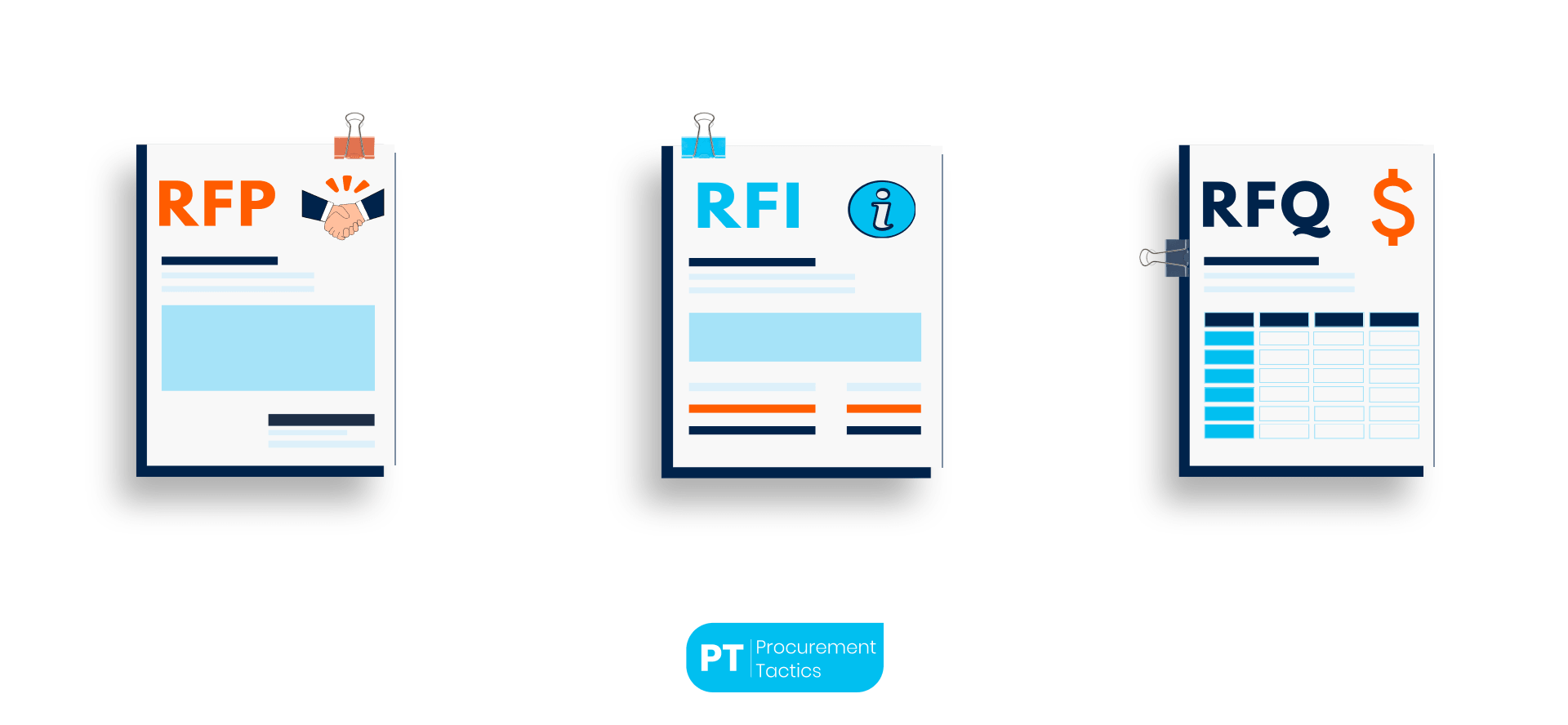
RFP, RFI, and RFQ are not interchangeable. Each has a different purpose, a different structure, and a different set of evaluation criteria.
The RFP Prompt
An RFP is a formal sourcing document for strategic procurement. It produces supplier responses on multiple dimensions, technical capability, commercial terms, delivery approach, service levels, references, and compliance. The evaluation is multi-dimensional; no single metric determines the award.
The Claude prompt for an RFP draft has five components. First, the category context, what is being sourced, what business need it serves, the volume, and the spend profile. Second, the evaluation framework, the dimensions that will determine the award, and the weight on each. Third, the minimum requirements, what suppliers must meet to be considered. Fourth, the response structure, the format responses should follow, which makes comparison possible. Fifth, the timeline, when responses are due, when the award decision will be made, and when the contract starts.
Claude produces a draft RFP of typically 15 to 25 pages covering all standard sections. The procurement professional edits for specificity, adding the organisation-specific requirements, adjusting the evaluation weights, confirming the commercial terms, and finalises. The draft-to-final ratio is usually around 70% direct use, 30% adjustment.
The RFI Prompt
An RFI is an information-gathering document, used before committing to a procurement process, to understand the market, the capable suppliers, and the approximate cost range. The output is narrower than an RFP: not a full commercial response, but structured information about supplier capability, reference customers, approximate pricing, and approach.
The Claude prompt for an RFI is shorter than the RFP prompt. Category context. Specific questions the procurement team needs answered, typically five to ten questions, not thirty. Response format, short, structured, comparable across suppliers. Timeline is usually shorter than an RFP, because the depth of response required is less.

Claude produces an RFI of typically 3 to 5 pages. The editing ratio is usually even higher, 80% direct use, because the simpler structure has less organisational variation.
The RFQ Prompt
An RFQ is a price request against a defined specification. The supplier responds with price, delivery terms, and confirmation of specification compliance. Evaluation is primarily on price, with minor adjustments for delivery and terms. The document is typically short, 2 to 4 pages, but the specification it references can be extensive.
The Claude prompt for an RFQ focuses on two things: the specification to be priced (which usually exists already and gets referenced rather than rewritten), and the commercial terms the procurement organisation requires (payment, delivery, warranty, termination). The output is a short document supplier can price against quickly.
Why the Evaluation Framework is the Most Valuable Part of the Output
A well-drafted RFP is useful. An RFP paired with a clear evaluation framework is what turns sourcing from an exercise into a commercial decision process.
The evaluation framework specifies, before supplier responses arrive, exactly how the procurement team will score them. For each evaluation dimension, the framework gives: the weight (as a percentage of the total score), the specific criteria that determine the score, the score range, and examples of what a high-score vs low-score response looks like.
Without this framework, scoring is applied inconsistently across suppliers. One evaluator weighs technical capability heavily; another weighs commercial terms. One evaluator scores a mid-range response as a 7; another scores it as a 5. The final ranking depends on who evaluated first and who evaluated last. Procurement defensibility, the ability to show the award decision was fair and consistent, requires a framework applied uniformly.
Claude produces the evaluation framework as a separate output alongside the RFP draft. The framework typically covers four to six evaluation dimensions with weights summing to 100%, each with its scoring criteria specified. The procurement team reviews and adjusts the framework, then uses it to score every supplier response.
Procurement Tactics' methodology on supplier relationship management and strategic sourcing, which the AI Fundamentals for Procurement Teams program teaches in structured form, treats the evaluation framework as the foundational commercial decision, not the RFP document itself. The Claude workflow reflects this framing: the framework is the output that changes decisions; the RFP is the output that enables supplier participation.
From the field

At an international sports federation (30-minute consultation call, March 2026)
Using Claude to Evaluate Supplier Responses
When supplier responses arrive, Claude handles the first-pass scoring as a separate step from the drafting. The workflow: the evaluation framework, each supplier's response, and the Claude prompt to score the response against the framework dimension by dimension.
The output is a scorecard per supplier, with dimension-level scores, brief commentary justifying each score, and flags for any responses where specific required information is missing or unclear. The procurement team reviews the scorecards before the evaluation meeting; the meeting then focuses on the judgment calls, where Claude's scoring feels low or high, where the commentary surfaces something worth deeper discussion, and where supplier responses reveal something the framework did not anticipate.
The consistency gain is significant. The five suppliers responding to the same RFP get scored against the same framework in the same way. Differences between suppliers reflect actual response quality, not evaluator preference. This matters for defensibility, particularly in regulated sectors or public procurement contexts, and it matters for the quality of the final decision.
In my experience running this workflow across procurement teams, the evaluation meeting with AI-prepared scorecards takes roughly 40% of the time of the equivalent meeting with manual scoring. The time-saving matters, but the consistency matters more. The meeting focuses on the decision rather than on reconciling different evaluators' interpretations of the framework.
What the RFP Workflow Does Not Replace
Three boundaries worth naming.
Claude does not replace the sourcing strategy. Deciding whether to run an RFP at all, what to source, how to structure the sourcing wave, and what the award criteria should prioritize, these are strategic procurement decisions that sit with the procurement professional. Claude produces the execution artefacts; the strategy is upstream of Claude.
Claude does not replace supplier market knowledge. Understanding which suppliers are likely to respond, which are likely to win on price, which have the capability to deliver, and which are strategically worth developing these come from the procurement professional's experience in the category. Claude can produce a generic RFP targeted at a generic supply base; a good RFP is targeted at a specific supply base that the procurement team understands.
Claude does not replace the commercial conversation after the RFP closes. Best and final offer discussions, clarification rounds, negotiation on specific terms, these are human conversations. Claude can prepare briefing documents and draft negotiation positions, but the conversations themselves are where the commercial value is realised, and those stay with the procurement team.
From One RFP to a Repeatable Capability
The highest-value version of this workflow is not a single RFP. It is a repeatable one, every sourcing event in the procurement portfolio runs through the same AI-assisted framework, producing consistent documents, consistent evaluation frameworks, and consistent scoring.
Procurement teams building this as a capability across the function typically do three things.
They build a Claude Project per category. The Project accumulates the category's sourcing history, previous RFPs, previous evaluation frameworks, and previous supplier response patterns. The second RFP in a category is sharper than the first because the Project knows what happened previously.
They maintain a template library. The organisation's standard RFP template, standard evaluation framework structure, and standard commercial terms are all kept in a shared location and referenced in Claude prompts. This ensures consistency across RFPs produced by different procurement professionals.
They invest in prompt design. The five-component RFP prompt gets refined over time as the procurement team learns what produces the best output for their specific context. After a year of use, the prompts are mature; the team gets significantly better output than the first attempts.
Conclusion
RFx work has always been one of procurement’s biggest time drains. Writing RFPs, structuring evaluation criteria, reviewing supplier responses, and aligning stakeholders can consume days or even weeks of effort, especially for lean procurement teams managing multiple sourcing events at once.
What makes Claude valuable in this process is not simply that it drafts documents faster. The bigger advantage is the structure and consistency it brings to the workflow. A well-designed RFP paired with a clear evaluation framework creates a sourcing process that is more organised, more defensible, and ultimately easier for procurement teams to manage at scale.
The procurement professional still defines the sourcing strategy, understands the supplier market, and makes the commercial decisions that shape the outcome. Claude supports the execution layer, helping teams move from blank page to structured procurement workflow far more efficiently than traditional manual processes allow.
Over time, the real value compounds when procurement teams stop treating AI-assisted RFx work as a one-off productivity boost and start building repeatable sourcing capabilities around it. Consistent templates, reusable evaluation frameworks, category-specific Projects, and mature prompts gradually turn sourcing into a more scalable and standardised process across the entire procurement function.
And for many procurement teams, that shift matters just as much as the time savings themselves.
Frequentlyasked questions
How long does it take Claude to draft a full RFP?
Claude produces the draft in a few minutes; the procurement professional's review and refinement typically takes two to three hours. The total elapsed time from decision to issue is usually one working day, compared with one to two weeks for a fully manual process.
Can Claude draft an RFP in a language other than English?
Yes, Claude handles the major European and Asian business languages well. For highly technical categories in less common languages, a local procurement professional should validate technical terminology before issuing.
How do we prevent Claude from fabricating requirements that don't apply to our category?
A well-structured prompt asks Claude to clarify before drafting, including whether any technical, regulatory, or organisational requirements apply that Claude should not invent. Claude is less likely to fabricate when asked to ask questions first.
Should sensitive commercial terms appear in the RFP itself?
Usually not. The RFP specifies the commercial framework, pricing structure, payment terms, and warranty requirements, but detailed negotiating positions stay internal. The evaluation framework specifies how commercial responses will be scored, not what the procurement team's fallback positions are.
Is Claude appropriate for public sector or regulated RFPs?
Yes, with stronger governance. Public sector and regulated procurement typically requires specific language, defined procedural steps, and robust audit trails. Claude produces a draft; the procurement professional ensures the draft meets the applicable procurement framework. The evaluation framework and scoring workflow are particularly valuable in regulated contexts because defensibility matters more.
Can Claude score RFP responses objectively?
Claude applies the evaluation framework consistently across responses, which is a form of objectivity, more consistent than human evaluators applying the same framework. The framework itself still reflects the procurement team's commercial priorities; Claude does not make those priorities objective. The combination, framework set by the team, applied consistently by Claude, validated by the team, is a useful form of objectivity.

About the author
My name is Marijn Overvest, I’m the founder of Procurement Tactics. I have a deep passion for procurement, and I’ve upskilled over 200 procurement teams from all over the world. When I’m not working, I love running and cycling.
