

Written by Marijn Overvest | Reviewed by Sjoerd Goedhart | Fact Checked by Ruud Emonds | Our editorial policy
Contract Lifecycle Management in Procurement — Definition, Process + Examples
Table of contents
- What is Contract Lifecycle Management in Procurement?
- The Contract Lifecycle Management Process in Procurement
- 3 Real-Life Examples of CLM in Procurement
- Key Benefits of CLM for Procurement
- Common Challenges Without CLM
- Key Features of a Procurement CLM System
- How to Implement CLM in Procurement
- Why CLM Matters for Procurement?
- Conclusion
- Frequently asked questions
- Contract Lifecycle Management (CLM) in Procurement is the structured process of creating, negotiating, managing, and optimizing supplier contracts throughout their entire lifecycle.
- Automated workflows make contracting faster and reduce risks, because approvals, signatures, renewals, and obligations are fully tracked and controlled.
- Better contract visibility leads to better decisions, stronger compliance, and more value from every supplier relationship.
What is Contract Lifecycle Management in Procurement?
Contract Lifecycle Management (CLM) in procurement refers to the structured process of managing every stage of a supplier contract. It starts with the initial request for a contract, continues through drafting and negotiation, and ends with performance monitoring, renewals, or closure. The goal is simple. Procurement teams use CLM to control obligations, reduce risks, and ensure that suppliers deliver exactly what was agreed.
Without CLM, contracts are often scattered across emails, folders, and shared drives. This creates hidden risks, missed renewal dates, pricing inconsistencies, and limited visibility into supplier commitments. CLM solves this by centralizing all contracts in one place and standardizing the entire workflow.
The Contract Lifecycle Management Process in Procurement
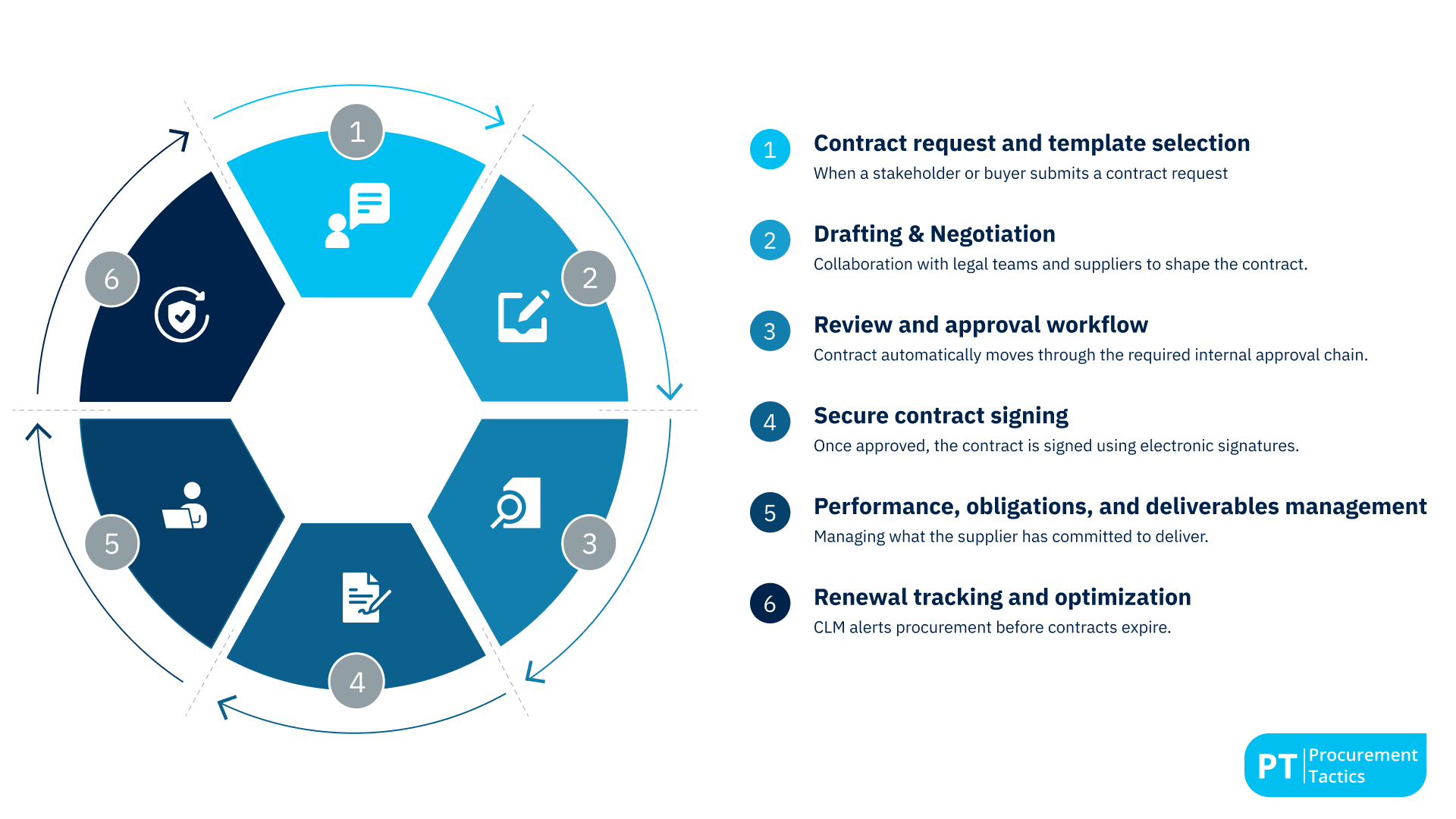
A complete CLM process covers every step a supplier contract goes through, from the first request to the final renewal. The goal is to make contracting predictable, transparent, and fully controlled.
1. Contract request and template selection
The process begins when a stakeholder or buyer submits a contract request. Instead of starting from scratch, procurement chooses an approved template with predefined clauses, terms, and risks already aligned with legal standards. This ensures consistency and reduces errors.
2. Drafting and negotiation
Procurement collaborates with legal teams and suppliers to shape the contract. CLM tools track all edits, comments, and versions, so everyone works from the same document. This avoids conflicting drafts and speeds up negotiations.
3. Review and approval workflow
The contract automatically moves through the required internal approval chain. Approvers receive notifications, deadlines, and the final version they need to review. This eliminates bottlenecks and ensures compliance with internal policies.
4. Secure contract signing
Once approved, the contract is signed using electronic signatures. This shortens the contracting cycle and ensures a legally valid and auditable signing process.
5. Performance, obligations, and deliverables management
After the signature, CLM shifts to managing what the supplier has committed to deliver. Procurement can track service levels, pricing, milestones, and obligations in real time. This helps prevent value leakage and ensures suppliers meet expectations.
6. Renewal tracking and optimization
CLM alerts procurement before contracts expire. This prevents unwanted auto-renewals and creates space to renegotiate pricing, terms, or supplier performance. The focus becomes optimization rather than last-minute firefighting.
3 Real-Life Examples of CLM in Procurement
Here are three real-world examples of how leading companies are using CLM to modernize procurement.
1. Vodafone Procurement Company: Global Contract Consolidation
What they do:

Vodafone’s centralized procurement unit manages tens of thousands of supplier contracts across multiple countries. Before CLM, each region stored contracts separately, using different templates and manual approval processes. This created inconsistencies, compliance risks, and long cycle times.
How It Works:
Vodafone implemented a unified CLM platform that replaced all regional systems. All contract templates, clause libraries, and approval rules are now standardized and controlled centrally.
The CLM tool stores more than 30,000+ contracts and automates workflows from drafting to signature. The system also tracks obligations, performance metrics, and renewal dates, giving procurement full visibility across the global supply base.
Why It’s Effective:
- Contract disputes with suppliers decreased by 80%.
- Manual administrative work dropped by 60%.
- Procurement gained a single source of truth for all agreements worldwide.
Vodafone’s approach shows how CLM can eliminate fragmentation and bring contract discipline to large, global procurement teams.
2. Coca-Cola Bottling Company UNITED: Faster and Safer Contract Execution
What they do:
Coca-Cola Bottling Company UNITED handles thousands of supplier and distributor contracts every year. The company needed a way to manage risk, simplify approvals, and ensure all contracts were audit-ready.
How It Works:
The company introduced a CLM system that centralizes all supplier agreements and automates the approval workflow. The platform provides real-time contract status, alerts for risk flags, and instant access to the latest versions.
E-signature integration allows the team to execute contracts in minutes instead of hours. All edits, histories, and approvals are documented automatically, making audits significantly easier.
Why It’s Effective:
- Contracts are now completed in seconds instead of hours.
- Risk exposure decreased thanks to better clause control and version tracking.
- The company improved internal visibility into contract status and cycle times.
Coca-Cola UNITED demonstrates how CLM can dramatically speed up contracting while strengthening compliance.
3. Global Pharmaceutical Manufacturer: Full Supply Base Visibility Through CLM
What they do:
A multinational pharmaceutical and consumer-goods manufacturer needed to manage a large supplier base with strict compliance and quality requirements. Contract versions were stored across multiple systems, making it difficult to enforce standards and monitor obligations.
How It Works:
The organization adopted an enterprise-wide CLM platform through Icertis. All procurement contracts are now stored in a single repository with standardized templates aligned to global compliance guidelines.
The system flags risky clauses, tracks supplier performance, and provides structured contract data for spend optimization and category planning. Renewal alerts prevent unwanted auto-renewals and ensure every agreement is reviewed on time.
Why It’s Effective:
- Procurement gained 100% visibility into all supplier contracts.
- The company achieved significant savings through better renegotiation and consolidation.
- Compliance with regulatory requirements improved across all categories.
This example shows how CLM becomes a strategic asset when obligations, supplier performance, and contract data are integrated into one platform.
Key Benefits of CLM for Procurement
The table below summarizes the key benefits of CLM and what each one means for procurement.
Common Challenges Without CLM
The table below outlines the most common challenges procurement teams face when CLM is not in place.
Key Features of a Procurement CLM System
When choosing a CLM system, procurement teams should focus on features that reduce risk, speed up workflows, and improve contract visibility. The right capabilities make contracting easier, more consistent, and fully aligned with compliance and supplier management needs.
How to Implement CLM in Procurement
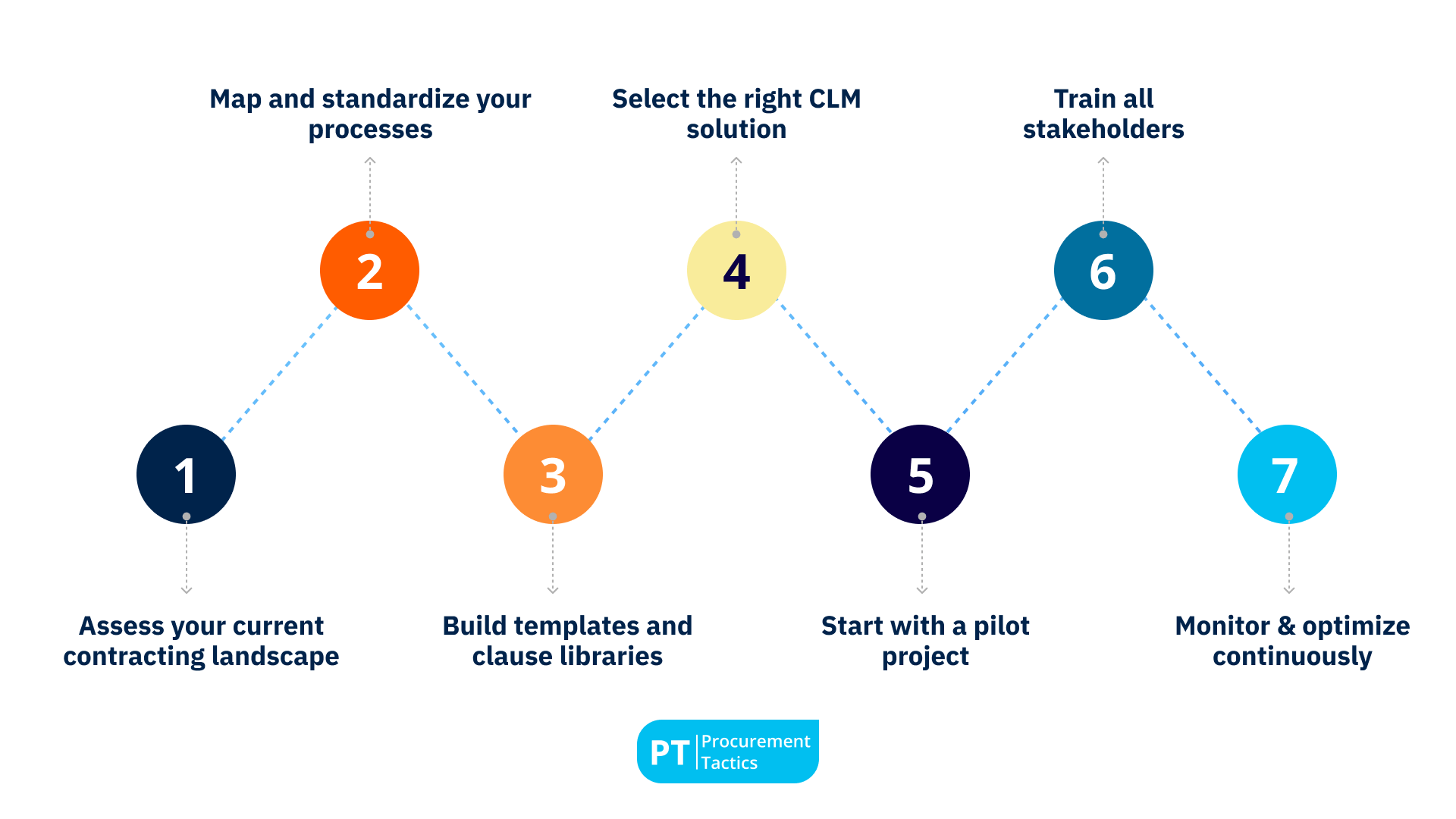
Implementing CLM is more than installing software. It requires redefining how contracts are created, reviewed, approved, signed, and managed across the business. Here is a simple step-by-step guide procurement teams can follow:
1. Assess your current contracting landscape
Identify where contracts are stored, how they are created, who is involved, and where delays happen. This helps uncover gaps, risks, and inefficiencies that CLM should solve.
2. Map and standardize your processes
Create a clear workflow for drafting, review, approval, and signing. Align these steps with legal, finance, and key stakeholders to ensure consistent and compliant contracting.
3. Build templates and clause libraries
Develop approved templates for different contract types and a library of standard clauses. This speeds up drafting and reduces legal and compliance risks.
4. Select the right CLM solution
Evaluate tools based on features, integrations, ease of use, and long-term scalability. Choose a system that supports procurement’s end-to-end lifecycle.
5. Start with a pilot project
Implement CLM in one category or business unit first. Use the pilot to learn, refine workflows, and adjust templates before scaling across the organization.
6. Train all stakeholders
Provide practical training for procurement, legal, finance, and business teams. Good training prevents people from reverting to old manual habits.
7. Monitor and optimize continuously
Track key metrics such as cycle times, compliance rates, system usage, and supplier performance. Use this data to improve contracting workflows and maximize long-term value.
Why CLM Matters for Procurement?
Procurement handles many supplier contracts, and without a structured system, these documents become scattered, inconsistent, and difficult to manage. CLM fixes this by centralizing contracts, automating approvals, and tracking obligations throughout the entire lifecycle.
CLM is essential for three key reasons:
- Better control and compliance – Teams use approved templates and standardized workflows, reducing legal and financial risk.
- Faster contracting – Automated reviews and e-signatures shorten cycle times and keep projects moving.
- More value from suppliers – CLM tracks performance, pricing, and renewals, helping procurement prevent value leakage and improve results.
In simple terms, CLM turns contracts from static documents into active tools that support better decisions and stronger supplier relationships.
Conclusion
Contract Lifecycle Management has become one of the most important capabilities in modern procurement. As supplier relationships grow more complex and organizations face greater compliance and performance pressures, managing contracts manually is no longer sustainable. CLM gives procurement a structured, consistent, and data-driven way to manage every step of the contract lifecycle, from the first draft to the final renewal.
By centralizing contracts, standardizing templates, automating approvals, and tracking obligations in real time, procurement teams reduce risk, accelerate contracting, and protect the organization from value leakage. The benefits are clear: faster cycle times, stronger compliance, better visibility, and more strategic supplier management.
Frequentlyasked questions
What is Contract Lifecycle Management in Procurement?
Contract Lifecycle Management (CLM) in Procurement is the structured process of creating, negotiating, managing, and optimizing supplier contracts. It centralizes contracts, automates workflows, and tracks obligations throughout the entire contract lifecycle.
What is the main goal of CLM?
The goal of CLM is to improve control, reduce risk, standardize contracting, and ensure suppliers deliver exactly what was agreed.
What are the biggest challenges without CLM?
Without CLM, organizations face scattered documents, slow manual approval flows, weak compliance, poor visibility into obligations, and frequent auto-renewal surprises.
About the author
My name is Marijn Overvest, I’m the founder of Procurement Tactics. I have a deep passion for procurement, and I’ve upskilled over 200 procurement teams from all over the world. When I’m not working, I love running and cycling.