

Written by Marijn Overvest | Reviewed by Sjoerd Goedhart | Fact Checked by Ruud Emonds | Our editorial policy
Contract Negotiation: Explanation, Process + Examples
- Contract negotiation is the process of discussing and finalizing the terms of a contract to make sure both parties clearly understand their interests and responsibilities.
- Effective contract negotiation enables procurement teams to secure better pricing, manage risk, and establish partnerships founded on transparency and trust, rather than short-term gains.
- When done strategically, contract negotiation strengthens supplier relationships through fairness and collaboration, protects organizations from legal and operational risks, and drives long-term value by aligning agreements with business goals.
What is Contract Negotiation?
Contract negotiation is the process of discussing, reviewing, and agreeing on the terms of a contract to ensure both parties clearly understand their rights and obligations. It’s where expectations are aligned, responsibilities are defined, and potential risks are managed before any deal is signed.
In procurement, contract negotiation goes far beyond setting prices. It involves balancing cost, quality, performance, risk, and compliance to build agreements that serve the long-term goals of both buyer and supplier. Done right, it creates clarity, reduces future disputes, and builds stronger business relationships. Done poorly, it can lead to misunderstandings, unplanned costs, and missed opportunities.
Today, as supply chains become more complex and global, the ability to negotiate well-written, fair, and flexible contracts has become a vital skill for procurement professionals. It’s no longer just about who gets the better deal; it’s about creating mutual value, fostering trust, and ensuring stability in every partnership.
The Contract Negotiation Process
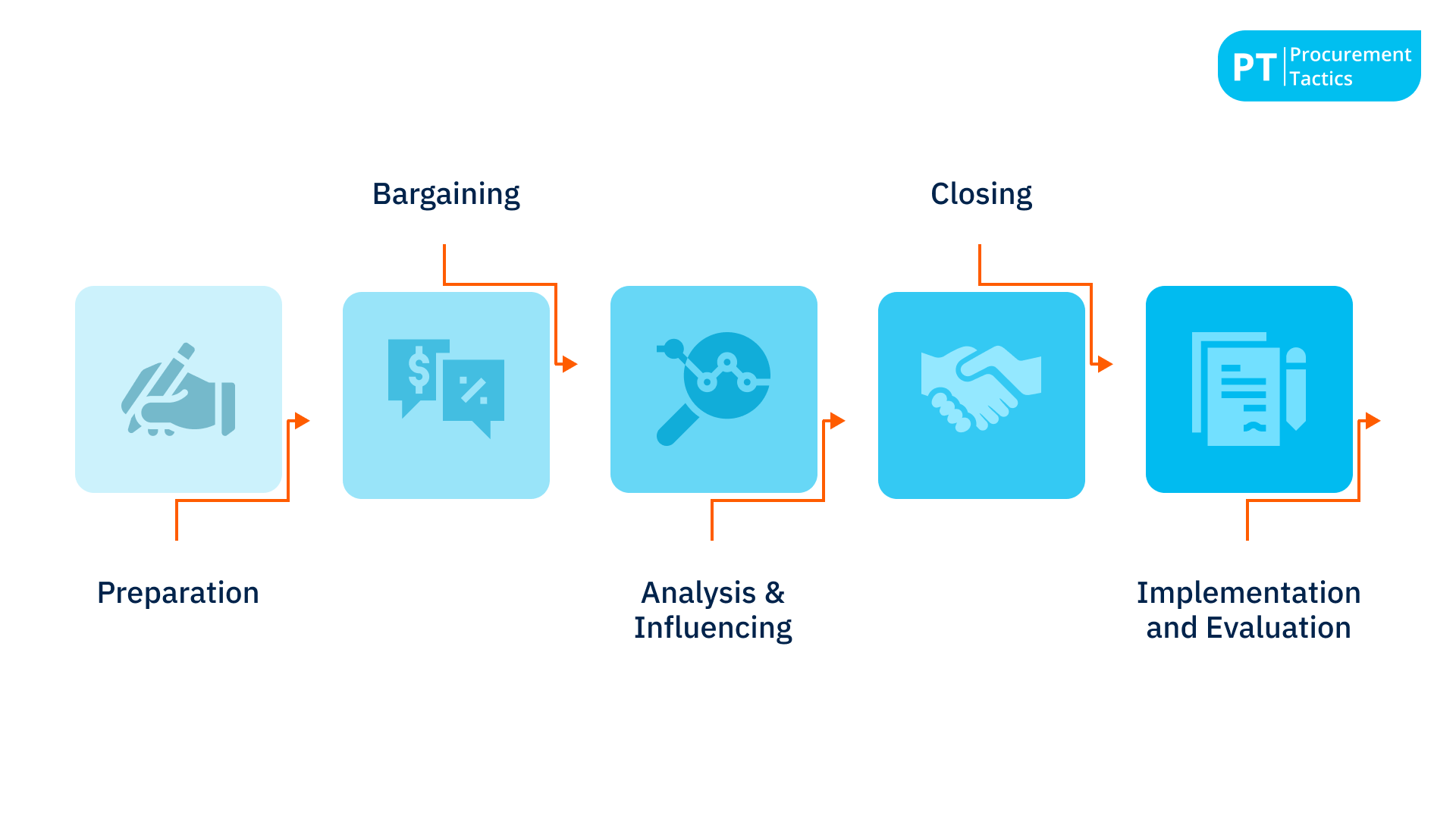
Contract negotiation follows the same core stages as any negotiation, but every step is shaped by the details, risks, and obligations written in the contract. Below is how the process works specifically in contract negotiations, from preparation to post-signing review.
1. Preparation
Preparation is the most important phase in any contract negotiation. Here, procurement teams gather all the information they need to create a strong, fact-based position.
Start by reviewing internal needs: what services or products are required, what the expected outcomes are, and what limits or risks exist. Next, collect external data, supplier background, market benchmarks, and cost breakdowns. This research helps define your key negotiation points, such as pricing structure, delivery schedule, and performance metrics.
At this stage, set your BATNA. It defines when to walk away if the deal no longer makes sense. Also, identify your ZOPA, the realistic range where both sides can find common ground. Finally, ensure your contract goals support your company’s broader strategy, for example, improving quality, reducing total cost, or ensuring sustainability in your supply chain.
2. Bargaining
This is where both sides exchange proposals and discuss contract terms. Unlike simple price talks, contract bargaining covers multiple dimensions, pricing models, service levels, legal clauses, and responsibilities.
Use data to justify your position. For instance, show supplier performance reports or total cost of ownership analyses to explain your price or service demands. Good negotiators also use trade-offs: you might accept longer lead times in exchange for a lower price or extend the contract duration for better payment terms. Always keep the conversation collaborative. The goal is to create a contract both sides can deliver on, not one that looks good on paper but fails in execution.
3. Analysis & Influencing
Once the initial proposals are exchanged, analyze them carefully. Compare every clause with your company’s requirements, policies, and potential risks. This includes checking warranty terms, penalties, and termination clauses to avoid hidden liabilities.

Influencing means using facts and logic to guide the other party toward a balanced agreement. Show evidence, such as market data or prior contract results, to support your suggestions. The best contract negotiators combine analysis with emotional intelligence, understanding when to push, when to compromise, and when to pause discussions to review details.
4. Closing
The closing phase is where the agreement becomes official, but it’s also where mistakes often happen. Before signing, review every contract term in detail: delivery timelines, KPIs, pricing formulas, confidentiality clauses, and escalation procedures. Avoid vague phrases like “as soon as possible.” Instead, write measurable targets, for example: “Supplier must deliver 95% of orders within five business days.”
Before final approval, document all changes made during discussions. If needed, use the “last-minute nibble” technique, ask for a small but valuable addition, such as an extra warranty period or free onboarding support. Once everything is agreed, have both parties sign and store the contract in a secure system, such as a Contract Lifecycle Management (CLM) tool.
5. Implementation and Evaluation
A contract’s success depends on how well it’s managed after signing. Assign responsibilities to specific departments, such as procurement, operations, or legal, to track performance and compliance. Monitor KPIs like on-time delivery, cost savings, or service quality using dashboards or monthly reviews.
When issues arise, follow the escalation process defined in the contract. This prevents conflict and keeps relationships professional.
Finally, evaluate the contract’s performance at renewal time. Ask: Did both sides meet expectations? Were there lessons to apply next time? Continuous evaluation turns contract negotiation from a one-time event into a process of ongoing improvement.
7 Strategies for Contract Negotiation
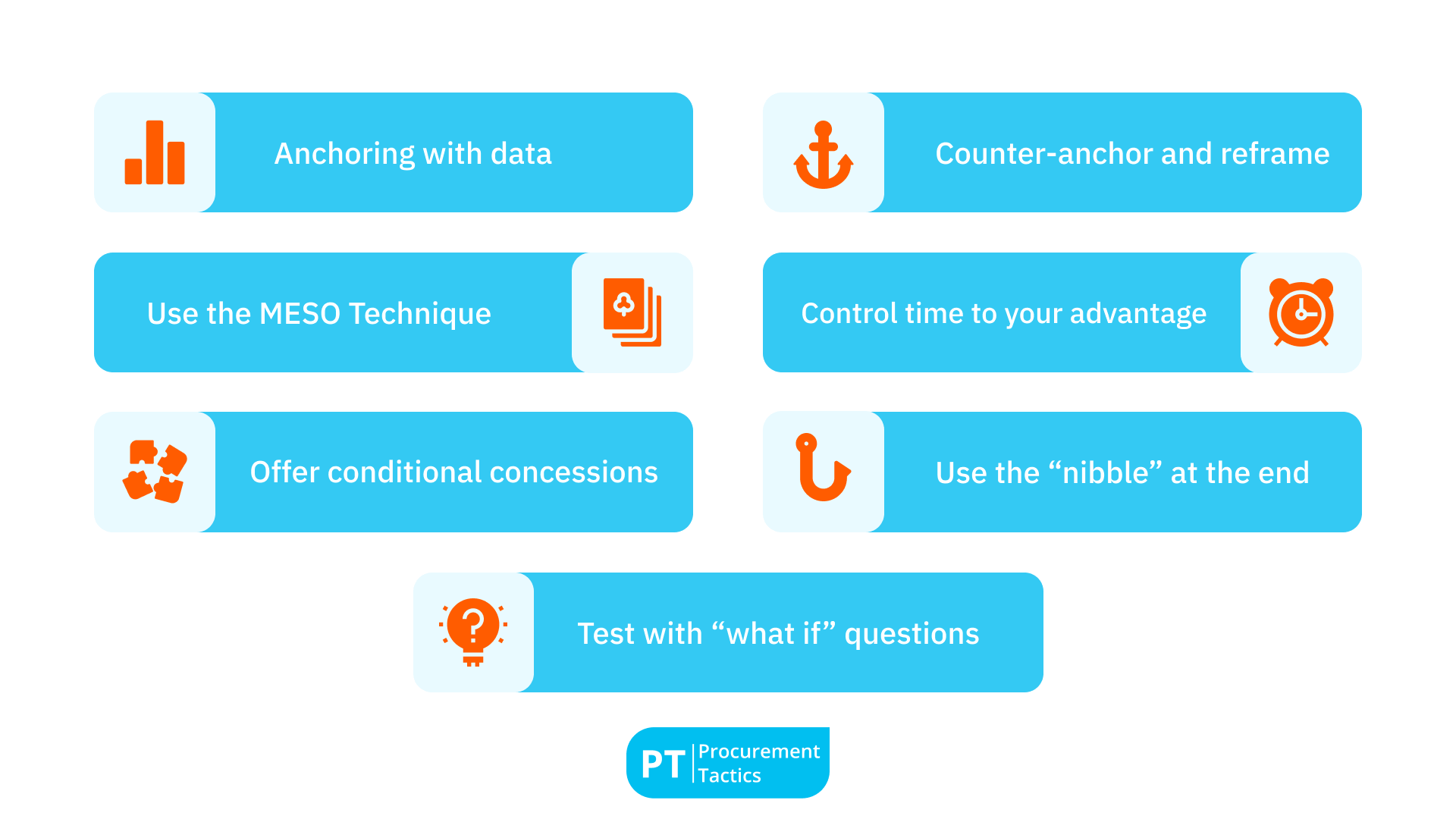
Strong negotiators don’t rely on luck. They use proven strategies that guide every conversation toward a better deal. Here are seven contract negotiation strategies you can use to secure value, manage risk, and build lasting supplier partnerships.
1. Anchoring With Data
Start strong by setting the first reference point, your “anchor.” When you open with a realistic, data-based offer, you shape how the other side thinks about the deal. For example, instead of waiting for a supplier to name a price, present your proposal backed by benchmarks or historical data. Anchoring works because it creates a clear starting frame that defines what’s fair and realistic.
2. Use the MESO Technique
MESO stands for Multiple Equivalent Simultaneous Offers. Instead of giving one proposal, present two or three that are equally valuable to you. This gives the other party options and reveals what they care about most: cost, timing, or flexibility. For instance, you might offer:
- Option A: lower price, longer payment terms
- Option B: higher price, faster delivery
- Option C: stable price, longer contract duration
When people choose, they feel in control, and you learn what matters most to them.
3. Offer Conditional Concessions
Never give something for nothing. Use “if–then” statements to make every concession mutual. For example: “If we extend the contract to 24 months, then we can reduce the price by 3%.” This keeps negotiations fair and balanced, while helping both sides feel they’ve gained value.
4. Counter-Anchor and Reframe
When the other party starts with an extreme offer, don’t just reject it, reframe it.
Acknowledge their point, then introduce your own data to bring the discussion back to reality.
For example: “I understand your rate increase, but based on the market index, a 3–5% range is more realistic.” Reframing keeps the conversation factual and avoids emotional reactions.
5. Control Time to Your Advantage
Time pressure influences decisions. Set clear deadlines for discussion points and milestones to maintain focus and momentum. Example: “Let’s close payment terms by Thursday, and finalize pricing by Friday.”
Short time frames help prevent endless back-and-forth and keep negotiations productive.
6. Use the “Nibble” at the End
Once the deal is nearly done, ask for a small but valuable addition, a “nibble.” It could be free shipping, extra support, or faster payment terms. Because people are eager to finish, they’re often open to small last-minute changes. Just make sure your requests are reasonable, not pushy.
7. Test With “What If” Questions
When discussions stall, try hypothetical questions to test limits without commitment.
Example: “What if we increased order volume? Could you improve delivery speed?”
This approach opens new possibilities and helps uncover flexibility on both sides.
Common Contract Negotiation Mistakes to Avoid
Even the best negotiators make mistakes that can weaken a contract, create hidden risks, or damage relationships. Knowing what to avoid is just as important as knowing what to do.
Here are six common mistakes that often appear in contract negotiations, and how to prevent them.
1. No Preparation
Walking into a negotiation without preparation is the fastest way to lose leverage. Without understanding your goals, limits, or the other party’s position, it’s easy to agree to terms that don’t serve your business.
Before every meeting, gather market data, study the supplier’s motivations, and define your must-haves and deal-breakers. Good preparation gives you confidence and helps you spot opportunities for creative trade-offs instead of rushed compromises.
2. Getting Straight to Business
Jumping right into numbers and contract terms might feel efficient, but it usually backfires. Negotiations are led by people, not companies, and trust comes before agreement.
Take time to build rapport and connect with the person across the table. A short, genuine conversation at the start creates comfort, reduces tension, and often leads to more open discussions later.
3. Competing Instead of Collaborating
Treating negotiation as a battle is a classic mistake. When one side “wins,” the other often feels forced into a bad deal, and that can hurt future cooperation.
In contract negotiations, think long-term. Use transparency, share priorities, and look for solutions that create value for both parties. Instead of fighting for a bigger piece of the pie, find ways to make the pie bigger together.
4. Talking Too Much
Many negotiators lose deals simply because they can’t stop talking. Silence is a powerful tool, it gives you time to think and puts subtle pressure on the other side to fill the gap, often revealing useful information or making concessions.
Don’t rush to respond. Listen carefully, take notes, and use pauses strategically to guide the conversation.
5. Forgetting That Walking Away Is an Option
Not every deal is worth signing. If the terms don’t match your goals or the other side doesn’t have the authority to make final decisions, continuing talks only wastes time.
Define your BATNA, your best alternative to a negotiated agreement, before you start. Knowing when to walk away keeps you in control and prevents emotional or one-sided agreements.
6. Signing the Contract Without Reading
It sounds obvious, but it happens often. Rushing to sign a contract without reviewing every clause can lead to costly surprises later, hidden fees, unclear KPIs, or unfair penalties.
Always take the time to read the full document. Check that all commitments, deadlines, and responsibilities match what was agreed verbally. If something looks unclear, clarify it before signing, not after.
Smart negotiators slow down where others rush. They prepare thoroughly, build relationships, and read every line before they agree. Avoiding these common mistakes keeps your contracts strong, your relationships healthy, and your results sustainable.
7 Practical Tips for Effective Contract Negotiation
Successful contract negotiations don’t just happen. They’re built on consistent preparation, teamwork, and clear communication. These practical tips will help procurement professionals prepare better, communicate clearly, and close stronger contracts with confidence.
1. Know What Success Looks Like
Start every negotiation with a clear goal. Define what success means for your team, whether it’s cost savings, quality improvements, or better supplier performance. Having clear priorities helps you stay focused and avoid accepting terms that don’t fit your business needs.
2. Do Your Homework
Preparation gives you power. Before the meeting, research market prices, review past supplier performance, and understand the cost structure behind the offer. Data helps you argue from facts, not assumptions, and protects you from agreeing to unrealistic terms.
3. Involve the Right People Early
Contract negotiation is a team effort. Include procurement, legal, and finance from the start to avoid delays later. When everyone knows their role, who approves pricing, who checks compliance, negotiations move faster and smoothly.
4. Stay Flexible but Focused
Good negotiators know when to compromise and when to hold firm. Be open to alternative terms that still meet your goals, for example, a longer contract for a better rate. Flexibility builds trust and often leads to creative solutions that work for both sides.
5. Communicate Clearly and Respectfully
Clarity builds trust. Ask open-ended questions, listen carefully, and confirm what’s been agreed before moving on. Avoid aggressive tactics; the goal is not to “win,” but to build a fair, long-term partnership that both sides can sustain.
6. Put Everything in Writing
Never rely on verbal agreements. Document every term clearly: pricing, delivery, KPIs, and penalties. Ambiguity causes conflict later. So write in simple, measurable language that everyone understands.
7. Review and Learn After Each Deal
Every negotiation is a chance to learn. Once the contract is signed, review what worked and what didn’t. Get feedback from your team and suppliers. Over time, these lessons help make your next negotiation stronger and more efficient.
Conclusion
Contract negotiation is more than just a skill. It is a structured business capability. When procurement teams follow a clear process, use data-driven strategies, and avoid common mistakes, negotiations become less stressful and more consistent in delivering results.
The key is balance. Preparation builds confidence, strategy shapes decisions, and communication maintains trust. Each negotiation becomes an opportunity to strengthen relationships, improve performance, and create long-term value rather than simply closing a deal.
By applying the framework presented here, organizations can shift from short-term transactions to strategic, transparent, and mutually beneficial agreements. In today’s fast-changing markets, this is what sets proactive procurement apart from the rest.
Frequentlyasked questions
What is contract negotiation?
Contract negotiation is the process of discussing, revising, and agreeing on contract terms to make sure both parties have a clear understanding of their interests and responsibilities.
What is the main goal of contract negotiation?
The goal of contract negotiation is to reach an agreement that benefits both parties. In procurement, this means finding the balance between cost, quality, and risk while maintaining a positive supplier relationship. A good contract doesn’t just save money, it builds trust and long-term stability.
What are the biggest mistakes to avoid in contract negotiations?
Some of the most common mistakes include going into a negotiation unprepared, rushing straight to numbers, or treating it like a competition instead of a collaboration. Others include talking too much, forgetting that walking away is an option, or signing the contract without reading every clause carefully.
About the author
My name is Marijn Overvest, I’m the founder of Procurement Tactics. I have a deep passion for procurement, and I’ve upskilled over 200 procurement teams from all over the world. When I’m not working, I love running and cycling.