


Written by Marijn Overvest | Reviewed by Sjoerd Goedhart | Fact Checked by Ruud Emonds | Our editorial policy
Contract Risk Management in Procurement — Definition, Types + Template

As taught in the Contract Management Course / ★★★★★ 4.9 rating
Table of contents
- What is Contract Risk Management in Procurement?
- Why Contract Risk Management Matters?
- 2 Types of Contract Risks
- 8 Steps to Run a Risk Assessment Procedure
- Contract Risk Assessment Template
- How Procurement Uses Risk Registers and Escalation Paths
- 7 Key Contract Clauses for Managing Procurement Risk
- 5 Practical Controls to Reduce Contract Risk
- Conclusion
- Frequently asked questions
- Contract risk management is the continuous process of identifying, assessing, allocating, and reducing risks across the contract lifecycle.
- It protects value by pairing clear ownership with concrete controls and escalation paths.
- Used consistently, it prevents surprises, shortens resolution time, and improves supplier performance.
What is Contract Risk Management in Procurement?
In procurement, contract risk management is the structured and ongoing practice of spotting potential risks in supplier agreements, evaluating their impact and likelihood, assigning ownership, and putting controls in place.
It is not a one-time activity at signature. Risks evolve as markets shift, suppliers change, and operational realities emerge. For procurement teams, this means reviewing and updating risks throughout sourcing, contracting, and contract execution to ensure obligations are met and value is protected.
Why Contract Risk Management Matters?
Effective risk management protects interests and assets across the contract lifecycle. It improves resilience when timelines are tight, and decisions become real, and it helps parties anticipate issues rather than react to them. By treating risk as ongoing, teams navigate complexity with more confidence and fewer costly surprises.
2 Types of Contract Risks
Risks are diverse and generally fall into two broad groups. Naming them clearly helps determine controls and clauses.
1. Internal risks
Originate within the organization and are usually influenceable. Examples include budget overruns, cash-flow issues, information-system outages, process inefficiencies, misalignment with business goals, unclear approvals, or resource constraints. These often point to governance or process areas that can be strengthened.
2. External risks
Come from outside and are less controllable. Examples include interest and exchange rate shifts, currency volatility, regulatory changes, technology failures at third parties, competitive dynamics, geopolitical events, natural disasters, or policy changes. These require monitoring, allocation through contract language, and contingency planning.
8 Steps to Run a Risk Assessment Procedure
Before agreeing, and at defined milestones, run a structured assessment. The goal is to identify the risk, understand its scope, and decide how it will be treated.
1. Identify and scope the risk
Name the risk and describe what could happen, where, and with which dependencies or interfaces.
2. Classify the nature
Financial, strategic, operational, compliance/regulatory, legal/liability, hazard, or reputational. Clear categories aid consistent treatment.
3. List stakeholders and ownership
Specify who is responsible for managing, who is consulted, and who must be informed.
4. Quantify impact and likelihood
Use simple scales (e.g., Low/Medium/High or 1–5) and note assumptions. Include potential cost, schedule, and quality effects.
5. Define risk tolerance/appetite
State acceptable exposure levels, control objectives, and performance thresholds.
6. Select treatment and controls
Avoid, reduce, transfer, or accept with monitoring. Link each treatment to concrete controls and review cadence.
7. Plan improvements
Capture additional actions, owners, and dates to reduce residual risk.
8. Assign policy and strategy ties
Note the function accountable for related policies and escalation.
Contract Risk Assessment Template
Use this table to capture each risk in one place and keep it current.
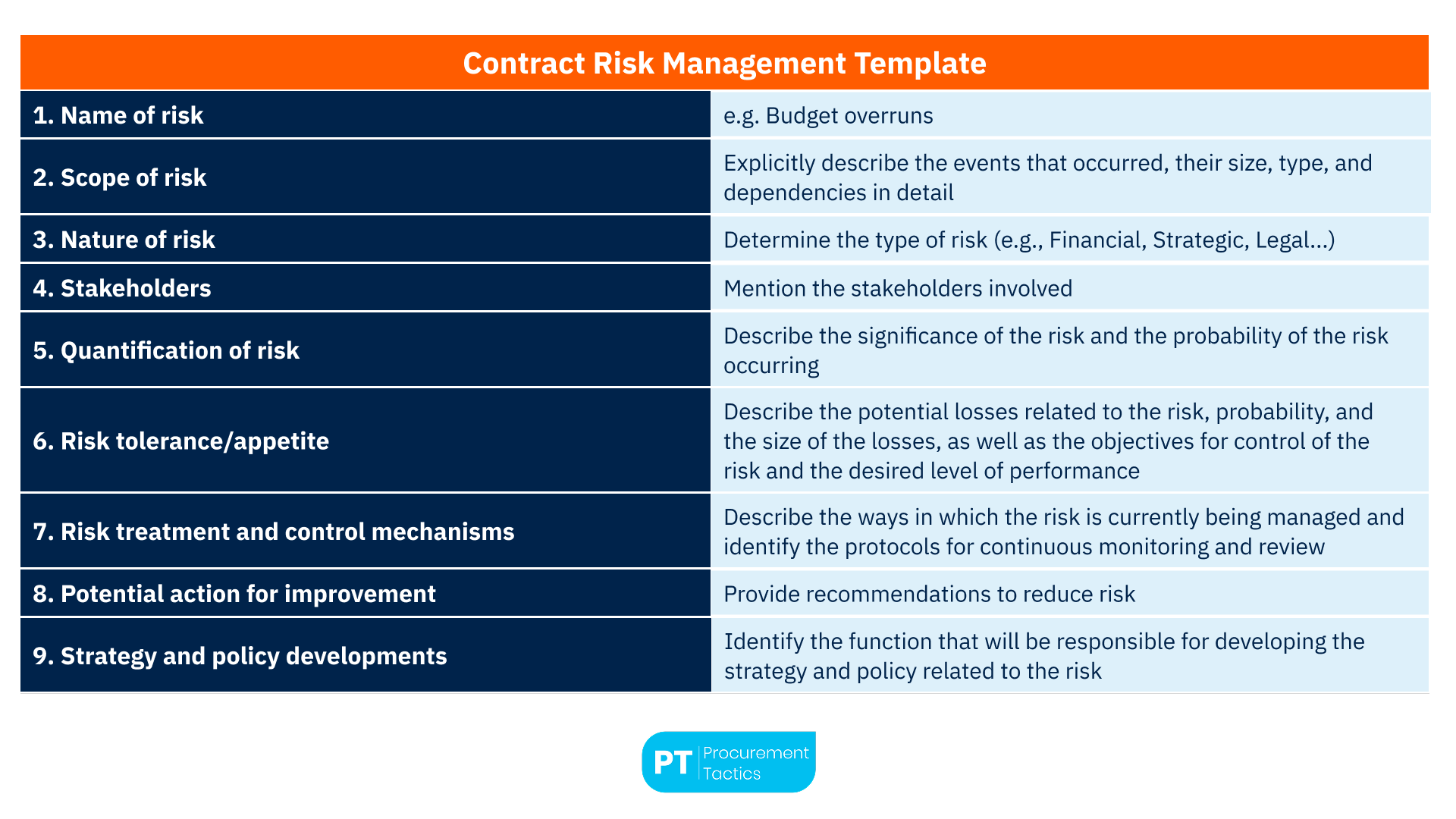
Here’s how you should fill it in.
- Identify the Risk
In the first row, state the name of the risk being addressed.
- Describe the Scope of the Risk
In the second row, provide a detailed description of the risk’s scope. Include what occurred, the relevant events, their scale and type, and any associated dependencies.
- Define the Nature of the Risk
Classify the risk, such as financial, strategic, operational, hazard, or another appropriate category.
- List Key Stakeholders
Identify the individuals, teams, or functions involved in managing or overseeing the risk.
- Quantify the Risk
Assess the significance of the risk and the likelihood of its occurrence.
- Outline Risk Tolerance or Appetite
Describe the potential losses, their probability and magnitude, and specify your objectives for controlling the risk, including the level of performance you aim to achieve.
- Explain Risk Treatment and Control Mechanisms
Detail how the risk is currently managed and outline the protocols for ongoing monitoring and review.
- Propose Potential Actions for Improvement
Provide recommendations on how the risk could be reduced or managed more effectively.
- Specify Strategy and Policy Developments
Identify the function or team responsible for developing the strategy and policies related to this risk.
This template will help you keep all information regarding the particular risk in one place. It guides you through identifying the risk, detailing its scope and nature, and quantifying its impact, but also how the risk is currently managed, suggesting improvements, and assigning responsibilities. It’s designed to ensure you cover all key aspects of risk management in a clear and organized way.
How Procurement Uses Risk Registers and Escalation Paths
Most organizations maintain a central risk register. Procurement teams should actively pull relevant entries into contract planning, identify supply-related risks, and align monitoring cadence with contract criticality.
Clear reporting and escalation routes ensure that procurement, legal, and business stakeholders know who to contact in case of deviation, disruption, or emergency. This allows risks to surface early and be addressed at the appropriate level before they escalate.
7 Key Contract Clauses for Managing Procurement Risk
Contract language is a primary mechanism for allocating and managing risk in procurement. Clauses should be clear, specific, and aligned with the identified risk profile.
1. Force majeure: Defines extraordinary events and relief mechanisms.
2. Termination: Convenience and for-cause triggers, notice periods, and obligations on exit.
3. Liability and limitations: Caps, exclusions, and proportionality to risk.
4. Indemnities: Who covers third-party claims and under what conditions?
5. Service levels and remedies: KPIs, credits, cure periods, and improvement plans.
6. Change control: Process for scope, timeline, and price adjustments.
7. Dispute resolution: Escalation steps, mediation/arbitration, and governing law.
5 Practical Controls to Reduce Contract Risk
These day-to-day practical controls translate assessment of risk into action and create early warning signals during contract execution.
1. Conditional payments
Tie payments to milestones, deliverables, or verified performance rather than paying upfront. This aligns cash outflow with value received.
2. Regular check-ins
Schedule periodic reviews for long-term or volatile arrangements. Use a simple agenda: status vs. plan, risks, decisions, actions.
3. Early-warning indicators
Track leading signals such as missed intermediate dates, quality defects, staff turnover on the supplier side, or credit alerts.
4. Performance guarantees
Use bonds, parent guarantees, or holdbacks where exposure is high or counterparties are new.
5. Clear exit paths
Define termination conditions, transition assistance, and knowledge transfer so the organization can pivot cleanly if needed.
Conclusion
Contract risk management is most effective when it is continuous, structured, and tied to clear ownership and clauses. Identify internal and external risks, assess impact and likelihood, and choose targeted treatments.
Keep a concise register, establish reporting routes, and use contract language to allocate exposure. With practical controls like milestone-based payments, routine reviews, early warnings, guarantees, and clear exits, teams protect value and reduce costly surprises.
Frequentlyasked questions
What is the first step in contract risk management?
Run a structured risk assessment before signing: name the risk, classify it, quantify impact and likelihood, and assign ownership and treatment.
How often should risks be reviewed?
At a minimum, at phase gates and after major changes. For high-exposure or fast-moving contracts, review monthly or at agreed milestone cadence.
Which clauses reduce the most risk?
Force majeure, termination, liability limitations, indemnities, SLAs with remedies, change control, and dispute resolution. The right mix depends on the risk profile.
About the author
My name is Marijn Overvest, I’m the founder of Procurement Tactics. I have a deep passion for procurement, and I’ve upskilled over 200 procurement teams from all over the world. When I’m not working, I love running and cycling.