


Written by Marijn Overvest | Reviewed by Sjoerd Goedhart | Fact Checked by Ruud Emonds | Our editorial policy
Data Sourcing — Definition, Steps + Examples
Table of contents
- What is Data Sourcing?
- The 4 Steps of Data Sourcing
- How Data Sourcing Shapes Modern Procurement
- 3 Real-Life Examples of Data Sourcing
- The 5 Main Types of Data Sources
- The Challenges of Data Sourcing And How To Solve Them
- 10 Best Practices for Effective Data Sourcing
- 5 Trends of Data Sourcing
- Conclusion
- Frequently asked questions
- Data sourcing is finding, collecting, and managing the right data to support better decisions.
- Combining internal, external, and partner data provides a 360° view of your business.
- Strong data sourcing practices help procurement teams predict trends, manage risks, and improve supplier performance.
What is Data Sourcing?
Data sourcing means finding, collecting, and managing the right data to support better decisions. It’s more than just gathering information; it’s the structured process of transforming raw, scattered data into reliable insights that guide business strategy.
In today’s organizations, data comes from everywhere: ERP and CRM systems, supplier reports, websites, sensors, and public databases. Without a clear sourcing strategy, these fragments stay disconnected, making it impossible to see the full picture. Data sourcing bridges that gap.
It ensures that the information entering your systems is accurate, consistent, and aligned with your goals. Whether it’s supplier performance in procurement, customer trends in marketing, or operational efficiency in logistics, the process guarantees that every decision is built on verified facts, not assumptions.
In essence, data sourcing turns information chaos into business intelligence. It’s the first and most important step toward analytics, automation, and smarter decision-making across the entire organization.
The 4 Steps of Data Sourcing
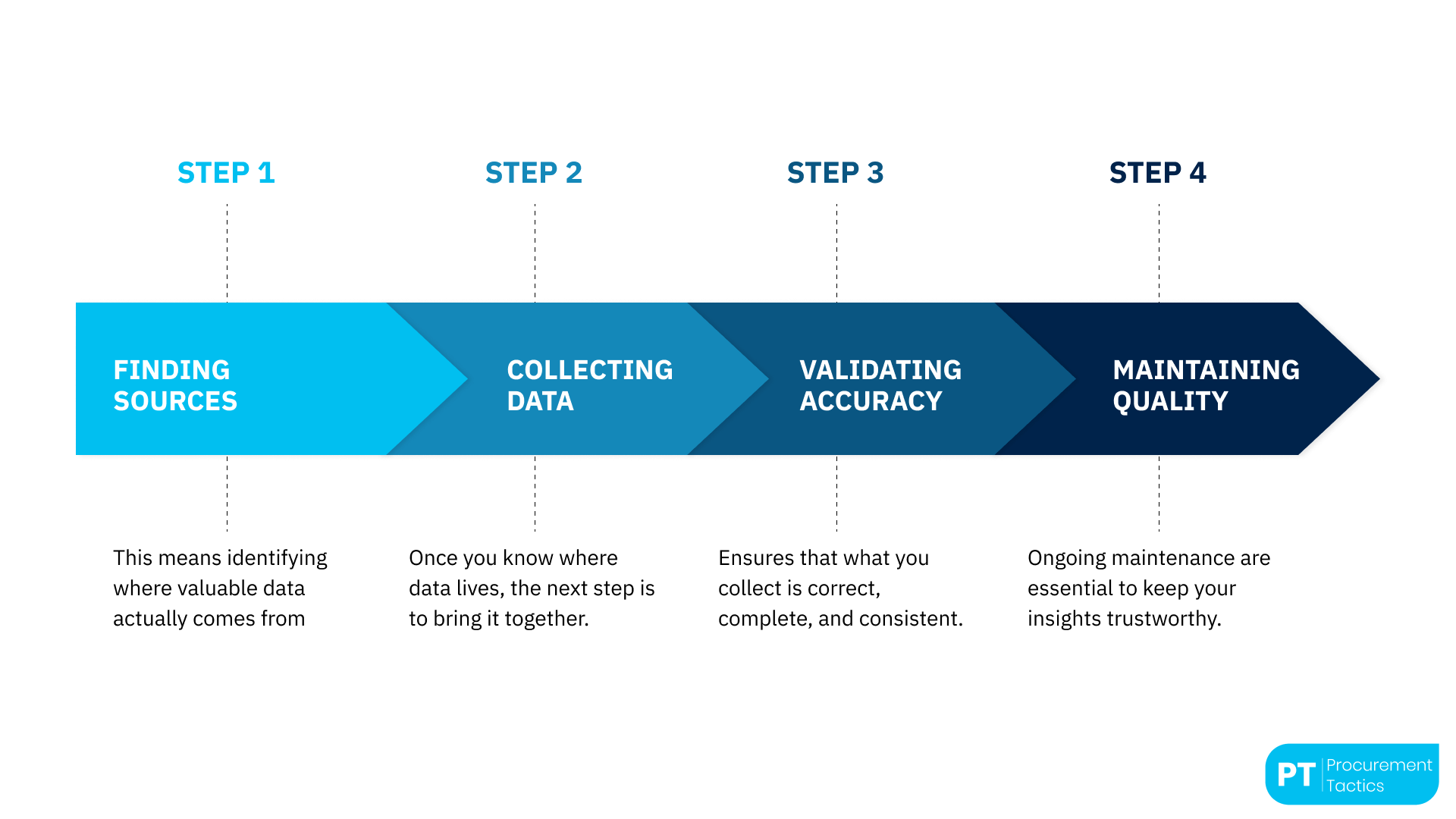
1. Finding sources
This means identifying where valuable data actually comes from. It could be your ERP system, supplier reports, public datasets, or even real-time feeds from sensors and digital platforms. The goal is to map out all potential data points that matter to your business.
2. Collecting data
Once you know where data lives, the next step is to bring it together. This can happen through manual exports, automated pipelines, or API connections. The key is to collect data efficiently while keeping its original meaning intact.
3. Validating accuracy
Raw data is rarely perfect. Validation ensures that what you collect is correct, complete, and consistent. It involves cross-checking entries, removing duplicates, and flagging missing or outdated values. This is the “quality control” phase of the process.
4. Maintaining quality
Good data sourcing doesn’t stop once information is collected. Data changes over time, suppliers update their pricing, systems evolve, and markets shift. That’s why ongoing maintenance, monitoring, and version control are essential to keep your insights trustworthy.
How Data Sourcing Shapes Modern Procurement
Here are 5 ways how effective data sourcing can shape modern procurement:
1. Spend on Visibility and Analysis
Procurement teams often struggle to see where money truly goes. Invoices, purchase orders, and expense data sit in different systems, making spend analysis difficult. Effective data sourcing brings these pieces together, connecting ERP data with invoice records and supplier information.
Once spending is consolidated, teams can identify high-cost areas, duplicate suppliers, and hidden savings opportunities. It’s the first step toward data-driven category management.
2. Supplier Performance and Risk Tracking
Suppliers generate huge amounts of data, including delivery times, defect rates, certifications, and ESG performance reports. When this information is properly sourced and structured, it becomes a powerful decision-making tool.
For example, a data-sourced supplier dashboard can instantly show which vendors consistently deliver on time and which pose a risk. Combining performance data with external financial or geopolitical indicators allows procurement to forecast potential disruptions before they occur.
3. Market Intelligence and Benchmarking
Procurement doesn’t operate in isolation. Market conditions, raw material costs, and competitor behavior all influence sourcing strategies. Data sourcing enables teams to pull in external datasets, such as commodity indexes, logistics rates, or public tenders, to benchmark their prices and contracts. This helps procurement stay competitive and negotiate with confidence.
4. Sustainability and Compliance
With growing ESG expectations, procurement teams must track supplier emissions, labor practices, and ethical sourcing standards. Proper data sourcing makes this possible by connecting internal records with sustainability databases or third-party audit results.
When ESG data is integrated into sourcing systems, compliance reporting becomes faster, easier, and more transparent. It also helps procurement choose partners who align with corporate sustainability goals.
5. Strategic Decision-Making
The ultimate purpose of data sourcing in procurement is not just to collect information, it’s to turn it into strategic action. With reliable, well-structured data, procurement leaders can simulate scenarios, forecast demand, and plan budgets with greater precision. For instance, by sourcing data from both suppliers and internal operations, companies can anticipate shortages, avoid overstocking, and strengthen supplier collaboration.

When done right, data sourcing transforms procurement into a center of intelligence. It connects strategy with execution, aligns stakeholders, and drives measurable business value. Simply put: better data means smarter buying.
3 Real-Life Examples of Data Sourcing
1. Unilever: Centralized Supplier Data for Sustainability Reporting
What They Did:
Unilever faced a major challenge; supplier information was scattered across regions, systems, and spreadsheets. Tracking ESG performance, labor standards, and compliance indicators manually was slow and inconsistent. To fix this, Unilever launched a global data sourcing initiative to bring all supplier data into a single, standardized platform.
The company connected its procurement systems with third-party sustainability databases such as EcoVadis and CDP, and digitized supplier self-assessments and audits. This created a unified “source of truth” for sustainability metrics across its supply base of over 60,000 suppliers.
How It Works:
The platform automatically pulls and updates supplier data from verified sources, procurement records, certifications, audit results, and sustainability ratings.
Procurement teams can access dashboards showing each supplier’s environmental, social, and governance (ESG) score and track progress against corporate targets.
Why It’s Effective:
By replacing manual reporting with automated data sourcing, Unilever reduced compliance workload and improved transparency. Now the company can identify high-risk suppliers early, focus on corrective actions, and publish verified ESG reports faster and with higher accuracy.
2. Siemens: IoT Data Sourcing for Predictive Maintenance
What They Did:
Siemens wanted to reduce downtime and improve operational efficiency across its manufacturing sites. Instead of relying on scheduled maintenance, they decided to use real-time data from connected machines to predict failures before they occur.
The company implemented MindSphere, a cloud-based industrial data platform, designed to source data directly from sensors embedded in production lines, turbines, and factory equipment. The goal was to create a continuous data loop between operations, procurement, and engineering teams.
How It Works:
IoT sensors collect data on temperature, vibration, power use, and pressure. This information is transmitted in real time to the MindSphere platform, where AI models analyze it and trigger alerts when anomalies appear.
When the system detects potential equipment wear, procurement teams are automatically notified to order spare parts or schedule service.
Why It’s Effective:
This proactive data sourcing model allows Siemens to anticipate supply needs before breakdowns happen. It has cut unplanned downtime, reduced emergency procurement costs, and improved collaboration between maintenance and sourcing teams. In short, Siemens turned operational data into a competitive advantage.
3. Tesla: External Market Data Sourcing for Strategic Procurement
What They Did:
Tesla’s supply chain depends on volatile commodities such as lithium, cobalt, and nickel, all essential for battery production. Traditional market reports and quarterly updates weren’t fast enough to support real-time decision-making.
To gain better foresight, Tesla built automated data sourcing pipelines that connect directly to global commodity exchanges, financial platforms, and environmental data providers.
This system continuously monitors price trends, geopolitical developments, and production volumes related to critical materials. The objective was clear: turn external market data into actionable procurement intelligence.
How It Works:
The platform aggregates and normalizes thousands of data points, including spot prices, mining output, and trade data, into Tesla’s analytics dashboard.
This information is cross-referenced with internal production plans and demand forecasts, allowing the procurement team to simulate “what-if” scenarios.
Why It’s Effective:
By sourcing live external data, Tesla can anticipate supply risks and price fluctuations weeks in advance. This gives the company leverage in supplier negotiations and helps secure materials under long-term contracts before market volatility spikes. The result is a more resilient and cost-efficient procurement strategy.
The 5 Main Types of Data Sources
In procurement, data comes from many directions: internal systems, supplier networks, and external markets. Understanding where your data originates helps you build a complete, reliable view of your supply base and spending behavior. Here are the five main data sources every procurement team should use:
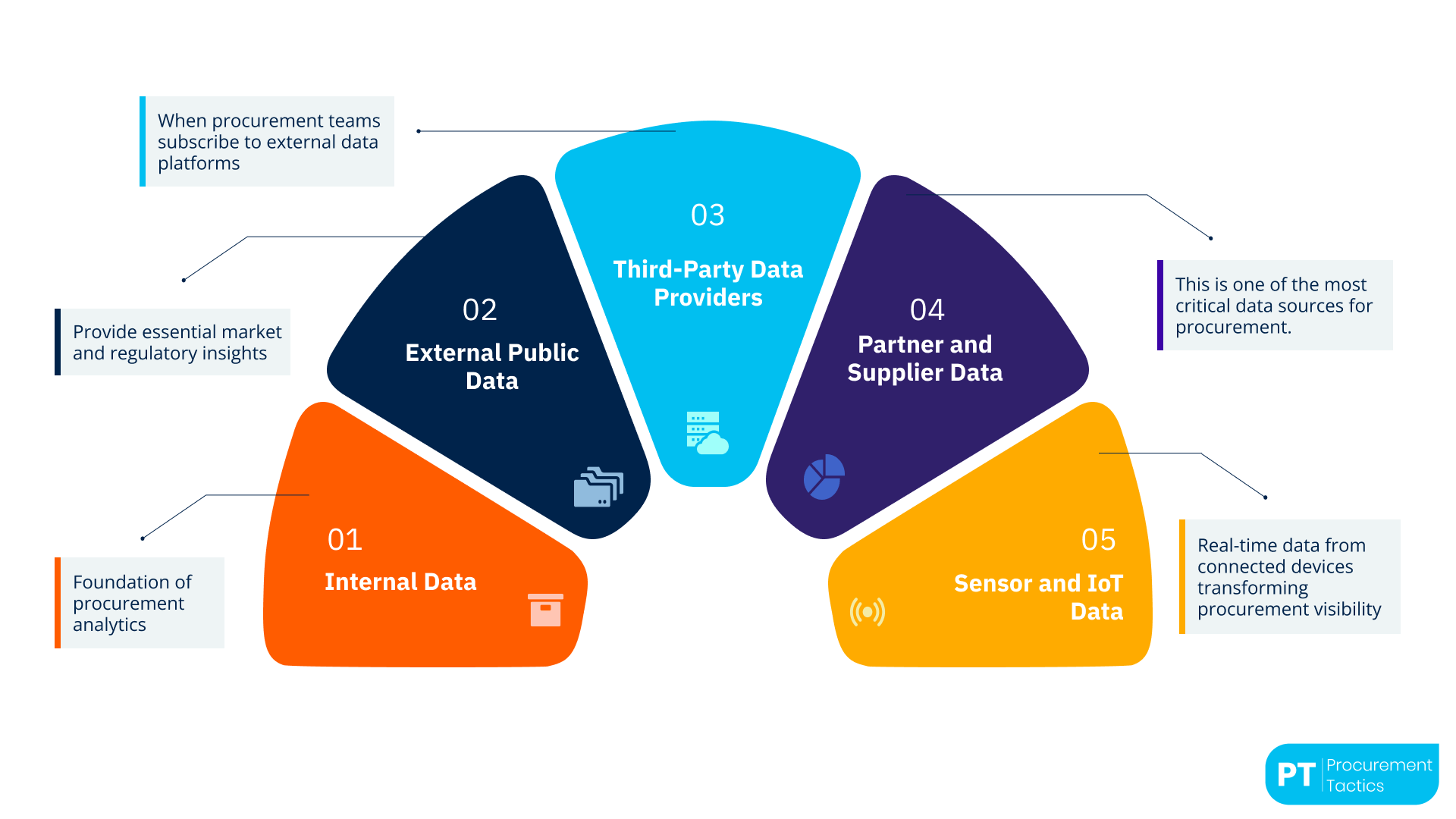
1. Internal Data
Internal data is the foundation of procurement analytics. It includes information from your ERP, finance, and contract management systems, such as purchase orders, invoices, payment terms, and approval workflows.
This data shows how your organization buys, who spends the most, and which categories or suppliers drive the highest costs. Accurate internal data is key to identifying savings opportunities, monitoring compliance, and improving process efficiency.
2. External Public Data
Publicly available datasets provide essential market and regulatory insights. These include government trade statistics, customs records, inflation indexes, and industry benchmarks. Procurement teams use this data to understand pricing trends, evaluate supplier markets, and anticipate changes in import/export conditions. For example, public transport or energy-sector reports can guide sourcing decisions for logistics or sustainability projects.
3. Third-Party Data Providers
Many procurement teams subscribe to external data platforms such as Coresignal, Neudata, or Crunchbase. These providers supply structured datasets on suppliers, markets, and company financials.
Third-party data helps enrich internal records with insights on supplier stability, ownership, or ESG performance. It also supports benchmarking and category strategy by comparing your suppliers with industry peers.
4. Partner and Supplier Data
This is one of the most critical data sources for procurement. It includes delivery performance metrics, defect rates, certifications, and sustainability reports directly from suppliers.
Integrating this data into your procurement systems gives a transparent view of supplier reliability and risk. It also enables more collaborative relationships, suppliers and buyers can share real-time information on quality, capacity, and compliance.
5. Sensor and IoT Data
As supply chains become more digital, real-time data from connected devices is transforming procurement visibility. Sensors on trucks, warehouses, or production lines generate live data on shipment status, temperature, and energy consumption.
Procurement teams use this data to monitor logistics performance, track carbon emissions, and ensure products arrive on time and in good condition. IoT data also supports sustainability initiatives by helping companies measure efficiency and reduce waste.
When procurement integrates all five data sources, internal, public, third-party, supplier, and IoT, it gains a 360° view of the supply chain. That visibility turns data into a strategic advantage, enabling smarter sourcing, stronger supplier relationships, and measurable business impact.
The Challenges of Data Sourcing And How To Solve Them
Here are the most common challenges teams face:
10 Best Practices for Effective Data Sourcing
Here are the 10 proven best practices that make data sourcing effective.
1. Define Clear Objectives
Before collecting any data, define what you need and why. Ask yourself: What business problem am I solving? or What decisions will this data improve?
Without clear goals, teams often gather too much irrelevant information. When objectives are defined early, you save time, reduce storage costs, and ensure every dataset serves a specific purpose.
2. Start with Trusted Sources
Not all data is created equal. Always assess the reliability and reputation of your data sources, especially when using external providers.
For instance, supplier data from official audits or ERP systems is far more reliable than information copied from emails or spreadsheets. Building your data foundation on trusted sources ensures that every future analysis starts from a place of accuracy.
3. Document Data Lineage
Every dataset has a story, where it came from, how it was transformed, and who has access to it. Documenting this “data lineage” builds transparency and accountability.
When problems occur, it’s easier to trace errors back to the source and fix them quickly. This documentation also helps with compliance audits and governance, especially when handling supplier or customer data.
4. Automate Data Collection
Manual data entry is slow, expensive, and error-prone. Automating the collection process, through APIs, data connectors, or ETL (Extract, Transform, Load) tools, keeps data accurate and up to date.
Automation also ensures that information from different platforms (ERP, CRM, procurement software) flows seamlessly into one central system. This reduces human workload and speeds up decision-making.
5. Standardize Formats and Definitions
If each team uses a different format or definition, confusion is guaranteed. Standardization creates a common language for the entire organization. That means consistent naming conventions, measurement units, supplier IDs, and category structures.
For example, if one team records “vendor” while another uses “supplier,” merging data becomes messy. Standardization makes analytics scalable and collaboration smooth.
6. Validate Data Regularly
Data quality degrades over time, values change, entries get duplicated, and systems drift out of sync. Regular validation keeps your data trustworthy.
Set up automated quality checks that flag missing, outdated, or suspicious records. Make this a recurring task, not a one-time clean-up. Reliable data validation routines protect decision-makers from acting on wrong assumptions.
7. Ensure Legal and Ethical Compliance
Data sourcing comes with responsibility. Organizations must follow privacy and data protection laws such as GDPR or CCPA. That means obtaining consent when necessary, avoiding overcollection, and storing data securely.
It’s also about ethics, using data only for its intended purpose and respecting the rights of individuals and partners. A compliance-first culture builds trust both inside and outside the company.
8. Monitor Data Freshness
Old data leads to outdated insights. Tracking how current your information is helps maintain relevance. For example, supplier performance metrics should be reviewed quarterly, while market prices might need daily updates.
Use timestamps, version control, and automated refresh cycles to make sure your analysis reflects reality. Fresh data equals faster reactions to change.
9. Integrate Systems for Full Visibility
Many companies struggle because their systems don’t communicate. When ERP, CRM, and procurement tools are isolated, teams miss valuable connections between spend, supplier, and performance data. Integration breaks these barriers.
It enables one source of truth across departments, letting finance, logistics, and procurement see the same numbers at the same time. Integrated data turns fragmented operations into a coordinated ecosystem.
10. Educate and Empower Your Team
Technology can’t replace data literacy. Train employees to understand what good data looks like, how to interpret metrics, and when to question results. Encourage curiosity, ask “does this make sense?” before accepting any conclusion.
A data-literate team not only avoids mistakes but also uncovers insights others might miss. In the long run, culture is what keeps data sourcing strong and consistent.
5 Trends of Data Sourcing
Data sourcing is entering a new era, one defined by automation, artificial intelligence, and real-time visibility. As organizations grow more digital, the way they collect and manage data is rapidly evolving.
In the end, the future of data sourcing is about speed, accuracy, and trust. Automation will handle routine work, AI will uncover insights faster than ever, and governance will protect integrity. But the most competitive companies will be those that combine all three, technology, transparency, and human intelligence, into one powerful system.
Conclusion
Data sourcing has become a core capability for modern organizations. It connects systems, people, and decisions through accurate and timely information. When procurement teams manage their data like a strategic asset, they gain visibility, agility, and confidence in every decision they make.
The future will belong to organizations that balance technology and governance, those that automate wisely, protect privacy, and use data not just to look back, but to look ahead. Strong data sourcing turns information into intelligence, and intelligence into action.
Frequentlyasked questions
What is data sourcing?
Data sourcing is finding, collecting, and managing the right data to support better decisions.
How is data sourcing different from data collection?
Data collection is just one step of the process. Data sourcing also includes validating, cleaning, integrating, and maintaining the information so it stays reliable and useful over time.
Why is data sourcing important in procurement?
Procurement depends on good data to manage suppliers, analyze spend, and predict risks. Without structured, up-to-date data, decisions become reactive and costly. Effective sourcing turns procurement into a proactive, strategic function.
About the author
My name is Marijn Overvest, I’m the founder of Procurement Tactics. I have a deep passion for procurement, and I’ve upskilled over 200 procurement teams from all over the world. When I’m not working, I love running and cycling.