


Written by Marijn Overvest | Reviewed by Sjoerd Goedhart | Fact Checked by Ruud Emonds | Our editorial policy
Different Types of Innovation in Procurement

As taught in the Innovation in Procurement Course / ★★★★★ 4.9 rating
- Conservative and incremental innovation focus on refining existing processes—conservative keeps things stable, while incremental introduces small, continuous improvements.
- Disruptive innovation introduces new solutions that gradually change the market and challenge established practices.
- Radical innovation delivers groundbreaking approaches that can completely transform procurement and entire industries.
The 4 Types of Innovation in Procurement
There is no single way to be innovative, as innovation appears in several ways. Each kind is important for allowing companies to adapt, grow, and stay ahead as the business landscape continues to change.
In procurement, innovation can show up as small improvements or huge industry shifts. What matters most is how these innovations create value, whether through efficiency, customer satisfaction, or entirely new business models.
So, which types of innovation appear most often in procurement? We’ll take a look at each part individually. Being aware of these categories allows you to pick the right strategy for your organization.
1. Conservative Innovation
This approach focuses on stability and gradual improvement. Instead of overhauling systems or taking big risks, conservative innovation enhances what already works. It’s about building on familiar processes to improve efficiency, accuracy, or performance without disruption.
Example of Conservative Innovation
A large manufacturing company had been using the same procurement software for nearly a decade. It worked, but it was far from perfect. Buyers often found themselves manually checking supplier data, and mistakes, though minor, happened more often than they should have.
Rather than replacing the system entirely (a costly and risky move), the procurement team proposed a conservative approach: integrate automated data validation tools and introduce real-time analytics dashboards. The goal wasn’t to reinvent the system, but to make it smarter.
Over the next few months, these small enhancements started making a big difference. Data accuracy improved, errors dropped, and the team could now spot supplier issues before they escalated. Procurement cycles became faster, reports became clearer, and user frustration significantly declined.
What’s important here is that nothing dramatic changed. The core system remained, but the way it worked evolved just enough to drive better outcomes. This is conservative innovation in action, low risk, high practicality, and meaningful results.
2. Disruptive Innovation
Disruptive innovation transforms how industries operate by introducing solutions that significantly change consumer behavior or create new markets. It often starts by serving an underserved segment and grows to challenge established players.
Example of Disruptive Innovation
Back in the early 2000s, Netflix was just a DVD rental service shipping discs to customers. Blockbuster dominated the market back then, with its vast network of stores and devoted following. But Netflix saw an opportunity and took a risk. They started streaming movies online.
At first, it didn’t seem like a big deal. The selection was small, and most people still stuck with physical DVDs. But slowly, viewers realized how much easier it was to watch instantly. No more late fees. No more trips to the store. Just click and watch.

That small shift changed everything. Today, Netflix isn’t just a streaming service. It’s a global entertainment giant producing its own shows and tailoring recommendations to every user. Meanwhile, Blockbuster became a relic of the past. Netflix didn’t just change movie rentals. It transformed how we all consume entertainment.
This is what disruptive innovation looks like. It starts quietly, almost unnoticed, but eventually reshapes entire industries. Companies that don’t adapt get left behind.
3. Incremental Innovation
This is the most common form of innovation: focused on small, ongoing enhancements to existing products, services, or workflows. Over time, these improvements lead to optimized performance and better outcomes.
Example of Incremental Innovation
Do you still remember when the pandemic hit? Zoom went from office tool to everyday essential overnight. People relied on it for work calls, online classes, and even virtual happy hours. It did the job, but users kept wishing for more.
Then Zoom rolled out breakout rooms.
What seemed like a minor upgrade actually revolutionized virtual collaboration. Suddenly, large meetings could split into smaller conversations just like in person. Teachers could divide classes into project groups. Managers could host effective brainstorming sessions. Trainers could run interactive workshops.
This wasn’t some complete platform redesign. Just one smart feature addition. But it fundamentally changed how people used Zoom, expanding its possibilities far beyond simple video calls into meaningful digital interaction.
4. Radical Innovation
Radical innovation introduces entirely new concepts that transform markets or even create new ones. It’s bold, high-risk, and often driven by major technological advances or new business models.
Example of Radical Innovation
Before Airbnb, travelers had two main lodging options: hotels or hostels. Both came with limitations, standardized rooms, fixed check-in times, and often higher costs in popular cities.
Then came Airbnb, offering something no one expected: the ability to rent a stranger’s spare bedroom or entire home. At first, people were skeptical. Could it be safe? Could it be trusted?
But the model took off. Suddenly, travelers had access to unique, personalized, and often more affordable stays in cities around the world. Homeowners could turn unused space into income. The hospitality industry was flipped on its head.
Airbnb didn’t improve on the hotel model, it created an entirely new one. It wasn’t just disruptive; it was radical. It required a shift in mindset, in trust, in travel behavior.
Today, Airbnb is a global platform and a cultural shift in how people travel. Its radical innovation paved the way for new thinking not just in hospitality, but in trust-based, peer-to-peer economies.
The Difference Between Disruptive and Radical Innovation
Upon reading disruptive and radical, I know you might be wondering, how are they actually different, right? It’s a fair question. These two terms are often used interchangeably, but they represent distinct paths in innovation.
Disruptive innovation is used in areas that have been neglected. It provides easier, more budget-friendly, or more open options that, over time, shape the entire industry. Over the years, these new ideas have replaced traditional ones by answering the current needs of the market more efficiently.
On the other hand, radical innovation involves bringing into existence reasons and methods that create brand-new markets. Most of these innovations are risky, complex, and demand huge changes in consumer behavior or infrastructure. While they can deliver massive competitive advantages, they often face initial resistance because they require people to change how they think or behave.
Here’s a table below for you to better understand their differences
The Innovation Matrix
To better understand how different types of innovation compare, let’s take a look at the Innovation Matrix. This matrix helps categorize innovation based on two key dimensions:
- Horizontal axis (Nieuwigheid / Novelty): This represents the level of change or transformation involved, from familiar, incremental improvements to bold, novel concepts.
- Vertical axis (Impact op de markt / Market Impact): This reflects how significantly the innovation affects the market, from low-impact tweaks to high-impact breakthroughs.
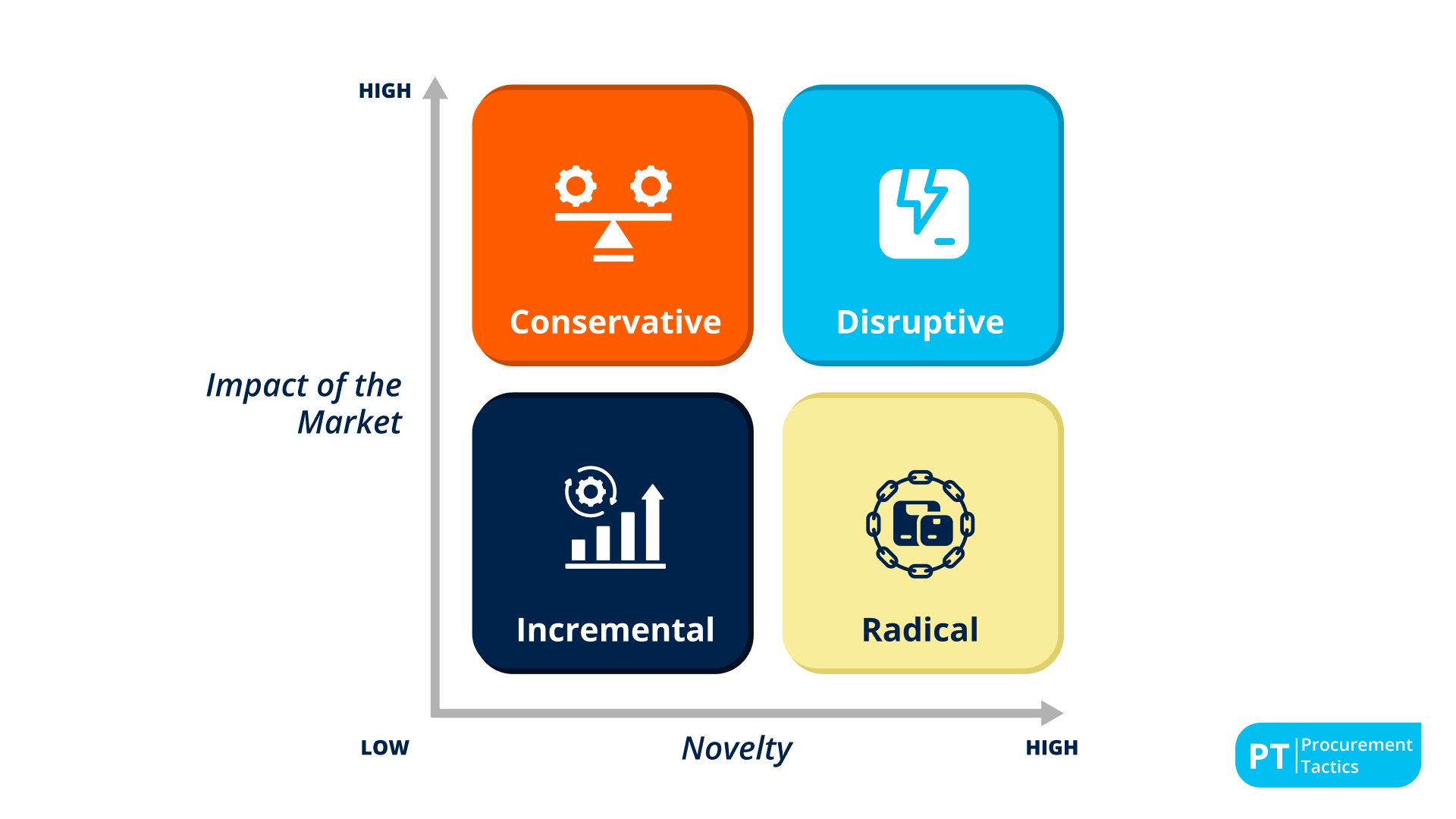
Here’s a breakdown of the four quadrants:
- Conservative (Behoedend): High impact but low novelty. These are proven innovations that scale what already works, often used to stabilize or improve existing processes.
- Disruptive (Disruptief): High impact and high novelty. These innovations redefine industries, challenge the status quo, and often emerge from unexpected players.
- Incremental (Incrementeel): Low impact and low novelty. These are the small, continuous improvements that help organizations run more efficiently without major changes.
- Radical (Radicaal): High novelty but initially lower market impact. These innovations require significant investment and risk but can lead to transformative long-term value.
So, how does this apply to you?
Think about where your organization fits on this matrix. Are you in a phase of optimizing what works? Then, incremental innovation may be your go-to strategy. Are you aiming to break into new markets or leapfrog the competition? Radical or disruptive approaches may be worth exploring.
In procurement, for example, incremental innovation might involve automating approval workflows to boost efficiency. Radical innovation, on the other hand, could mean redesigning the entire supplier ecosystem for sustainability, a longer-term play with transformative potential.
Conclusion
Innovation in procurement comes in many forms. From low-risk improvements to bold and market-changing ideas, each type—conservative, disruptive, incremental, and radical—plays an important role. The key is to understand where your organization stands and choose the approach that fits your goals, capabilities, and appetite for change.
Whether you are fine tuning existing systems or rethinking the entire procurement process, innovation is no longer optional. It is a necessary part of staying competitive and creating long term value. By recognizing the different types of innovation, you can make better decisions and lead your organization toward meaningful progress.
Frequentlyasked questions
What are the different types of innovation in procurement?
There are four main types of innovation in procurement: conservative, disruptive, incremental, and radical. Conservative innovation improves what already exists without major changes. Disruptive innovation introduces new solutions that slowly reshape the market. Incremental innovation makes small, continuous improvements. Radical innovation brings entirely new approaches that can transform industries.
What role does innovation play in procurement today?
Innovation helps procurement stay aligned with business goals, improve speed and accuracy, and find new sources of value. Whether through automation, sustainability, or supplier partnerships, innovation supports better decision-making and long-term competitiveness.
How can we decide which type of innovation to use?
The choice depends on your organization’s needs, risk tolerance, and available resources. If you’re focused on improving what you already do, conservative or incremental innovation may be right. If you want to change how things work or lead the market, disruptive or radical innovation might be more suitable.
About the author
My name is Marijn Overvest, I’m the founder of Procurement Tactics. I have a deep passion for procurement, and I’ve upskilled over 200 procurement teams from all over the world. When I’m not working, I love running and cycling.