


Written by Marijn Overvest | Reviewed by Sjoerd Goedhart | Fact Checked by Ruud Emonds | Our editorial policy
Electronics Sourcing: Definition, Process + Examples
- Electronics sourcing is the process of identifying, evaluating, and purchasing electronic components from reliable suppliers to ensure consistent production, quality, and compliance in the electronics industry.
- Global supply chain disruptions, component shortages, and rising demand for sustainable and traceable materials have made sourcing a strategic function rather than just a procurement task.
- Building strong supplier relationships, leveraging digital tools for visibility, and diversifying sourcing regions are key steps to ensure stability, cost-efficiency, and innovation in your electronics supply chain.
What is Electronics Sourcing?
Electronics sourcing is the process of identifying, evaluating, and purchasing electronic components such as semiconductors, sensors, circuit boards, and connectors that are essential for manufacturing electronic products. It is a critical part of the electronics supply chain, ensuring that the right components are available at the right time, cost, and quality level.
A well-structured sourcing strategy enables companies to maintain production continuity, reduce costs, and remain competitive in an industry characterized by rapid technological advancements and short product lifecycles. Successful sourcing decisions have a direct impact on product performance, reliability, and brand reputation.
Today, electronics sourcing also includes digital and data-driven tools that improve visibility and decision-making. Platforms for e-sourcing and AI-based procurement systems allow organizations to compare suppliers in real time, monitor component availability globally, and predict risks such as delivery delays or raw material shortages.
The Electronics Sourcing Process
Sourcing electronic components must be precise, reliable, and compliant with quality, safety, and regulatory standards. Below are seven steps that ensure the process is structured, efficient, and fully aligned with the specific requirements of the electronics industry.
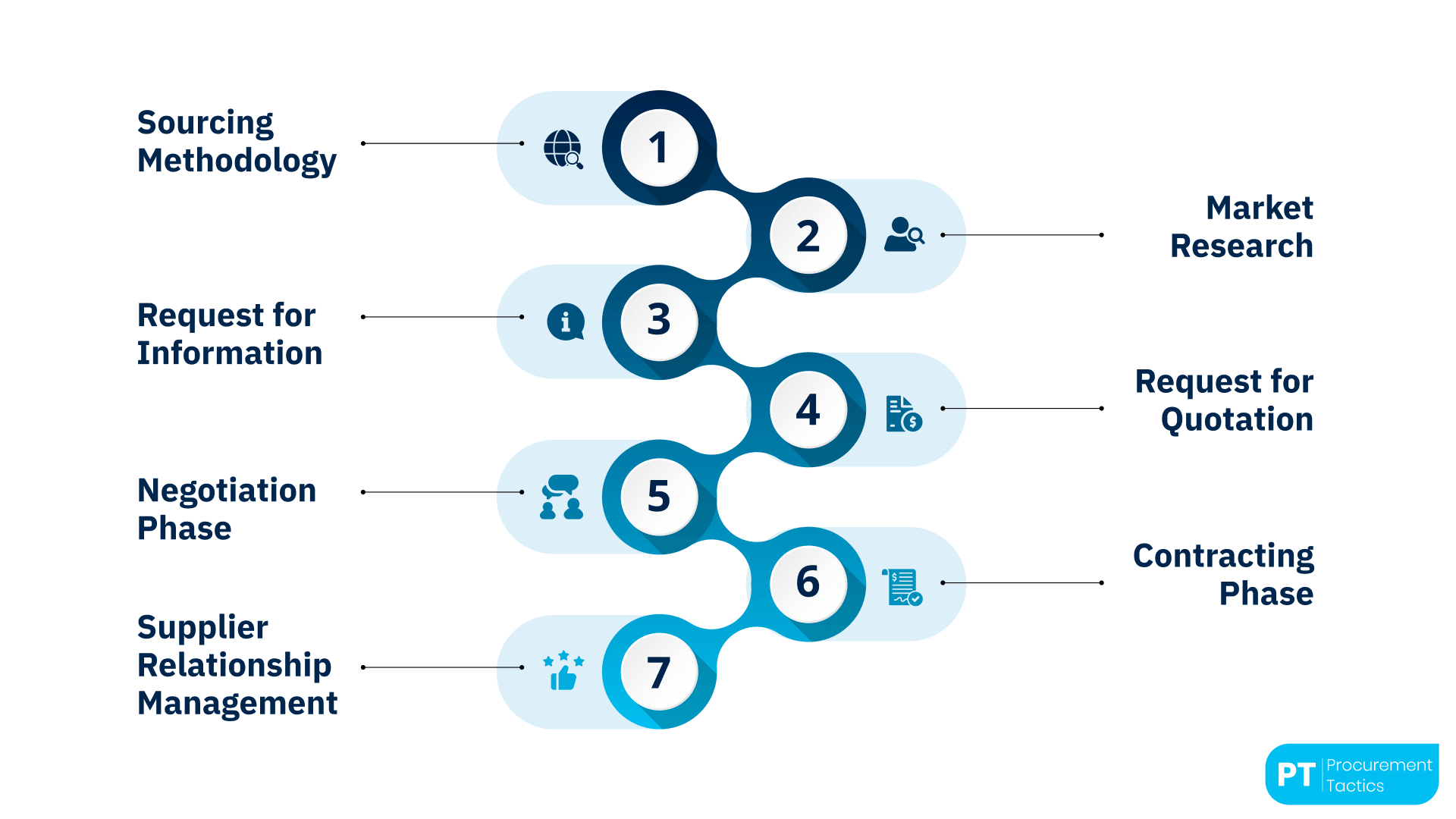
1. Sourcing Methodology
Before searching for specific components, organizations must define a clear sourcing framework. In electronics, this means identifying which categories are covered (for example, semiconductors, PCBs, sensors, or connectors), confirming production needs, and forming a cross-functional team that includes engineers, quality specialists, and procurement managers.
This “roadmap” ensures everyone understands the objectives, whether that’s avoiding production delays, improving component quality, or optimizing inventory levels for high-turnover parts.
2. Market Research
Market research in electronics sourcing involves analyzing authorized distributors, OEMs, and independent suppliers. Procurement must verify each supplier’s certifications (such as ISO 9001, RoHS, or REACH), lead times, and logistics capabilities.
For instance, when sourcing microchips, the team must check if the supplier provides traceability documentation, can guarantee stable delivery, and has access to current stock. Detailed market insight helps avoid counterfeit risks and supply interruptions that can halt entire production lines.
3. Request for Information (RFI)
At this stage, buyers send RFIs to potential suppliers to collect details about product availability, certifications, manufacturing capacity, and logistics support.
Internally, engineering teams validate technical specifications and tolerances, while procurement confirms minimum order quantities and acceptable lead times.
Based on RFI responses, suppliers that meet both technical and operational requirements are shortlisted for the next step.
4. Request for Quotation (RFQ)
Once qualified suppliers are identified, the procurement team sends an RFQ for specific components. The request includes pricing, delivery terms, warranty conditions, and batch tracking requirements.
In electronics sourcing, price is important, but availability, authenticity, and reliability are often more critical. For example, a cheaper supplier offering longer delivery times could stop an entire production cycle, leading to far greater costs than the component itself.
5. Negotiation Phase
Negotiation in electronics sourcing is not only about lowering prices. It also includes delivery schedules, logistics support, quality assurance, replacement terms, and long-term supply agreements. For instance:
“If we commit to a 12-month supply agreement, can you guarantee 30-day delivery windows and provide quarterly price reviews?” Effective negotiation balances cost efficiency, supply stability, and technological reliability.
6. Contracting Phase
Once all terms are agreed, every detail must be clearly specified in the contract. Electronics sourcing contracts typically include:
- Part numbers and specifications
- Compliance standards such as RoHS, REACH, and ISO 9001 help regulate hazardous materials, chemical use, and production quality.
- Delivery and logistics details
- Warranty and replacement conditions
- Traceability and documentation requirements
7. Supplier Relationship Management (SRM)
The process doesn’t end with signing the contract; it truly begins there. SRM in electronics sourcing means continuously monitoring supplier performance through KPIs such as on-time delivery, defect rate, and responsiveness to changes.

Regular reviews and audits help maintain high quality and reliability. Long-term partnerships with trusted suppliers ensure consistent access to certified, authentic components and help procurement teams respond quickly to market shifts or technological updates.
5 Real-World Examples of Electronics Sourcing
Example 1: Flex – Regional Sourcing for Global Stability
What they do:
Flex, one of the world’s largest electronics manufacturing service providers, recognized that its heavy reliance on long global supply chains created serious operational risks.
Component shortages, shipping delays, and regional lockdowns had repeatedly disrupted production across its global network.
To strengthen resilience, Flex redesigned its sourcing strategy around regional hubs located near key manufacturing centers in the Americas, Europe, and Asia-Pacific, each capable of operating independently if global logistics were interrupted.
How It Works:
Each regional hub manages a network of certified local suppliers and maintains real-time visibility dashboards that track inventory, pricing, and logistics performance.
The company introduced a unified digital procurement platform linking suppliers, planners, and engineers, enabling automated purchase order routing and faster communication.
Advanced analytics detect early signs of shortages and allow procurement teams to shift demand between regions as needed. This setup gives Flex a proactive, data-driven approach to supply management.
Why It’s Effective:
- Production continuity was maintained even during global transport disruptions.
- Lead times were reduced, while transport costs and carbon emissions decreased.
- Supplier reliability and overall supply chain stability improved across all regions.
Example 2: Siemens – Digital Supplier Management and Data Analytics
What they do:
Siemens, a global technology and manufacturing leader, faced growing complexity across its vast electronics supply chain.
Each business unit relied on separate tools and disconnected supplier databases, making it nearly impossible to track availability, compliance, or delivery performance in real time.
To fix this, Siemens built a centralized, AI-driven sourcing platform that connects engineering, procurement, and logistics teams within one integrated digital ecosystem.
How It Works:
The new platform consolidates supplier information, inventory visibility, and performance data across all business units. It uses predictive analytics and machine learning to monitor component availability, supplier KPIs, and compliance metrics continuously.
When potential shortages are detected, the system automatically recommends alternative suppliers or substitute parts. Procurement teams receive real-time alerts via dashboards, allowing them to make proactive, data-backed sourcing decisions instead of reacting to disruptions.
Why It’s Effective:
- Improved on-time delivery rates and supplier collaboration through shared, real-time data.
- AI-driven insights reduced production risks and enhanced negotiation leverage.
- Transformed a fragmented, reactive process into a unified, transparent, and predictive sourcing system that supports Siemens’ innovation and resilience goals.
Example 3: Foxconn – Supplier Diversification and Risk Control
What they do:
Foxconn, one of the world’s largest electronics manufacturers, had long relied on production and supplier networks concentrated in China.
This dependence created major vulnerabilities during logistics disruptions, border restrictions, and pandemic-related shutdowns.
To strengthen resilience, Foxconn launched a global diversification program that expanded sourcing and assembly operations to Vietnam, India, and Mexico.
How It Works:
The company restructured its supplier portfolio by adding regional partners and balancing procurement volumes across multiple continents.
It invested heavily in automated quality-control systems to maintain identical standards in all factories and introduced blockchain-based traceability for high-value components.
Every part can now be digitally tracked from supplier to production line, ensuring full visibility and protecting against counterfeit materials.
Why It’s Effective:
- Supply continuity was maintained even during Chinese transport bottlenecks and regulatory delays.
- Blockchain traceability improved transparency and verified component authenticity.
- Diversification turned supply-chain risk into a strategic advantage, giving Foxconn greater flexibility, compliance, and operational continuity across global markets.
Example 4: APAG Cosyst – Sustainable Electronics Sourcing
What they do:
APAG Cosyst, a Swiss electronics manufacturer supplying major automotive brands, aimed to align its procurement operations with EU sustainability regulations and corporate environmental goals.
The company realized that traditional sourcing approaches often ignored suppliers’ ecological impact.
To close this gap, APAG embedded sustainability criteria into every supplier selection and evaluation process, ensuring that environmental responsibility became a core procurement standard rather than an afterthought.
How It Works:
Procurement teams established mandatory sustainability documentation for all suppliers, covering areas such as energy efficiency, waste management, and material recycling.
Every new supplier was required to prove ISO 14001 compliance and present transparent waste-reduction initiatives. APAG also began conducting regular sustainability audits and introduced a scoring model that rated suppliers by their environmental performance and lifecycle impact.
The system allowed procurement officers to visualize sustainability metrics alongside price and quality when making sourcing decisions.
Why It’s Effective:
- Helped APAG meet stringent EU environmental regulations and client sustainability targets.
- Reduced waste and energy consumption while improving recycling efficiency.
- Enhanced the company’s brand reputation and built stronger partnerships with eco-conscious automotive customers.
Example 5: Rand Technology – Strategic Inventory Management
What they do:
Rand Technology, a global distributor of electronic components, faced recurring disruptions due to fluctuating customer demand and inconsistent supplier lead times.
Many of its OEM clients suffered production stoppages caused by missing critical parts.
To address these challenges, Rand implemented a strategic inventory management model centered on visibility, forecasting, and proactive stock control, aiming to ensure continuous component availability and minimize operational downtime.
How It Works:
Rand established a network of distribution centers strategically positioned near major manufacturing hubs worldwide. Each facility maintains safety stock for high-risk components identified through historical demand and volatility analysis.
The company integrated IoT sensors and predictive algorithms to monitor inventory in real time and forecast replenishment needs before shortages occur.
Data from suppliers and customers is analyzed continuously, allowing Rand to balance global inventory levels and reduce excess stock while maintaining readiness for urgent orders.
Why It’s Effective:
- Eliminated costly production delays for OEM customers through proactive stock control.
- Improved delivery reliability and responsiveness across global markets.
- Combined real-time data and predictive analytics to strengthen supply chain stability and customer trust.
Key Challenges in Electronics Sourcing
Below are some of the most common challenges procurement teams face when sourcing electronic components, along with practical solutions to address them:
Best Practices for Electronics Sourcing
Below are seven best practices that leading companies use to keep their supply chains stable, compliant, and cost-efficient.
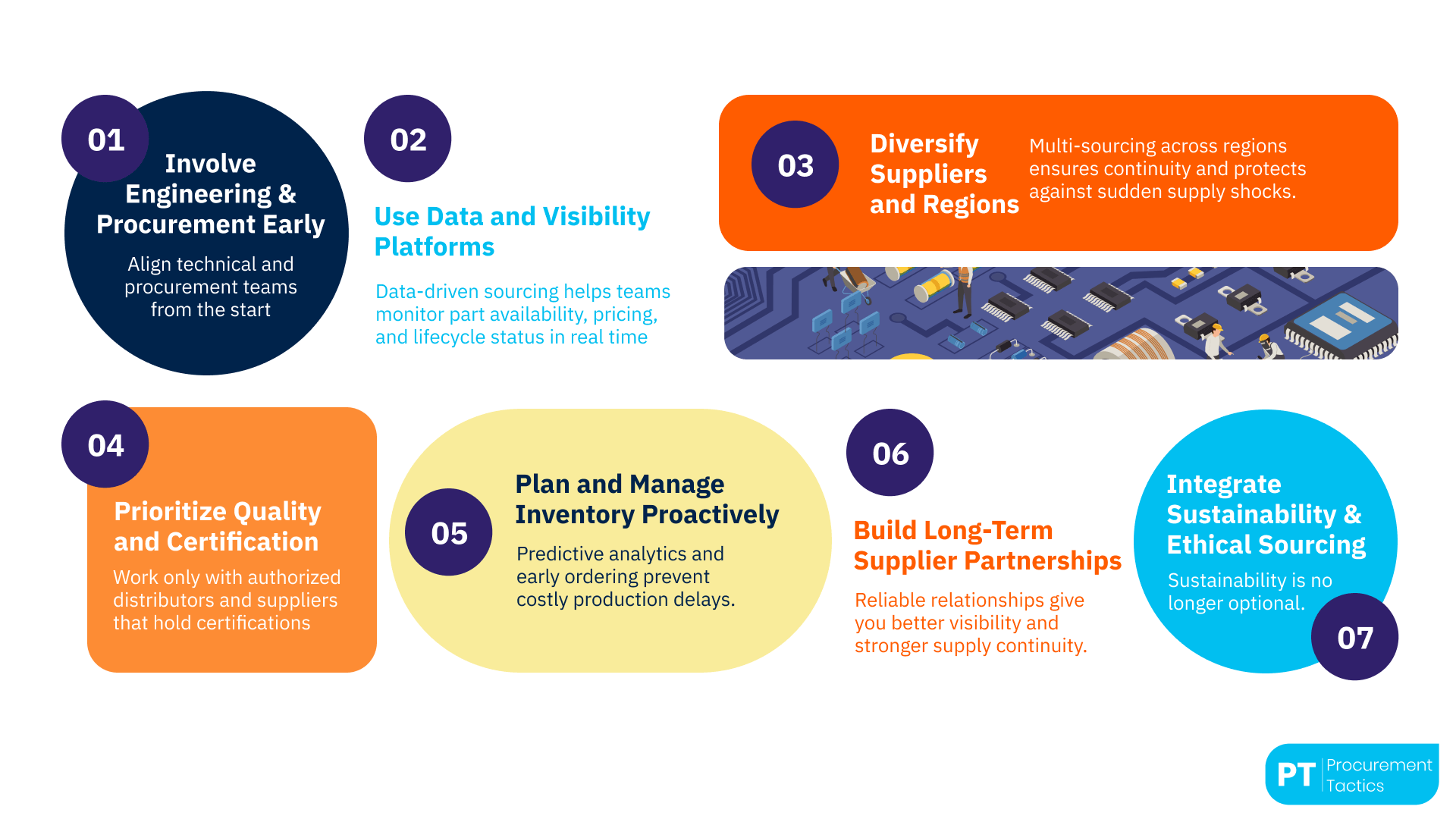
1. Involve Engineering and Procurement Early
The first best practice is to align technical and procurement teams from the start. When sourcing decisions are made alongside product design, companies can prevent late component changes, delays, and cost overruns.
For example, missing visibility between engineering and sourcing often leads to board re-spins and wasted time.
Tip:
Add a “component sourcing review” as part of your product design process, not just your purchasing workflow.
2. Use Data and Visibility Platforms
Data-driven sourcing helps teams monitor part availability, pricing, and lifecycle status in real time. Digital platforms integrate supplier databases, stock levels, and lead times into one system. This allows procurement to react faster when shortages arise.
Tip:
Integrate your sourcing data platform with ERP or PLM systems for real-time component lifecycle updates.
3. Diversify Suppliers and Regions
Never rely on one supplier or region. Global disruptions, from natural disasters to geopolitical conflicts, can shut down production. Multi-sourcing across regions ensures continuity and protects against sudden supply shocks.
Tip:
For each critical component, qualify at least two independent suppliers from different geographic areas.
4. Prioritize Quality and Certification
In electronics, quality is everything. Counterfeit or non-compliant parts can lead to product recalls and safety issues. Work only with authorized distributors and suppliers that hold certifications such as ISO 9001, RoHS, or REACH.
Tip:
Include traceability and inspection clauses in every contract to verify part authenticity and compliance.
5. Plan and Manage Inventory Proactively
Electronics sourcing must be proactive, not reactive. Components can suddenly become critical due to market trends or technology shifts. Predictive analytics and early ordering prevent costly production delays.
Tip:
Use demand forecasting tools to plan component needs and set reorder points for high-risk parts.
6. Build Long-Term Supplier Partnerships
Don’t chase the lowest one-time price. Instead, establish long-term agreements that guarantee stable pricing, priority allocation, and collaborative planning. Reliable relationships give you better visibility and stronger supply continuity.
Tip:
Use framework agreements that define volume ranges, review clauses, and performance-based incentives.
7. Integrate Sustainability and Ethical Sourcing
Sustainability is no longer optional. Electronics manufacturing faces real challenges with e-waste, recycling, and conflict minerals. Responsible sourcing improves both brand reputation and compliance with ESG standards.
Tip:
Select suppliers with verifiable sustainability certifications and include environmental clauses in your sourcing policies.
Conclusion
Electronics sourcing has shifted from a simple purchasing activity to a strategic driver of resilience and innovation. Global chip shortages, sustainability pressures, and volatile market conditions have forced procurement teams to think beyond price and focus on visibility, collaboration, and compliance.
Successful organizations treat sourcing as a continuous, data-driven process that connects engineering, procurement, and supply-chain functions. By adopting predictive analytics, regional diversification, and ethical standards, companies can secure a stable supply of authentic components while meeting environmental and social goals.
The future of electronics sourcing is digital, sustainable, and risk-aware. Those who invest in long-term supplier partnerships and intelligent sourcing tools today will be the ones leading tomorrow’s electronic manufacturing landscape.
Frequentlyasked questions
What is electronics sourcing?
Electronics sourcing is the process of identifying, evaluating, and purchasing electronic components, such as semiconductors, sensors, and circuit boards, from certified suppliers. It ensures that manufacturers receive the right parts on time, at the right quality and compliance level.
Why is electronics sourcing important?
Because even a single missing or faulty component can halt production. Strategic electronics sourcing ensures continuous supply, keeps costs under control, prevents counterfeit parts from entering the supply chain, and supports responsible, sustainable manufacturing practices.
How can companies improve their electronics sourcing strategy?
Use data-driven sourcing platforms for real-time visibility, diversify supplier regions to reduce dependency, establish long-term contracts, and integrate sustainability requirements into every sourcing decision.
About the author
My name is Marijn Overvest, I’m the founder of Procurement Tactics. I have a deep passion for procurement, and I’ve upskilled over 200 procurement teams from all over the world. When I’m not working, I love running and cycling.