

Written by Marijn Overvest | Reviewed by Sjoerd Goedhart | Fact Checked by Ruud Emonds | Our editorial policy
Insurance Procurement — Definition, Process + Examples
- Insurance procurement is the strategic process of sourcing, purchasing, and managing insurance policies and related services to ensure optimal protection and cost efficiency for an organization.
- Insurance procurement bridges risk management and procurement by aligning insurance coverage with corporate risk appetite and operational goals.
- Effective insurance procurement requires cross-functional collaboration between procurement, risk management, finance, and legal teams.
What is Insurance Procurement?
Insurance procurement is a strategic process that connects risk management with procurement excellence. It involves identifying an organization’s risk exposure, defining insurance needs, and then sourcing, negotiating, and managing coverage that provides the best protection at the best value.
Traditionally managed by risk or finance teams, insurance procurement today plays a broader role in ensuring transparency, competitiveness, and cost control. Modern approaches focus on market benchmarking, strategic partnerships with brokers and insurers, and measuring the Total Cost of Risk (TCOR) rather than just premiums.
By bridging internal stakeholders with external insurance providers, procurement teams help reduce coverage overlaps, prevent underinsurance, and align risk transfer with business goals. In a world of volatile markets, climate risks, and cyber threats, insurance procurement has become a core driver of enterprise resilience and long-term value.
The Insurance Procurement Process
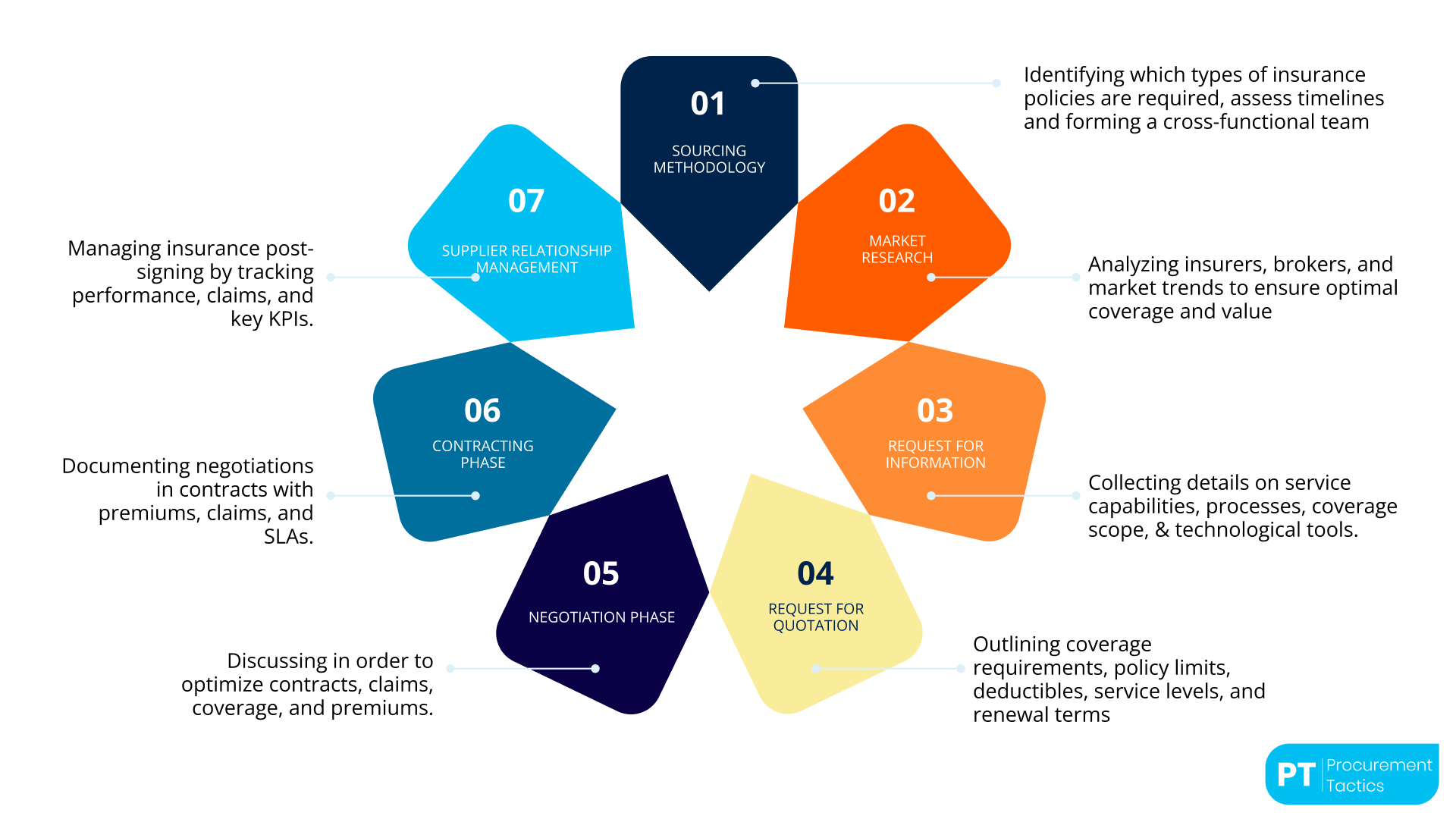
Below are seven stages that ensure the process is structured, data-driven, and fully compliant with regulatory and corporate standards.
1. Sourcing Methodology
Before launching an insurance tender, organizations must define a clear sourcing framework. This means identifying which types of insurance policies are required (for example, property, liability, cyber, marine, or directors & officers), assessing renewal timelines, and forming a cross-functional team that includes procurement, risk management, finance, and legal departments.
This “roadmap” ensures that all stakeholders share the same objectives, whether that’s reducing the total cost of risk (TCOR), expanding coverage for emerging risks, or strengthening insurer partnerships for long-term stability.
2. Market Research
Market research in insurance procurement involves analyzing insurers, brokers, and market trends to ensure optimal coverage and value. Procurement teams review insurer credit ratings, underwriting capacity, ESG credentials, and industry specialization.
For example, when sourcing cyber insurance, the team evaluates providers’ expertise in data breach response, claim turnaround time, and available risk-prevention services. Thorough research helps avoid coverage gaps, overpricing, or overreliance on a single insurer.
3. Request for Information (RFI)
At this stage, buyers send RFIs to potential brokers or insurers to collect details on their service capabilities, claims processes, coverage scope, and technological tools. Internally, risk and finance teams validate exposure data, claims history, and required coverage limits. Based on RFI responses, procurement can shortlist qualified providers that align with both technical and operational requirements, ensuring that only financially stable and specialized insurers proceed to the RFQ phase.
4. Request for Quotation (RFQ)
Once the shortlist is complete, the procurement team issues a detailed RFQ outlining coverage requirements, policy limits, deductibles, service levels, and renewal terms. The RFQ should also request data on claims handling procedures, communication channels, and value-added services like risk engineering.
In insurance, price matters, but so do reliability, claims efficiency, and support quality. For example, an insurer offering slightly higher premiums but faster claims resolution may deliver greater long-term value and business continuity.
5. Negotiation Phase
Negotiation in insurance procurement goes beyond premium reduction. It focuses on optimizing terms such as multi-year contracts, claim-response commitments, coverage extensions, and premium adjustment clauses.
For instance: “If we agree to a three-year term, can you guarantee a fixed premium for the first two years and a data-driven adjustment for the third?” Successful negotiation balances financial savings with service quality and predictable risk transfer.
6. Contracting Phase
Once negotiations are finalized, every detail must be clearly captured in the insurance contract or master service agreement. This includes premium schedules, policy renewals, claim procedures, service-level agreements (SLAs), data security provisions, and termination clauses.
Using Contract Lifecycle Management (CLM) systems helps organizations ensure compliance, track renewals, and centralize all policy documentation. This digital transparency supports audit readiness and internal governance.
7. Supplier Relationship Management (SRM)
Insurance procurement doesn’t end with signing a policy; it begins there. SRM involves continuously monitoring insurer performance, claims efficiency, and communication quality. Key performance indicators (KPIs) often include claim resolution time, renewal transparency, and policy accuracy.
Strong insurer and broker relationships lead to faster claim settlements, tailored coverage during renewals, and proactive advice on emerging risks such as climate exposure or cybersecurity. Over time, this transforms insurers into strategic partners in risk resilience rather than transactional vendors.

4 Examples of Effective Insurance Procurement
Below are several examples of how global companies have modernized their insurance procurement processes to achieve better coverage, stronger governance, and measurable cost savings.
1. Siemens – Centralized Insurance Procurement for Global Efficiency
What They Did:
Siemens consolidated more than 100 local insurance policies across regions into a single global framework. The procurement team worked closely with risk management and finance to standardize policy terms and create a unified tendering process with key insurers.
The Result:
The centralized model allowed Siemens to cut administrative costs by 15%, negotiate volume-based premium discounts, and improve claim handling consistency worldwide. It also enhanced data visibility across subsidiaries, helping the company monitor risk exposure in real time.
2. DHL Group – Using Data Analytics to Optimize Risk and Coverage
What They Did:
DHL integrated its global claims database with procurement analytics tools to calculate the Total Cost of Risk (TCOR) per business unit. This approach revealed areas of over-insurance and overlapping coverage.
The Result:
By restructuring policy layers and aligning deductibles with actual loss frequency, DHL reduced its total insurance spend by nearly 10% while maintaining the same level of protection. The procurement team gained credibility as a strategic partner to the risk department.
3. Unilever – Embedding ESG Criteria in Insurance Selection
What They Did:
Unilever aligned its insurance procurement strategy with the company’s sustainability framework. When renewing property and liability policies, procurement added ESG scoring criteria for brokers and insurers, rewarding those committed to net-zero underwriting and green claims handling.
The Result:
The company improved brand alignment, strengthened insurer partnerships, and received preferential terms from insurers with advanced sustainability practices. This also supported Unilever’s broader ESG reporting obligations.
4. Maersk – Strengthening Resilience Through Long-Term Partnerships
What They Did:
After facing major supply chain disruptions, Maersk’s procurement and risk teams launched a joint insurance review program. They engaged in multi-year negotiations with a select panel of insurers, focusing on stability, rapid claims response, and risk-prevention services.
The Result:
Maersk secured more predictable premiums, faster claims turnaround times, and value-added risk engineering services. This partnership approach improved operational resilience and reduced exposure to shipping-related incidents.
These examples show how companies can turn insurance procurement into a strategic advantage. Whether through data-driven decisions, sustainability alignment, or collaborative partnerships, success comes from treating insurance not as a cost, but as an investment in business resilience.
Challenges in Insurance Procurement
Even though insurance procurement is becoming more strategic, it still faces several industry-specific challenges. The table below summarizes the most common issues, explains why they occur, and outlines practical solutions for procurement teams.
Practical Tips for Successful Insurance Procurement
Beyond frameworks and case studies, several practical steps can make the insurance procurement process more efficient, transparent, and strategically valuable. The following table summarizes the most effective practices used by leading organizations.
Conclusion
Strategic insurance procurement is no longer a back-office renewal exercise.
It is a forward-looking business process that strengthens organizational resilience, controls costs, and builds lasting partnerships with insurers and brokers.
By combining procurement discipline with risk-management insight, companies can align coverage with operational priorities, improve claim responsiveness, and ensure transparency in every negotiation. Data analytics, digital tools, and ESG criteria are now essential enablers of smarter decision-making.
In the end, strategic insurance procurement is about more than buying protection; it is about procuring assurance: ensuring that every policy contributes to stability, compliance, and long-term value creation.
Frequentlyasked questions
What is strategic insurance procurement?
Strategic insurance procurement is the structured process of sourcing, negotiating, and managing insurance coverage through collaboration between procurement, risk, finance, and legal teams. It focuses on optimizing protection, cost efficiency, and governance, not just renewing existing policies.
How is it different from traditional insurance buying?
Traditional insurance buying is transactional and often managed solely by risk or finance. Strategic procurement adds data analysis, competitive tendering, and supplier performance measurement to ensure transparency and total-cost-of-risk optimization.
Why is cross-functional collaboration important?
Risk, finance, and procurement each hold different parts of the information needed to make smart insurance decisions. Cross-functional governance prevents coverage gaps, ensures compliance, and enables faster, more informed renewals.
About the author
My name is Marijn Overvest, I’m the founder of Procurement Tactics. I have a deep passion for procurement, and I’ve upskilled over 200 procurement teams from all over the world. When I’m not working, I love running and cycling.