

Written by Marijn Overvest | Reviewed by Sjoerd Goedhart | Fact Checked by Ruud Emonds | Our editorial policy
Procurement Savings — Definition, Types, Strategies + Examples
- Procurement costs can be reduced by buying smarter through better negotiations, supplier consolidation, and more strategic decision-making.
- Companies save money when they remove inefficiencies, automate manual tasks, and prevent unnecessary or off-contract spending.
- Long-term savings come from using data, optimizing inventory, and building strong supplier relationships that support stable pricing and better performance.
What is Procurement Saving?
Procurement saving refers to the money a company saves by improving the way it buys goods and services. These savings don’t happen by accident; they come from smarter sourcing, better negotiations, stronger supplier relationships, and more efficient internal processes.
In practice, procurement savings include anything that reduces total spending without lowering product or service quality. This can mean negotiating a lower price, choosing a more cost-effective supplier, avoiding rush fees, consolidating similar items, or improving workflows so the team spends less time and money on manual tasks.
3 Types of Procurement Savings
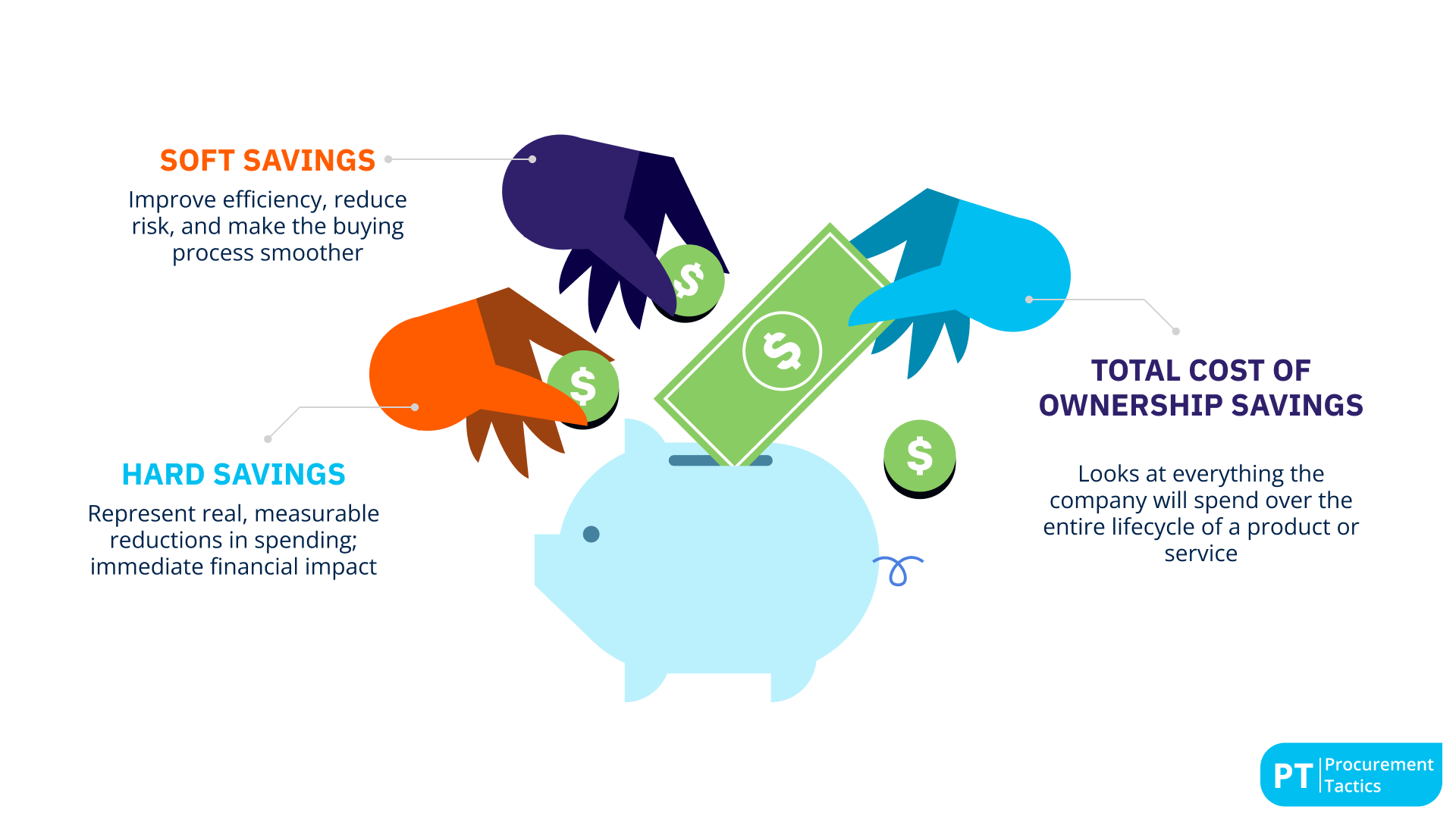
Procurement savings come in different forms. Some are visible immediately on the balance sheet, while others show up as fewer problems, smoother processes, or better long-term decisions. Most organizations categorize these savings into three types: hard savings, soft savings, and Total Cost of Ownership (TCO) savings.
1. Hard Savings
Hard savings are the most straightforward type of savings. They represent real, measurable reductions in spending and have an immediate financial impact. These are the savings everyone thinks of first when talking about procurement.
Hard savings typically come from:
- Negotiating lower prices
- Consolidating suppliers to get volume discounts
- Reducing shipping, logistics, or service fees
- Switching to a more cost-effective supplier
Because hard savings directly reduce costs, they are the easiest to calculate and report. If a company paid $10 before and now pays $8, the impact is immediate and visible.
2. Soft Savings
Soft savings are more subtle. Instead of reducing a current cost, they avoid or prevent a future cost. Soft savings improve efficiency, reduce risk, and make the buying process smoother, but they may not always show up as direct budget reductions.
Examples include:
- Avoiding rush charges by planning purchases earlier
- Reducing manual work through automation, saving labor hours
- Improving compliance to prevent over-ordering or duplicate purchases
- Reducing supplier risk to avoid delays or penalties
Soft savings often support long-term operational improvements. They don’t immediately lower spending, but they help the company spend smarter and avoid unnecessary costs down the road.
3. Total Cost of Ownership (TCO) Savings
TCO savings take a broader view. Instead of looking only at the purchase price, TCO looks at everything the company will spend over the entire lifecycle of a product or service.
This includes costs for:
- Installation
- Maintenance and repairs
- Energy use
- Spare parts
- Training
- Disposal or replacement
For example, buying a cheaper machine today might seem like a good idea, but if it breaks down often or uses more energy, it could cost more over time. A higher-quality option might have a higher upfront price but lower TCO.
TCO savings help procurement make decisions that are not just cheaper today but more cost-effective in the long run.
7 Strategies for Achieving Procurement Savings
Procurement savings don’t come from one action, they come from a structured, consistent approach to sourcing, supplier management, and process improvement.
Leading companies use data, strong supplier relationships, and smart decision-making to reduce costs while maintaining quality. Here are the core strategies they rely on to achieve measurable savings.
1. Negotiating Stronger and Smarter Contracts
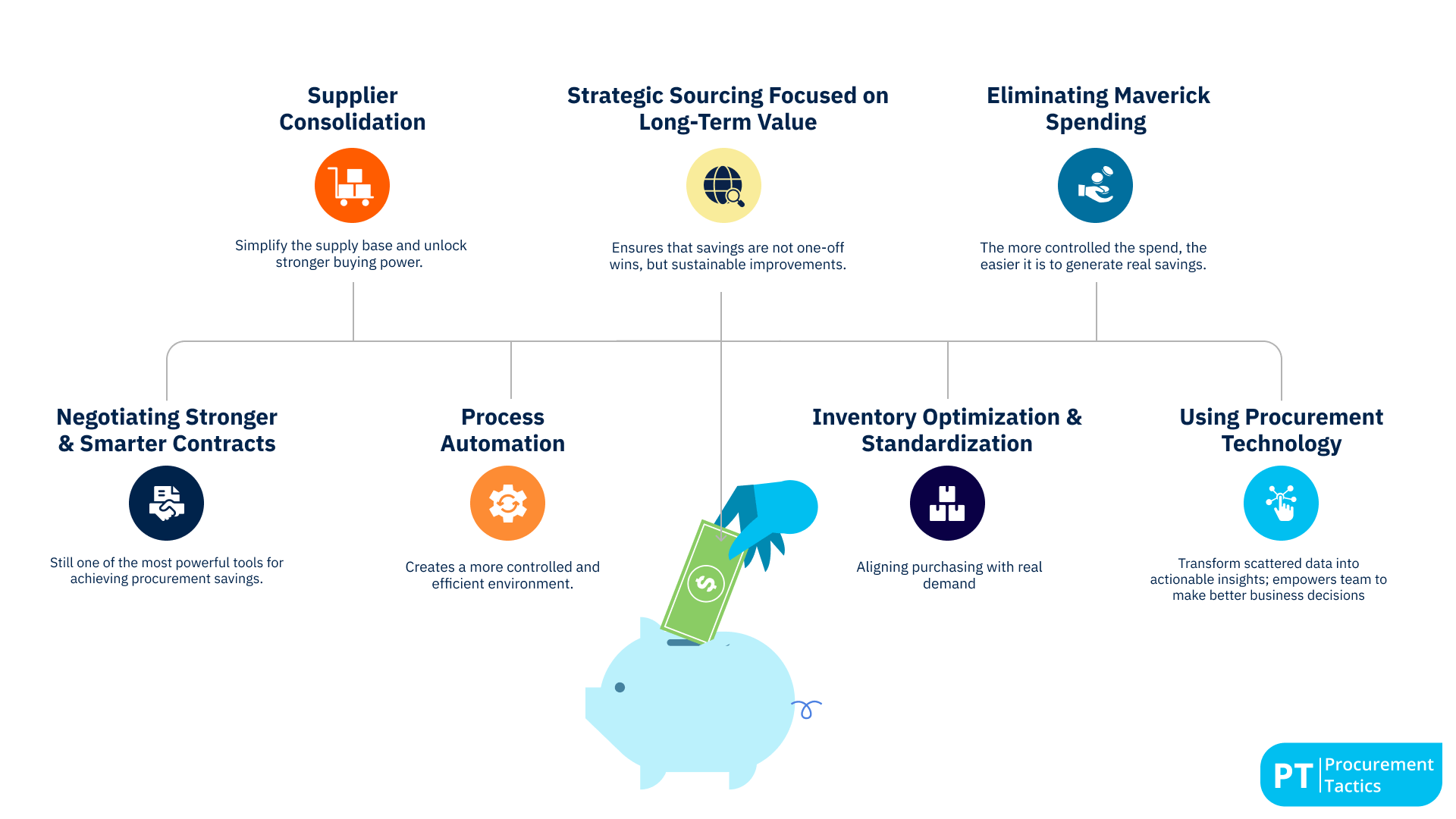
Negotiation is still one of the most powerful tools for achieving procurement savings. But modern negotiations go far beyond simply “asking for a lower price.” High-performing procurement teams prepare with market research, benchmark data, and a clear understanding of total cost, not just unit cost.
Effective negotiation can deliver:

- Lower prices through volume commitments
- Longer price-lock periods to protect against inflation
- Better payment terms that improve cash flow
- Added value, such as free delivery or extended warranties
When negotiation is done well, it immediately strengthens the company’s bottom line.
2. Supplier Consolidation for Higher Efficiency
Many organizations work with far more suppliers than they actually need. This creates complexity, scattered spending, and higher administrative costs. By consolidating suppliers, especially in indirect categories, companies simplify the supply base and unlock stronger buying power.
Benefits include:
- Larger volumes with fewer suppliers mean better discounts
- Less time spent managing contracts, invoices, and onboarding
- Clearer quality expectations
- More strategic, partnership-driven relationships
Consolidation reduces cost and improves operational coherence.
3. Process Automation to Reduce Manual Work and Errors
Manual procurement processes are slow, error-prone, and expensive. Automating key steps, such as purchase approvals, invoice verification, catalog ordering, and supplier onboarding, creates a more controlled and efficient environment.
Automation delivers savings by:
- Reducing invoice errors and duplicate payments
- Speeding up purchase cycles
- Improving policy compliance
- Freeing employees to focus on strategic tasks instead of paperwork
Digital workflows create transparency and predictability, which are essential for consistent savings.
4. Strategic Sourcing Focused on Long-Term Value
Strategic sourcing shifts procurement from a reactive function to a forward-looking one. Instead of choosing the cheapest option today, companies analyze trends, total cost of ownership, supplier performance, and risk exposure to make smarter long-term decisions.
This approach helps companies:
- Build reliable, high-performing supplier networks
- Stabilize pricing through long-term contracts
- Reduce supply disruptions
- Improve quality and service levels
Strategic sourcing ensures that savings are not one-off wins, but sustainable improvements.
5. Inventory Optimization and Standardization
Inventory ties up money. When stock levels are too high, companies pay for storage, insurance, and obsolescence. When stock levels are too low, they face emergency orders, delays, and premium shipping costs.
Optimizing inventory means:
- Aligning purchasing with real demand
- Reducing unnecessary variations of the same product
- Standardizing frequently used items across departments
- Reviewing safety stock regularly and adjusting it based on data
Even small improvements in inventory planning can generate significant long-term savings.
6. Eliminating Maverick Spending
Maverick spending happens when employees buy outside approved channels—often choosing more expensive suppliers or creating duplicate purchases. This behavior reduces visibility and weakens negotiation power.
Companies reduce maverick spending by:
- Providing clear procurement policies
- Offering easy-to-use purchasing tools that employees actually like
- Improving catalog availability and approved supplier lists
- Tracking and reporting off-contract spend
The more controlled the spend, the easier it is to generate real savings.
7. Using Procurement Technology for Data-Driven Decisions
Modern procurement tools (e-procurement, spend analytics, contract management, supplier management systems) transform scattered data into actionable insights. With the right tools, companies can see exactly where money is going and where savings opportunities exist.
Technology enables teams to:
- Identify overspending and duplicate suppliers
- Benchmark prices across suppliers
- Track contract compliance
- Improve forecasting and budgeting
- Automate repetitive work
Technology doesn’t replace the procurement professional, it empowers them to make smarter, faster, and more confident decisions.
3 Real-Life Examples of Procurement Savings
Here are three real-world examples of how leading companies achieve procurement savings in practical, measurable ways.
1. IBM: Supplier Consolidation and Global Standardization
What they do:
IBM manages thousands of categories across its global operations. For years, the company worked with almost 4,000 different suppliers for IT equipment alone. This created higher costs, inconsistent pricing, and complicated contract management. To fix this, IBM launched a global supplier consolidation initiative.
How It Works:
IBM analyzed its entire supplier base and eliminated duplicate vendors, negotiated new global framework agreements, and standardized IT equipment used across countries.
Instead of hundreds of laptop models, they moved to a small, approved set of devices. Together with strategic suppliers, IBM secured volume-based pricing and better service-level terms.
Why It’s Effective:
- Fewer suppliers mean stronger negotiation power
- Standardization reduces support and maintenance costs
- Global contracts ensure consistent pricing across markets
This approach helped IBM save millions by simplifying sourcing and increasing buying power.
2. Coca-Cola: Automating the Procurement-to-Pay Process
What they do:
Coca-Cola used to rely heavily on manual purchasing and invoice processes, which caused delays, errors, and unnecessary costs. To improve visibility and lower expenses, they implemented a global e-procurement and e-invoicing system.
How It Works:
The new system automates purchase requests, approvals, invoice matching, and contract compliance.
Procurement teams now use real-time data dashboards to track spend, spot savings opportunities, and reduce off-contract buying. Suppliers submit invoices digitally, which speeds up payments and reduces disputes.
Why It’s Effective:
- 65% faster purchasing cycles
- Fewer invoice errors and duplicate payments
- Higher compliance means more savings from negotiated contracts
By automating routine tasks, Coca-Cola significantly reduced administrative costs and improved overall savings performance.
3. Unilever: Strategic Sourcing for Packaging Materials
What they do:
Unilever spends billions on packaging across hundreds of brands. Because of high market volatility in plastics, paper, and aluminum, they needed a long-term strategy to control costs and improve stability.
How It Works:
Unilever shifted from short-term bidding to strategic sourcing.
They analyzed global demand, partnered with key suppliers, and negotiated multi-year agreements that included price stability, sustainability standards, and joint innovation initiatives.
They also reduced the number of packaging variations by standardizing common components.
Why It’s Effective:
- 8% overall reduction in packaging costs
- Better protection from price fluctuations
- Lower operational complexity and waste
Benefits of Procurement Savings
Procurement savings do far more than simply reduce costs. When they are applied consistently and strategically, they strengthen the entire organization, financially, operationally, and competitively.
Savings help companies improve profitability, work more efficiently, and build stronger supplier partnerships. The table below shows the key benefits and why they matter for long-term business success.
7 Common Challenges in Achieving Procurement Savings
These are the most common challenges companies face when trying to achieve procurement savings. Recognizing those helps procurement teams plan more effectively and build realistic savings strategies.
Conclusion
Procurement savings are not just about lowering prices; they are about transforming the way a company buys, plans, collaborates, and manages value. As this guide shows, real savings come from a combination of smarter sourcing, strategic supplier relationships, data-driven decisions, and streamlined internal processes.
When organizations invest in the right tools, skills, and strategies, procurement becomes a powerful driver of financial performance rather than a simple cost-control function.
Hard savings deliver immediate, measurable results. Soft savings prevent future costs and strengthen operations. Total Cost of Ownership (TCO) savings help companies make smarter decisions that pay off over time. Together, these savings shape a more resilient, efficient, and competitive organization.
Frequentlyasked questions
What are procurement savings?
Procurement savings are the cost reductions a company achieves by purchasing goods and services more efficiently. This includes negotiating better prices, improving processes, consolidating suppliers, preventing unnecessary costs, and making smarter long-term decisions that reduce total spending without compromising quality.
How do you calculate procurement savings?
Savings can be calculated in several ways, depending on the type:
- Hard savings: (Old price – New price) × Volume
- Soft savings: Estimated cost avoided due to improved processes or planning
- TCO savings: Total lifetime cost before improvement – Total lifetime cost after improvement
Organizations often track savings monthly or quarterly and validate them with Finance.
What causes companies to lose potential savings?
Typical reasons include maverick spending, poor data quality, siloed teams, outdated manual processes, lack of training, and a focus on short-term discounts rather than long-term value.
About the author
My name is Marijn Overvest, I’m the founder of Procurement Tactics. I have a deep passion for procurement, and I’ve upskilled over 200 procurement teams from all over the world. When I’m not working, I love running and cycling.