

Written by Marijn Overvest | Reviewed by Sjoerd Goedhart | Fact Checked by Ruud Emonds | Our editorial policy
Purchase Requisition — Definition, Process + Example
Table of contents
- What is a Purchase Requisition?
- How a Purchase Requisition Works
- The 9 steps of the Purchase Requisition Workflow
- The 7 Key Differences Between Purchase Requisition and Purchase Order
- What to Include in a Purchase Requisition
- The 6 Benefits of Using Purchase Requisitions
- 6 Common Challenges with Purchase Requisitions
- Real-World Example Purchase Requisition
- Conclusion
- Frequently asked questions
- A purchase requisition is an internal request used to formally ask for approval to buy goods or services. It is the first step in the procurement cycle and is not sent to suppliers.
- Its purpose is to document the need, justify the purchase, and route it through internal approvals before a purchase order is created.
- A requisition is an internal request for approval, while a purchase order is an external, legally binding document issued to suppliers. Requisitions initiate the process; Purchase orders(PO) finalize the transaction.
What is a Purchase Requisition?
A purchase requisition is an internal request used to ask for approval to buy goods or services before placing an order with a supplier. It marks the formal start of the procurement process.
The requisition describes what is needed, why it is required, and the estimated cost, then moves through internal approvals such as management, finance, or procurement.
Its purpose is to control spending, validate business needs, and ensure compliance. Once approved, it is converted into a purchase order, which is sent to the supplier.
How a Purchase Requisition Works
A purchase requisition follows a structured internal workflow that captures a purchasing need, routes it for review, and secures approval before any order is placed with a supplier. While processes may vary by organization, the core steps are largely the same.
The workflow starts when an employee or department identifies a need that cannot be met through existing stock or contracts. The requester submits a requisition with key details such as item description, quantity, estimated cost, justification, and required delivery date. At this stage, the requisition is a request only, not an approval.
The requisition then moves through internal approvals, typically involving the line manager, finance for budget validation, and procurement for policy and supplier compliance. Once approved, procurement converts the requisition into a purchase order (PO), which formalizes pricing, quantities, and delivery terms and is sent to the supplier.
By acting as an internal control point, the purchase requisition ensures that every PO is justified, approved, and aligned with budgets and policies before any financial commitment is made.
The 9 Steps of the Purchase Requisition Workflow
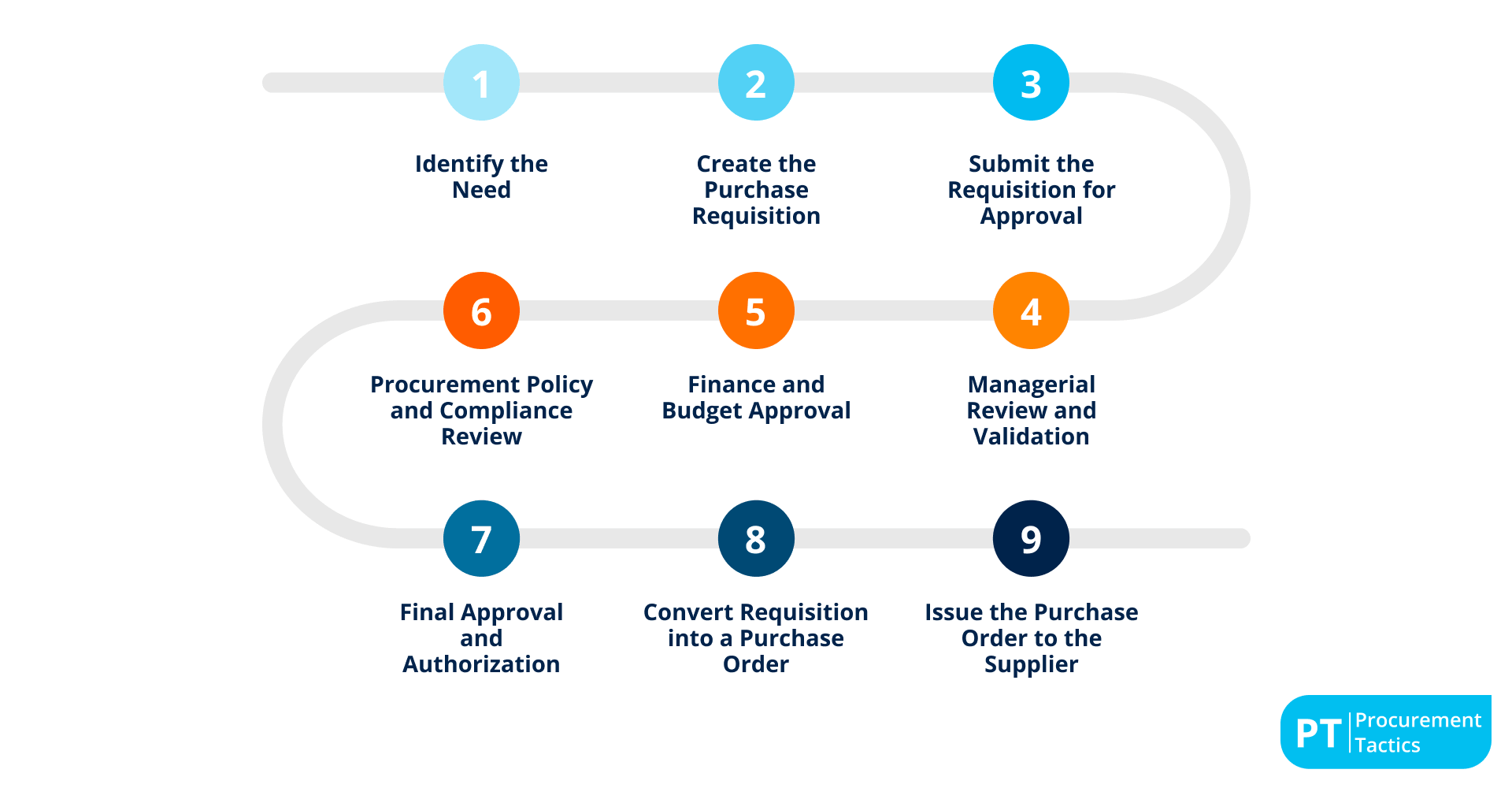
A purchase requisition follows a structured sequence from identifying a need to issuing a purchase order. While the exact workflow may vary by organization, the 9 steps below reflect how requisitions are typically handled in practice and explain not only what happens, but why each step matters.
1. Identify the Need
The process starts when an employee or department recognizes a requirement that cannot be fulfilled through existing inventory, framework agreements, or active contracts.
This might include replacing worn-out equipment, onboarding new employees who need software licenses, or securing external services for a specific project.
For example, a warehouse supervisor realizes that safety gloves are running low and the current stock will not last through the next production cycle.
2. Create the Purchase Requisition
Once the need is confirmed, the requester creates a purchase requisition. This step translates the need into a structured request by documenting what is required, in what quantity, and by when.
A well-prepared requisition typically includes specifications, estimated cost, justification, and sometimes suggested suppliers. For example, an IT manager requesting laptops may include technical requirements and reference a preferred vendor to speed up procurement review.
3. Submit the Requisition for Approval
After completion, the requisition is formally submitted to the approval workflow. This step ensures the request is visible to all relevant stakeholders and enters the company’s internal control system.
For example, a marketing coordinator submits a requisition for campaign materials through the procurement system instead of emailing the request informally.
4. Managerial Review and Validation
The requester’s line manager reviews the requisition to confirm that the purchase is operationally justified and aligned with departmental priorities. If details are missing or unclear, the requisition may be returned for clarification.
For example, a team lead questions whether ten licenses are needed immediately or if five would be sufficient for the current phase of the project.

5. Finance and Budget Approval
Once operationally approved, the requisition is checked by finance or the budget owner. This step focuses on financial feasibility: confirming budget availability, validating cost estimates, and ensuring the expense aligns with financial plans.
For example, a marketing campaign requisition may be approved operationally but delayed if it exceeds the allocated quarterly budget.
6. Procurement Policy and Compliance Review
Procurement reviews the requisition to ensure compliance with purchasing policies, preferred supplier lists, and existing contracts. This is often where procurement adds value by suggesting approved suppliers, negotiating better pricing, or consolidating demand with similar requests.
For instance, procurement may redirect a requisition to an existing framework agreement instead of initiating a new supplier engagement.
7. Final Approval and Authorization
After all required checks are completed, the requisition receives final approval and becomes an authorized request. For example, a high-value equipment purchase receives final sign-off from senior management due to its impact on annual capital expenditure.
8. Convert Requisition into a Purchase Order (PO)
Procurement converts the approved requisition into a purchase order, finalizing pricing, quantities, delivery terms, and contractual conditions. For example, procurement generates a PO using the approved requisition details, ensuring all specifications are carried over accurately.
9. Issue the Purchase Order to the Supplier
The purchase order is sent to the supplier, who reviews and accepts it. Once accepted, it becomes a legally binding agreement. For example, a supplier confirms the PO and provides an expected delivery date, allowing operations to plan accordingly.
The 7 Key Differences Between Purchase Requisition and Purchase Order
To clearly highlight the seven key differences between these two documents, the table below compares their purpose, usage, timing, and legal role within the purchasing workflow.
What to Include in a Purchase Requisition
A purchase requisition should contain all key information needed to review, approve, and process a request efficiently. The elements below form the core of a complete requisition. or other attachments that clarify the request. Including these elements ensures faster approvals, fewer clarifications, and accurate conversion of the requisition into a purchase order.
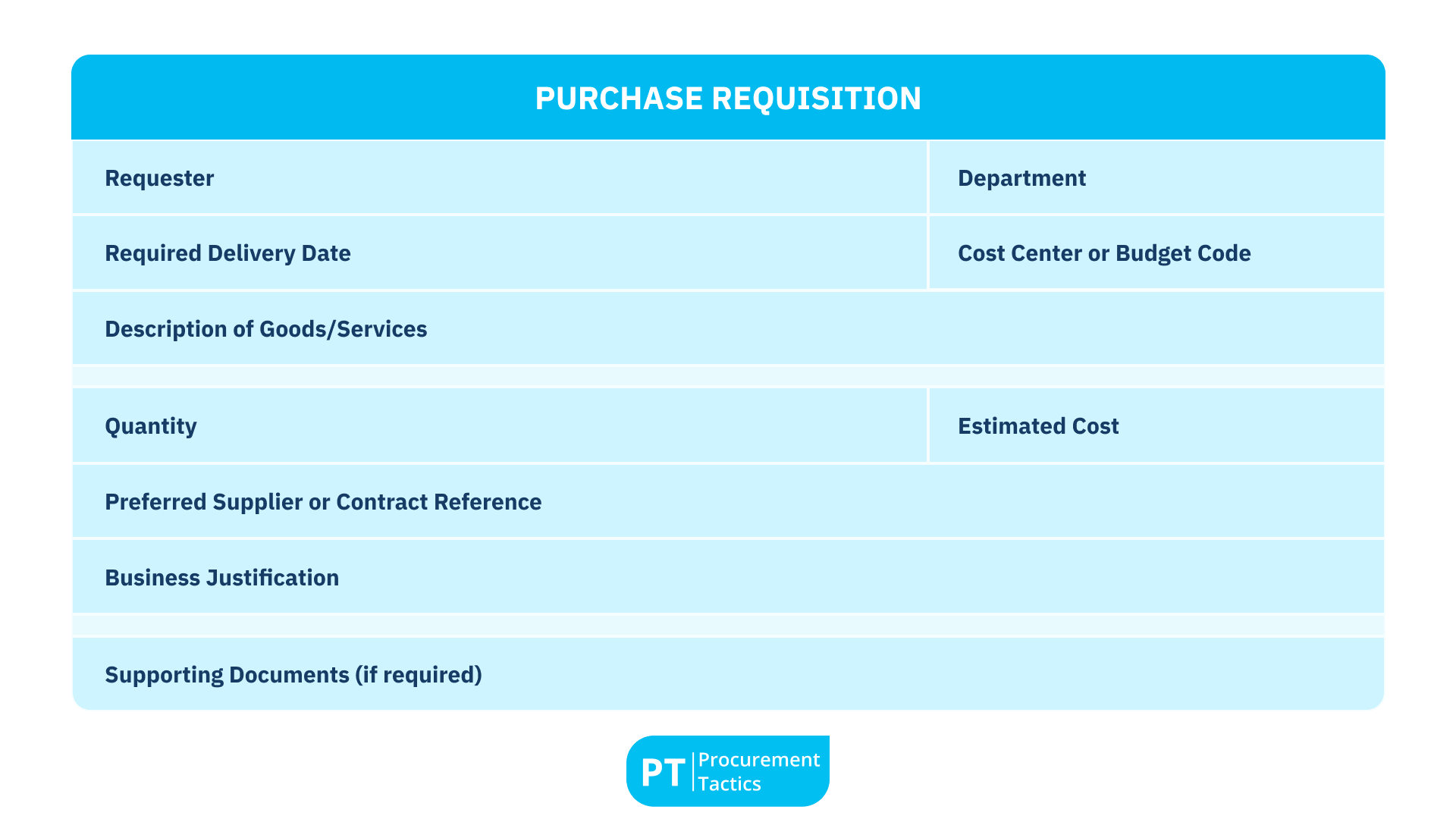
- Requester and Department – Identifies who is requesting the purchase and which department is responsible for the cost.
- Description of Goods or Services – Clearly defines what is being requested, including basic specifications or scope where relevant.
- Quantity – Specifies the number of items or level of service required.
- Required Delivery Date – Indicates when the goods or services are needed to support planning and prioritization.
- Estimated Cost – Provides an approximate value to support budget validation, even if the final price is not yet known.
- Cost Center or Budget Code – Ensures the expense can be correctly allocated and tracked by finance.
- Business Justification – Explains why the purchase is needed and how it supports operational or strategic objectives.
- Preferred Supplier or Contract Reference (if applicable) – Helps procurement assess whether existing suppliers or agreements can be used.
- Supporting Documents (if required) – Includes quotes, specifications, scopes of work, or other attachments that clarify the request and help approvers evaluate the purchase.
The 6 Benefits of Using Purchase Requisitions
The table below highlights the six key benefits, explains each one, and shows the practical outcome for the organization.
6 Common Challenges with Purchase Requisitions
Even well-designed requisition processes can face practical issues if policies, tools, or user training are unclear. The table below highlights the most common challenges, why they occur, how they can be resolved, and who is most affected.
Real-World Example Purchase Requisition
IBM Purchase Requisition Workflow
IBM provides a detailed and documented example of how a purchase requisition functions inside a structured enterprise workflow. Their model illustrates how organizations use requisitions to maintain cost control, enforce internal approvals, and ensure compliance before issuing any purchase order. The workflow described in IBM’s Control Desk documentation shows a tiered process where approval requirements depend on the value and nature of the request. This example clearly demonstrates how global companies operationalize requisition governance in everyday purchasing.
In the IBM scenario, the process begins when an employee submits a purchase requisition through the internal system. The requisition includes item details, estimated costs, and a justification for the purchase. Once submitted, the form enters an automated approval workflow where routing depends on the total dollar amount of the request. For low-value requisitions (e.g., below a predefined threshold such as 500 USD), the request may proceed directly to the purchasing department without additional review. Mid-range requisitions require approval from the requester’s manager, while high-value requisitions must be approved by senior management, sometimes including the finance director or CFO.
Only after all required approvals are collected does the requisition pass to the procurement team, which evaluates supplier options, verifies compliance with purchasing policies, and prepares the corresponding purchase order (PO). The PO is then issued to the supplier, initiating the formal buying process. IBM’s workflow demonstrates clearly that no purchase order can be created until the purchase requisition is fully approved, which enforces procedural discipline and financial control across the organization.
This example also highlights the scalability of requisition systems in enterprise environments. Since approvals are automatically triggered based on value thresholds, the organization avoids bottlenecks, prioritizes oversight for higher-risk purchases, and streamlines low-risk approvals. By using this approach, IBM ensures efficiency, compliance, and transparency throughout the procure-to-pay cycle.
Conclusion
Purchase requisitions are a foundational element of every controlled and mature procurement process. They ensure that all purchasing activity begins with a clear need, justified request, and documented approval. When implemented properly, requisitions improve financial discipline, strengthen policy compliance, and provide early visibility into upcoming spend.
They also streamline the creation of accurate purchase orders, reduce risk, and make procurement more strategic by preventing unauthorized or ad-hoc buying. Whether in small organizations or global enterprises like IBM, the requisition step acts as the gatekeeper that protects budgets, clarifies responsibilities, and supports transparent and efficient procurement operations.
Frequentlyasked questions
What is a purchase requisition?
A purchase requisition is an internal document used to formally request approval to purchase goods or services. It is the first step in the procurement process and must be approved before a purchase order can be created and sent to a supplier.
How is a purchase requisition different from a purchase order?
A requisition is an internal approval request, while a purchase order is an external, legally binding document sent to a supplier. Requisitions initiate the process; purchase orders finalize it.
What are the main benefits of using purchase requisitions?
Using purchase requisitions helps organizations control spending, ensure budget compliance, reduce the risk of unauthorized purchases, and maintain a clear audit trail. They also improve visibility of upcoming costs, streamline approval workflows, and support the creation of accurate purchase orders.
About the author
My name is Marijn Overvest, I’m the founder of Procurement Tactics. I have a deep passion for procurement, and I’ve upskilled over 200 procurement teams from all over the world. When I’m not working, I love running and cycling.