

Written by Marijn Overvest | Reviewed by Sjoerd Goedhart | Fact Checked by Ruud Emonds | Our editorial policy
Negotiation Team — How To Manage Your Team + Examples

As taught in the Negotiation Course for Procurement Professionals / ★★★★★ 4.9 rating
Table of contents
- What is a Negotiation Team?
- When to Negotiate With a Team vs When to Negotiate Alone
- 5 Steps How To Manage Your Negotiation Team
- 3 Real-Life Examples
- What Roles Do You Need in a Negotiation Team?
- 5 Tips When Working With a Negotiation Team
- 5 Benefits of Negotiating With a Team
- Conclusion
- Frequently asked questions
What is a negotiation team?
- A negotiation team is a group of individuals with complementary skills collaborating to achieve a favorable outcome in discussions with another party.
- Working with a negotiation team has the potential to outperform solo negotiations.
- It is best to negotiate with a team when facing complex deals, creative negotiation, and international discussions.
What is a Negotiation Team?
A negotiation team is a group of people who work together to plan, communicate, and make decisions during a negotiation with another party. It brings different strengths into one coordinated approach, such as strategy, subject expertise, relationship management, and data analysis, so the team can evaluate options and respond effectively. By aligning goals, preparing concessions and arguments in advance, and keeping a consistent message during discussions, a negotiation team reduces risk and improves the quality of the final agreement.
When to Negotiate With a Team vs When to Negotiate Alone
5 Steps How To Manage Your Negotiation Team
Step 1: Define the mandate and decision boundaries
Start by aligning the team on the negotiation goal, the scope of issues on the table, and what a “good outcome” looks like. Clarify decision authority early by setting the reservation point, walk-away conditions, and who can approve concessions during the talks. Build the plan around clear alternatives by defining your BATNA and assessing the other side’s likely BATNA so the team knows when to push and when to pause. This step prevents internal confusion and reduces last-minute, pressure-driven decisions.
Step 2: Assign roles and create simple team rules
Appoint a clear team leader and assign roles such as lead negotiator, subject-matter expert, note-taker, and observer who tracks signals and dynamics. Make responsibilities explicit so people know when to speak, when to support, and when to stay silent, which keeps the table organized and credible. Agree on internal rules for requesting a caucus, handling disagreements, and sharing information in real time. Clear roles and rules reduce mixed messages and make teamwork smoother under pressure.
Step 3: Build one shared strategy and concession plan
Develop a single storyline that connects your interests, objective criteria, and preferred package of terms so everyone argues from the same logic. Map priorities by separating must-haves from tradeables, then design concession moves that protect value and create options for the other side. Estimate the ZOPA and prepare a few strong proposals that can be adjusted without losing alignment within the team. This step turns the negotiation from improvisation into coordinated execution.
Step 4: Set the communication plan and rehearse
Decide in advance who delivers key messages, who answers technical questions, and how the team will stay “on message” even if the other side tries to split you. Create short internal signals to request a pause, redirect questions, or confirm numbers and commitments before agreeing out loud. Run a rehearsal or role-play to test opening statements, likely objections, and your response flow, then tighten weak spots. Practice improves consistency, timing, and confidence at the table.
Step 5: Execute, coordinate in the moment, and debrief
During the negotiation, monitor pace and dynamics while the leader manages who speaks and when, using caucuses to regroup and protect alignment. Capture decisions and open items clearly so nothing important is left ambiguous, especially around concessions, timelines, and next steps. After the session, run a structured debrief to review what worked, what failed, and what to adjust for the next round. This learning loop strengthens the team’s performance and builds repeatable negotiation discipline over time.
3 Real-Life Examples of How To Manage Your Negotiation Team
1. United Auto Workers bargaining teams in the 2023 “Stand Up Strike”
In 2023, Shawn Fain led negotiations with General Motors, Ford Motor Company, and Stellantis by coordinating bargaining priorities and sequencing pressure rather than treating each talk as isolated. A key management move was keeping internal alignment while selectively escalating actions, which shaped what information was shared publicly and when the team shifted leverage to specific plants or issues. This required tight role discipline between negotiators, communications, and local teams so the message stayed consistent and concessions were controlled. The result is widely discussed as a modern example of coordinating multiple negotiation tracks while maintaining one unified strategy.
A practical team-management lesson from this case is how they structured coordination across sites and bargaining groups so tactics stayed consistent across negotiations. Internal coordination and “shared demands” helped prevent mixed signals, while frequent updates and clear priorities kept members and negotiators synchronized under high pressure. By managing timing, spokesperson roles, and escalation triggers, the team reduced confusion and improved leverage without losing internal control. These are exactly the kinds of team behaviors that separate “many people negotiating” from “one managed negotiation team.”
2. COP21 presidency and the facilitation team led by Laurent Fabius
During UNFCCC negotiations in Paris, the French COP presidency managed a large, complex negotiation by structuring the work around facilitation, listening, and process discipline rather than pushing only one national position. One concrete example of team management was building a facilitator structure to handle parallel issues, unblock deadlocks, and keep talks moving while the presidency maintained neutrality and trust. This kind of “process leadership” is real-world negotiation team management at scale, because success depends on role clarity, information flow, and consistent rules for how decisions and drafts move. It is also a strong example of using planned consultations and controlled drafting to keep many sub-negotiations aligned.
From a management standpoint, this case shows how a leader can coordinate a negotiation team by assigning facilitators, running disciplined consultations, and making sure every party feels heard while the core team tracks the overall landing zone. The presidency used structured engagement and a transparent process to prevent fragmentation and last-minute chaos, which is a common failure mode in large negotiations. The lesson for smaller teams is transferable: set roles, define how input is gathered, and keep a stable process for consolidating positions into a final package. Even if your team is only three people, “process design” can be the difference between confusion and control.

3. U.S. Department of State negotiation team behind the Iran nuclear deal, led by Wendy Sherman
In the negotiations that produced the Joint Comprehensive Plan of Action, the public often saw John Kerry, but reporting and official materials emphasize that the work depended on a managed team with a lead negotiator, technical experts, and coordinated partners. A clear “team management” feature was combining diplomatic bargaining with technical problem-solving, including the involvement of Ernest Moniz, because technical details shaped what could be agreed politically. Managing that kind of team means the leader has to control who handles which track, how expert input becomes negotiating positions, and how internal disagreements get resolved before facing the other side. It’s a real example of cross-functional negotiation management where preparation, internal alignment, and disciplined messaging mattered as much as the table conversation.
This case also highlights a practical coordination lesson: long negotiations require a repeatable routine for briefings, caucuses, and decision gates so the team doesn’t drift or contradict itself over time. Public accounts describe years of work, which implies sustained internal coordination, not a single “good meeting.” The takeaway for managing your own negotiation team is to treat expert input as part of the strategy process, not as random help in the room. When everyone knows the mandate, the roles, and the decision boundaries, the team can negotiate faster and with fewer internal surprises.
What Roles Do You Need in a Negotiation Team?
Good players make a good team, so let'[s make sure you have the right players onboard yours.
1. Team Leader
Let’s start off with the obvious one, the team leader. From the beginning on it’s important to establish the leader of the negotiation team. The leader should be prepared to talk with the stakeholders to discover the interests of both parties.
Job title: Contracting officer, contracting specialist.
2. Technical Experts
Having a technical expert on your team is almost just as important as having a team leader. Without having the technical knowledge about the topic, you’re negotiating in the dark.

Job title: Engineer, technical specialist, project manager, commodity specialist, inventory manager, property manager, logistics manager, or simply the end-user.
3. Financial Analyst
The financial analyst should protect the financial goals your team is aiming to achieve. The financial analyst usually works closely together with the team leader to determine the BATNA and the minimum requirements for a deal.
Job title: Auditor, financial analyst.
4. Legal Analyst
When the negotiations are reaching the final phase it’s time to include the legal analyst to cover all legal aspects of the deal. That being said, in many negotiations the legal terms have a significant impact on the deal. In that situation, it’s best to include the legal analyst from the start.
Job title: Legal counsel, administrative contracting officer, administration specialist.
5. Bridge-builders
In theory, your negotiation team should be fine with the 4 key roles mentioned above. However, in some scenarios, you might want to add a fifth player to the game. A bridge-builder is a person who has an established – positive – relationship with the opposing party. Throughout the conversations, this person should be tasked with listening carefully to the other side’s perspectives and interests. Knowing what’s important to the opposing party is an important asset. Their insights could be of great value when proceeding with an offer or counter offer.
Job title: Depends. Mainly relies on the relationship with the opposing party.
5 Tips When Working With a Negotiation Team
Once your team is installed, it’s time to discuss your strategy. Here are 8 tips for a successful team negotiation.
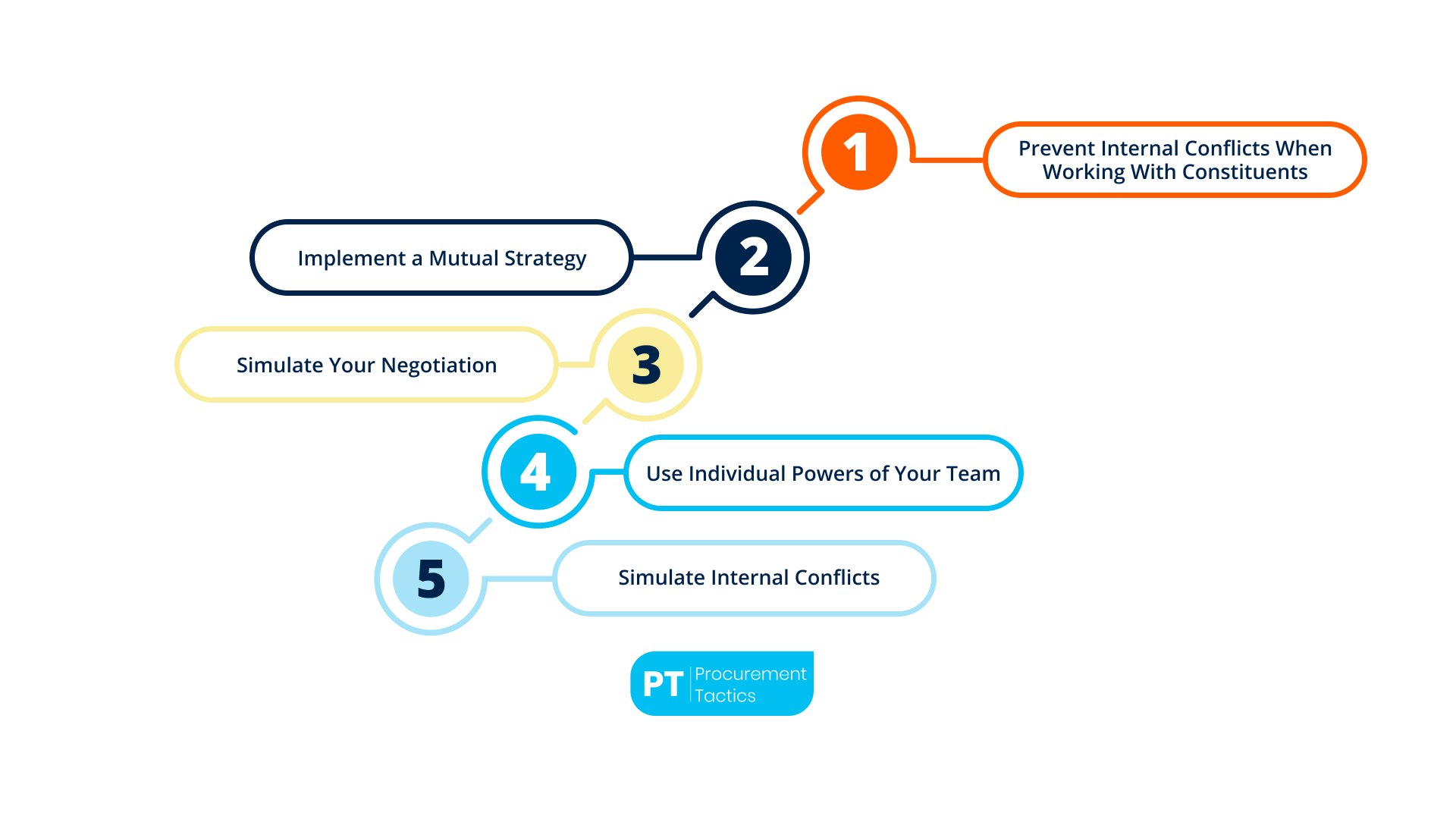
#1 Prevent Internal Conflicts When Working With Constituents
Many negotiations suffer from internal conflicts, simply because different team members pursue different goals. I’ll repeat:
Legal: “I don’t care about the costs. As long as we keep the patent safe.”
Sales: “I need this deal to happen. It will be good for my career”
Finance: “Let’s be cautious with this deal, we’re trying to close the books with a profit this year”
Because people don’t want to let their department down, they go all-in on their own goals which bottom line actually hurt the company. If constituents are presented with all the facts, however, they might be willing to concede more ground because they’ll also see the bigger picture. Therefore it might actually be wise to put together a team of individuals who are good at forming relationships across constituents.
#2 Implement a Mutual Strategy
If your negotiation team displays disagreement during a negotiation, you can be sure it won’t have a positive impact on your deal. Such breakdowns are a great source of inspiration for exploitation by the opposing party. Therefore, before you take a seat at the bargaining table, make sure to have one strategy.
#3 Simulate Your Negotiation
When preparing for negotiation there’s only so much you can predict. Opposing parties can pull unexpected tricks which mess up your strategy. Although some of these tricks are hard to predict, your team has to be prepared for each scenario. You can do this by simulating your negotiation. By roleplaying, you’re better able to put yourself in the shoes of your negotiating partner. This will help you to be better prepared for unexpected tricks.
#4 Use Individual Powers of Your Team
It’s important your team feels comfortable during the negotiation. You can help them by giving each a specific role.
For example, you could give your team clear instructions to protect the member who is responsible for the long-term client relationship by keeping him away from intense discussions. Don’t let him be the one to directly confront the other party about the pricing.
#5 Simulate Internal Conflicts
We’ve mentioned this a lot. Internal conflicts can have a disastrous impact on your negotiation. By simulating potential internal conflicts you’re able to prevent expensive mistakes at the bargaining table.
We like to do this by having each team member plotting down their own priority and position on each item of discussion. By discussing this upfront, you’ll make sure the team is on the same page when it matters.
5 Benefits of Negotiating With a Team
Conclusions
Working with a negotiation team has the potential of outperforming solo negotiations significantly. That being said, doing team negotiations with poor preparation could cause horrible results. Make sure your team is well prepared by implementing the tips mentioned in this article, and you’ll be set up for the perfect deal.
Want to know more about optimizing your team negotiation strategy? Enroll in our Negotiation Course For Procurement Professionals. It covers actionable negotiation strategies that have proven to lead to better deals.
But before you start to read this article, I have created a free-to-download, editable in-negotiation toolkit template. It’s a PowerPoint file that can help you create the best approach when negotiating with other parties. I even created a video where I’ll explain how you can use this template.
Frequentlyasked questions
What is a negotiation team?
A negotiation team is a coordinated group with clear roles that shares expertise, aligns goals and incentives, and delivers one consistent message to reach the best deal.
How to manage your negotiation team?
Manage your negotiation team by defining the mandate and decision boundaries, assigning clear roles, aligning incentives, preparing a structured concession plan, and controlling communication to prevent mixed messages.
When to negotiate alone?
Negotiate alone when team communication adds complexity or cost, incentives are misaligned, groupthink or internal competition is likely, or an inexperienced member could weaken your leverage.
About the author
My name is Marijn Overvest, I’m the founder of Procurement Tactics. I have a deep passion for procurement, and I’ve upskilled over 200 procurement teams from all over the world. When I’m not working, I love running and cycling.