


Written by Marijn Overvest | Reviewed by Sjoerd Goedhart | Fact Checked by Ruud Emonds | Our editorial policy
Tactics for Innovations in Operational Procurement

As taught in the Innovation in Procurement Course / ★★★★★ 4.9 rating
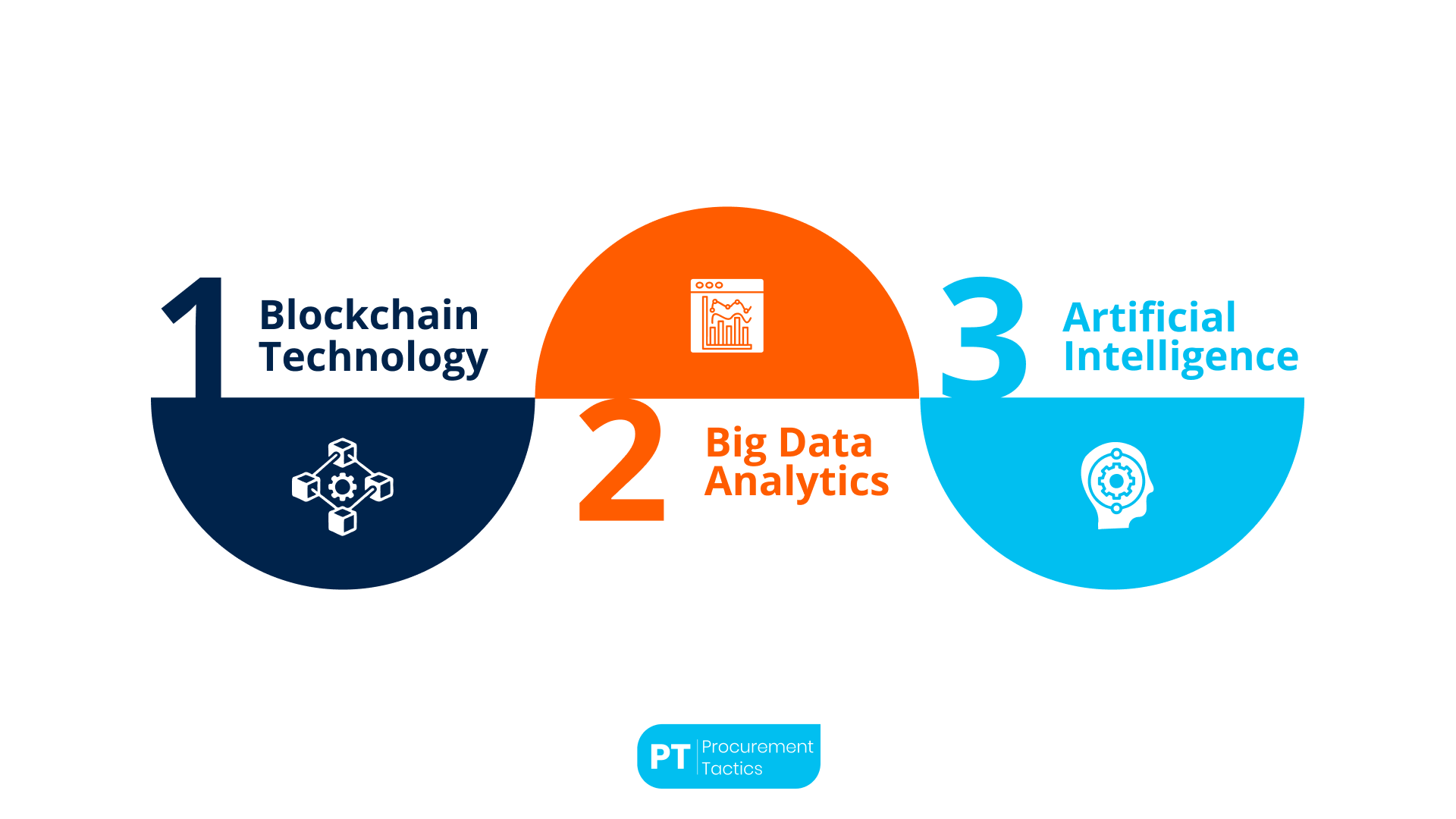
- The first tactic is blockchain technology, which provides secure, transparent tracking of transactions and goods across the supply chain.
- The second tactic is big data analytics, which enables smarter decisions by uncovering patterns, monitoring supplier performance, and predicting future needs.
- The third tactic is artificial intelligence, which automates manual tasks, detects anomalies, and delivers actionable insights to optimize procurement workflows.
What is Procurement 4.0?
Procurement 4.0 refers to the digital transformation of procurement. It uses sophisticated technologies, including artificial intelligence, along with automation systems, big data analytics, IoT capabilities, cloud-based frameworks, etc.
Procurement 4.0 is part of the broader Industrial 4.0 movement that seeks to make business operations smarter through connected, integrated systems.
The application of Procurement 4.0 results in moving away from manual and repetitive procedures to combine real-time systems that handle orders and invoices and manage supplier dialogues. The automation system enables better efficiency alongside accurate performance to secure strategic benefits in the daily procurement process and workflows.
Implementing Procurement 4.0 in your business operations can help you achieve the following:
- Workflow is faster and more accurate.
- More Data-driven information.
- Better supplier relationships.
- Risk reduction and compliance measures.
However, you must remember that the implementation of Procurement 4.0 requires more than just new technological implementation because organizations need to redesign their procurement system from a digital-first perspective.
The Three Tactics for Innovations in Operational Procurement
In this section, we will explain the three tactics using 4.0 technologies that can help you innovate your operational procurement. Let’s get started!
1. Blockchain Technology
Before we tell you how blockchain can help procurement, we must first know what blockchain is. Blockchain is a secure digital ledger that records transactions in a transparent, tamper-proof way.
To make this easier, you can think of it as a digital notebook that everyone can see, but no one can erase or change. Instead of being stored in one place, copies of this notebook are kept by a network of computers.
Every time something new is written down, like a transaction or update, it gets added to the end of the notebook, in a block, and locked in place. Over time, these blocks form a chain. That’s where the name comes from: blockchain.
Now, let’s discuss how it can help procurement. In supply chains, one of the biggest problems is tracking products and what’s happening during their journey to consumers. This is where blockchain can help. Instead of relying on scattered records, it creates a shared space where real-time updates are stored for transparency.
Imagine a bag of coffee beans leaving a farm in Colombia. With blockchain, every step, from picking to roasting to shipping, is tracked. By the time that coffee ends up in a café in New York, procurement teams can see exactly where it’s been. They can check for delays, verify sourcing, and catch any red flags along the way.
This approach is already making waves in industries like shipping, manufacturing, energy, and even healthcare. In short, blockchain isn’t just a hype, it’s a real tool solving real problems.
2. Big Data Analytics
Big Data Analytics (BDA) is the process of examining massive sets of information to discover patterns, relationships, and useful insights. Every day, companies generate an enormous amount of data from various sources. Without proper analysis, much of this information goes unused. That’s where BDA steps in; it helps make sense of this data and turns it into something valuable.
Here’s how BDA helps procurement in three major ways:
-
Managing Risks More Effectively
BDA gives teams access to current and past data, making it easier to detect issues early on. Whether it’s supplier delays, changes in lead times, or shifts in customer demand, BDA helps track these factors in real time. It also supports inventory planning by analyzing stock levels and demand trends, reducing the chance of running out of stock or over-ordering.
-
Monitoring Supplier Performance and Compliance
With the help of BDA, procurement can assess suppliers based on key metrics like quality, delivery speed, and pricing. It makes it easier to spot top-performing suppliers and identify those that need improvement. By comparing actual transactions with contract terms, teams can quickly check if suppliers are meeting their obligations.
-
Predicting Future Needs
BDA also helps with forecasting. By using large sets of data, procurement teams can anticipate what will be needed in the future. This means they can plan purchases based on likely demand, product availability, and pricing trends, reducing the chance of last-minute scrambling and improving long-term planning.
Of course, handling large amounts of data is no small task. Companies need the right tools and systems in place to manage and store it all. But once set up, Big Data Analytics can be a game-changer for procurement teams aiming to work more strategically.
3. Artificial Intelligence
Artificial Intelligence (AI) is the final technological solution within Procurement 4.0 that can enhance procurement operations. Before exploring its specific benefits for procurement, it’s important to establish a clear understanding of what AI is in procurement.
AI in procurement involves the use of AI tools to analyze data, streamline workflows, and produce valuable insights throughout the sourcing and purchasing lifecycle. With this, let’s now delve deeper into the ways AI can enhance procurement.
AI significantly enhances procurement by automating repetitive tasks, freeing up staff for strategic work. It empowers better decision-making through the identification of spending irregularities and the prevention of fraud. Furthermore, AI’s ability to analyze large datasets uncovers valuable cost-saving opportunities.
AI applications currently exist as practical solutions throughout procurement processes. For example, Zycus delivers an AI-powered smart catalog management solution to its clients. This system verifies that product information remains correct and uniform between regional and department divisions. The automated categorization feature enables the system to handle product sorting independently and prevent errors that negatively impact purchasing speed.
Another example of an AI tool is Coupa. Coupa demonstrates robust capabilities in fraud detection through its solutions. The platform employs AI and machine learning algorithms to perform ongoing data analytics on transactions, which enables the detection of abnormal behavior before flagging suspicious activities. The system protects against fraudulent activities while ensuring financial accuracy measures and compliance across all procurement operations.
Robotic Process Automation (RPA) is a specific AI application that uses software robots to automate repetitive manual tasks, like data extraction and form filling, by imitating human actions.
Automation Anywhere is a leading RPA software provider. They develop software robots capable of automating tasks such as data copying, form completion, and the transfer of system information. Their platform is known for its intuitive design, ability to scale, and strong security, making it a good choice for businesses dealing with substantial amounts of procurement data.
As artificial intelligence continues to grow and improve, its full impact on procurement is still unfolding. Still, the AI applications currently available are already enabling procurement specialists to optimize their processes, reduce errors, and achieve better outcomes with less manual oversight.

Real-Life Example Of The Three Tactics
1. Blockchain Technology Example — SkyCell
During the pandemic, global transport faced constant disruptions. One shipment of medicine, sent from Brussels to Mumbai, hit a major snag when flights were suddenly canceled. With the cargo stuck in transit and exposed to changing temperatures, there was a real risk that the medicine would spoil.
But SkyCell had a solution. Using blockchain, they were able to monitor and record temperature data at every point of the journey. Each update was securely logged, time-stamped, and instantly available to everyone involved. So even with delays, they could prove the medicine stayed within safe limits the entire time, ensuring it arrived in India ready for use.
2. Big Data Analytics Example — Hadoop, Cloudera, and MongoDB
When it comes to handling massive volumes of data, a few tools stand out—each built to manage different needs across industries.
Take Hadoop, for instance. It’s an open-source framework designed to store and process huge datasets across clusters of computers. Instead of relying on one machine, it spreads the workload out, which makes it great for dealing with big data. It can run countless virtual tasks at once, and though it’s powerful, getting the most out of it does mean having a solid grip on Java.
Then there’s Cloudera, which works alongside Hadoop to offer more enterprise-level features. Think of it as an upgrade that brings better security and management tools to the table, especially useful when companies need to protect sensitive data while scaling their operations.
And MongoDB takes a slightly different approach. It’s a flexible database that can handle everything from neat rows of structured data to messy, unstructured info like images or social media posts. One of its key advantages is that it cuts down on operational workload, by as much as 95%, thanks to its high-performance WiredTiger storage engine, which also boosts how efficiently data is stored.
These tools are just a few examples of how big data is being managed more intelligently in today’s digital world.
3. Artificial Intelligence Example — Signity Solution
Manual invoicing had become a time-consuming task for one IT company. Each month, their team had to pull data, sort it by project, calculate costs, generate invoices, and chase down approvals—all by hand. It was slow, error-prone, and pulled people away from higher-value work.
To solve this, they teamed up with Signity Solution, which introduced a Robotic Process Automation (RPA) system. The new setup handled everything: classifying project costs, exporting data monthly, creating invoices, alerting employees for approvals, and once approved, uploading everything to the ERP system and sending the invoices to clients. With this in place, the company automated 98% of its invoicing process and saw a sharp drop in manual errors.
Conclusion
Procurement 4.0 is a revolutionary shift from the traditional methods used to enhance the procurement process. It represents a powerful change by integrating advanced technologies like blockchain, big data analytics, and artificial intelligence to help procurement professionals make procurement faster, smarter, and agile by reducing the amount of time in focusing on repetitive tasks and avoiding risks that can damage supplier relationships and company reputation.
However, companies must ensure that they understand how they can use these advancements without risking their data privacy. They must have policies in place to mitigate the risks that these advancements can bring, especially when it comes to protecting their data. By embracing procurement 4.0, companies build a smarter procurement function that balances innovation with integrity.
Frequentlyasked questions
What is Procurement 4.0?
Procurement 4.0 refers to the digital transformation of procurement. It moves procurement away from manual, paper-based processes and toward smart, connected, and data-driven operations that enable better decision-making, enhanced collaboration, and faster execution.
What are the three tactics for innovations in operational procurement?
The three tactics that drive innovation in operational procurement are the use of blockchain technology to ensure transparency and traceability, the application of big data analytics to make informed and proactive decisions, and the adoption of artificial intelligence to automate tasks and improve forecasting accuracy.
Is Procurement 4.0 suitable for all types of businesses?
Procurement 4.0 is suitable for businesses of all sizes, as large enterprises benefit from scalability and process optimization, while small and medium enterprises can take advantage of affordable cloud-based solutions and automation tools to streamline their procurement operations.
About the author
My name is Marijn Overvest, I’m the founder of Procurement Tactics. I have a deep passion for procurement, and I’ve upskilled over 200 procurement teams from all over the world. When I’m not working, I love running and cycling.