

Written by Marijn Overvest | Reviewed by Sjoerd Goedhart | Fact Checked by Ruud Emonds | Our editorial policy
AI in Procurement Software — How it Transforms Procurement Workflows

As taught in the AI Implementation Course For Procurement Directors / ★★★★★ 4.9 rating
- AI in procurement software automates repetitive tasks like supplier screening, contract review, and spend analysis, saving time and reducing errors.
- AI in procurement software provides actionable insights, enabling procurement teams to make data-driven decisions and manage risks more effectively.
- AI in procurement software transforms workflows from reactive to proactive, helping teams anticipate challenges and optimize sourcing strategies.
How AI is Changing Procurement Workflows Today
AI is no longer just about speeding up tasks; it’s reshaping procurement workflows. With AI features built into software, teams can skip manual data crunching and compliance checks. Here’s how it’s changing daily work today:
1. Automated Supplier Screening
Traditionally, supplier selection meant weeks of checking financial reports, compliance records, and risk databases. Now, AI can scan thousands of suppliers in seconds, flagging risks such as poor financial health, past compliance violations, or geopolitical exposure. This allows procurement teams to focus less on paperwork and more on building strategic supplier relationships.
2. Contract Risk Analysis
Contracts are often long, complex, and filled with hidden risks. Instead of reading them line by line, AI-powered tools can instantly review agreements, highlight compliance gaps, flag unfavorable terms, and uncover risks that might be missed by human review.
For procurement teams managing hundreds of contracts, this automation reduces the chance of overlooking costly clauses, keeps agreements aligned with organizational goals, and allows teams to negotiate from a stronger position while avoiding expensive mistakes later.
3. AI-Powered Spend Analysis
Spend analysis used to mean exporting data into Excel, manually categorizing expenses, and then trying to make sense of patterns. AI changes this by instantly categorizing spend across business units, detecting unusual patterns, and identifying opportunities for savings.
It can even surface fraud risks or highlight supplier dependencies that may expose the company to disruption.
With AI built into procurement software, teams move from reacting to issues toward making proactive, insight-driven decisions.
An Insight from a Procurement Director
During a recent discussion, a procurement director from France shared how he approaches the rise of AI in procurement software. His provider had only just begun rolling out AI features, but instead of waiting for everything to be fully integrated, he looked for ways his team could benefit right away. By combining their existing platform with third-party AI tools, they were able to unlock insights in supplier analysis and risk detection that would have otherwise taken months to access.
His takeaway was straightforward: don’t wait for perfect integration—start where you are.

This perspective highlights a key reality in procurement today. AI adoption doesn’t need to be delayed until systems are flawless. Leaders who take initiative, experiment with available tools, and build AI into daily workflows sooner often gain an advantage over those who wait.
New AI Software or Smarter Use of AI?
Not every procurement team needs to buy brand-new software to benefit from AI. In fact, many platforms already have AI features built in. However, they are underutilized.
The key is to evaluate your pain points first:
- Does our current procurement software have AI features that meet our needs, or are we still doing manual data analysis?
- Are we struggling with supplier selection, contract management, or spend tracking, areas where AI could provide immediate value?
- Would AI-driven insights give us a competitive advantage in negotiations, risk management, or compliance monitoring?
- Do we need a completely new procurement platform, or could we integrate AI tools into our current systems?
For some organizations, unlocking existing AI features is enough to solve these challenges. For others, investing in AI-powered upgrades or new platforms may be the better move.
The bottom line: before spending on new software, assess whether smarter use of AI within your current system could already deliver the results you need.
What’s Coming Next in AI-Powered Procurement
The integration of AI into procurement software is evolving rapidly. While today’s tools focus on automating repetitive tasks like supplier screening, spend analysis, and contract reviews, the next generation of AI features will move beyond automation into proactive decision-making, helping procurement teams anticipate challenges and seize opportunities before they arise.
Some capabilities that may soon become standard include:
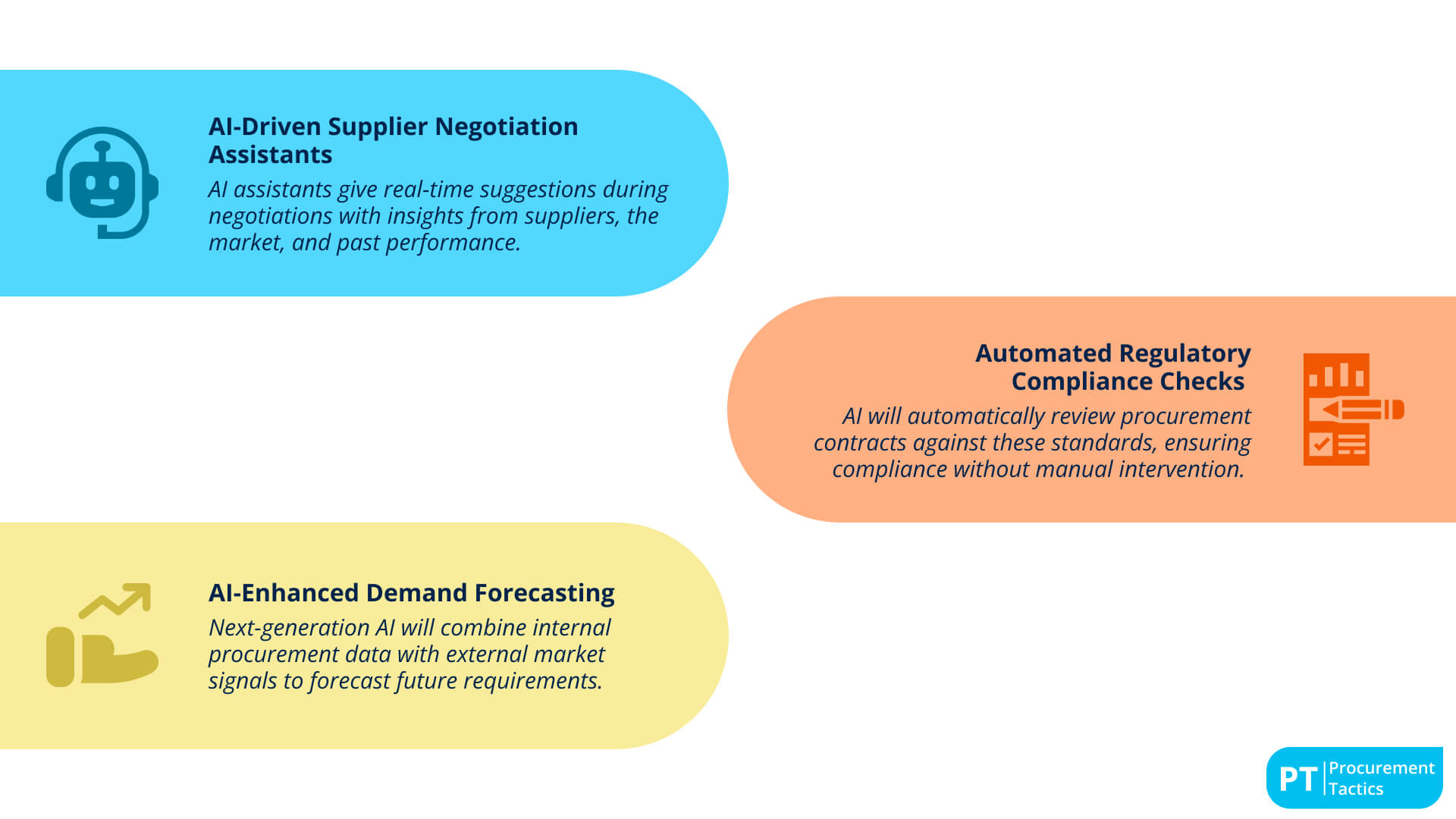
1. AI-Driven Supplier Negotiation Assistants
These assistants will provide real-time suggestions during supplier negotiations, using insights from supplier history, market conditions, and past performance.
Procurement professionals will be able to make informed decisions on pricing, contract terms, and concessions, increasing their leverage and efficiency.
2. Automated Regulatory Compliance Checks
Global trade laws, industry regulations, and contractual obligations are becoming increasingly complex. AI will soon be able to automatically review procurement contracts against these standards, ensuring compliance without manual intervention.
This not only reduces the risk of costly mistakes but also frees procurement teams to focus on strategic initiatives rather than tedious contract checks.
3. AI-Enhanced Demand Forecasting
Predicting procurement needs has traditionally relied on historical data, often leaving teams vulnerable to market fluctuations or supply chain disruptions.
Next-generation AI will combine internal procurement data with external market signals to forecast future requirements more accurately.
This allows organizations to plan sourcing strategies proactively, reduce inventory waste, and respond quickly to sudden changes in supply or demand.
Conclusion
AI in procurement software is no longer just an optional tool; it is becoming an integral part of how teams work. From automating routine tasks to generating actionable insights for supplier management, contract review, and spend analysis, AI enables procurement professionals to move from reactive processes to more informed, strategic decision-making.
The key to success is not just adopting AI, but using it wisely. Whether by unlocking existing features in current software or exploring next-generation capabilities, procurement teams that integrate AI thoughtfully gain efficiency, reduce risk, and make smarter, data-driven decisions.
As AI continues to evolve, teams that experiment with its capabilities today can better anticipate challenges, identify opportunities, and adapt to changes in the procurement landscape.
Frequentlyasked questions
How is AI changing procurement workflows today?
AI is transforming procurement by automating tasks like supplier screening, contract review, and spend analysis. It allows teams to quickly identify risks, flag compliance issues, detect unusual spending patterns, and focus more on strategic decision-making rather than manual data processing.
Do procurement teams need to buy new AI-powered software to benefit from AI?
Not necessarily. Many existing procurement platforms already have AI features built in, though they may be underutilized. The key is to evaluate your current pain points and determine whether unlocking these existing features or integrating third-party AI tools is enough before considering new software.
What AI capabilities are expected in the near future for procurement?
The next generation of AI in procurement will move beyond automation into proactive decision-making. Upcoming features include AI-driven supplier negotiation assistants, automated regulatory compliance checks, and AI-enhanced demand forecasting. These tools will help procurement teams anticipate challenges, optimize negotiations, ensure compliance, and plan sourcing strategies more effectively.
About the author
My name is Marijn Overvest, I’m the founder of Procurement Tactics. I have a deep passion for procurement, and I’ve upskilled over 200 procurement teams from all over the world. When I’m not working, I love running and cycling.

Procurement Roles Overview
Click on a role to learn more