


Written by Marijn Overvest | Reviewed by Sjoerd Goedhart | Fact Checked by Ruud Emonds | Our editorial policy
How to Get Started with AI in Procurement — Introduction and Experimentation

As taught in the AI Implementation Course For Procurement Directors / ★★★★★ 4.9 rating
- Use AI for simple, low-risk tasks such as summarizing supplier proposals, drafting first versions of RFQs or SOWs, and converting stakeholder interviews into requirement summaries.
- Explain the reason for using AI. Choose tools that are explainable.
- Run small pilots with fixed time limits. Share results and highlight early adopters.
How to Get Started with AI in Procurement?
Procurement leaders often ask, “Where should we begin with AI?” The best approach is to start small and smart. Focus on simple tasks that show quick wins and real benefits.
For example, one team used AI to summarize long supplier proposals. Another team asked AI to draft the first version of RFQs and scopes of work. A third turned stakeholder interviews into clear requirement summaries. These steps weren’t big leaps. They were practical upgrades that saved time, proved value, and built confidence to keep moving forward.
But technology alone does not create results. Leadership makes the difference. The most successful rollouts use the TOP lens: Technology, Organization, and People. This framework explains why AI is being introduced, sets supportive processes, and builds skills so teams feel involved and ready to grow with the change.
Where to Start on Using AI in Procurement?
Not sure where to start, even when all the information above? Start with small, useful tasks that show quick results. Use AI to shorten long supplier proposals so reviewers can focus on the key details. Let AI draft the first version of RFQs and scopes of work. Then improve them with human input. Capture stakeholder interviews and turn them into clear, simple requirement summaries. This helps everyone stay aligned.
These small wins save time, reduce manual effort, and keep projects moving. They also build confidence in using AI for bigger tasks later.
The ICE Ranking Template
When ideas start piling up, the ICE Ranking Template keeps experimentation focused and practical. It’s a simple, team-friendly way to decide what to try first, and you can download and customize it for your organization. Many teams use it in brainstorming sessions or when building an AI ideas roadmap; others fill it out asynchronously and review scores together.
Here’s how it works. For each experiment, score three dimensions on a 1–5 scale, then multiply them for a total between 1 and 125.
- Impact — How much value would this create if it succeeds?
- Confidence — How sure are we that it will work/be accurate?
- Ease — How easy is it to try, given our time, skills, and resources?
Example
“Use ChatGPT to generate the first draft of an RFQ” → Impact 3 (medium), Confidence 4, Ease 5 → 3 × 4 × 5 = 60.
To run this excercise:
- List about 20 experiment ideas your team wants to test.
- Score each idea for Impact, Confidence, and Ease (1–5), and rank by total score.
- Start with the highest-scoring idea(s) and work your way down.
- (Optional) Filter by sourcing step so exploration stays balanced.
- Build an experiment backlog by sourcing step: after ranking, group ideas by the stages of your sourcing process, and set a simple target like “start at least two experiments per step next quarter.”
- Keep a light cadence: a weekly 30-minute share where team members show prompts that worked, what didn’t, and why. (Many AI tools let you share chat conversations—this makes learning fast and visible.)
How to Experiment with AI Safely
Adoption starts with curiosity, not with rules. Turn curiosity into progress through structured tests. Let teams try AI in a controlled way.

Select one or two areas where AI can help quickly, such as spend analysis or supplier research. Assign small AI tasks. Set a clear trial period, for example, one month. Ask participants to record results: what worked, what failed, and where AI added the most value. End the trial with a short feedback session. Improve the process and expand use cases that showed strong results.
Set simple KPIs to measure success:
- Time saved per task
- Accuracy or quality of results
- Number of AI insights used in decisions
The goal is not forced adoption. The goal is a feedback loop where teams gain confidence and improve AI use over time.
For AI to last, give people space to test, fail, and learn without disorder. Structure tests, track results, and let growth come from real outcomes.
The TOP Framework to Guide Adoption
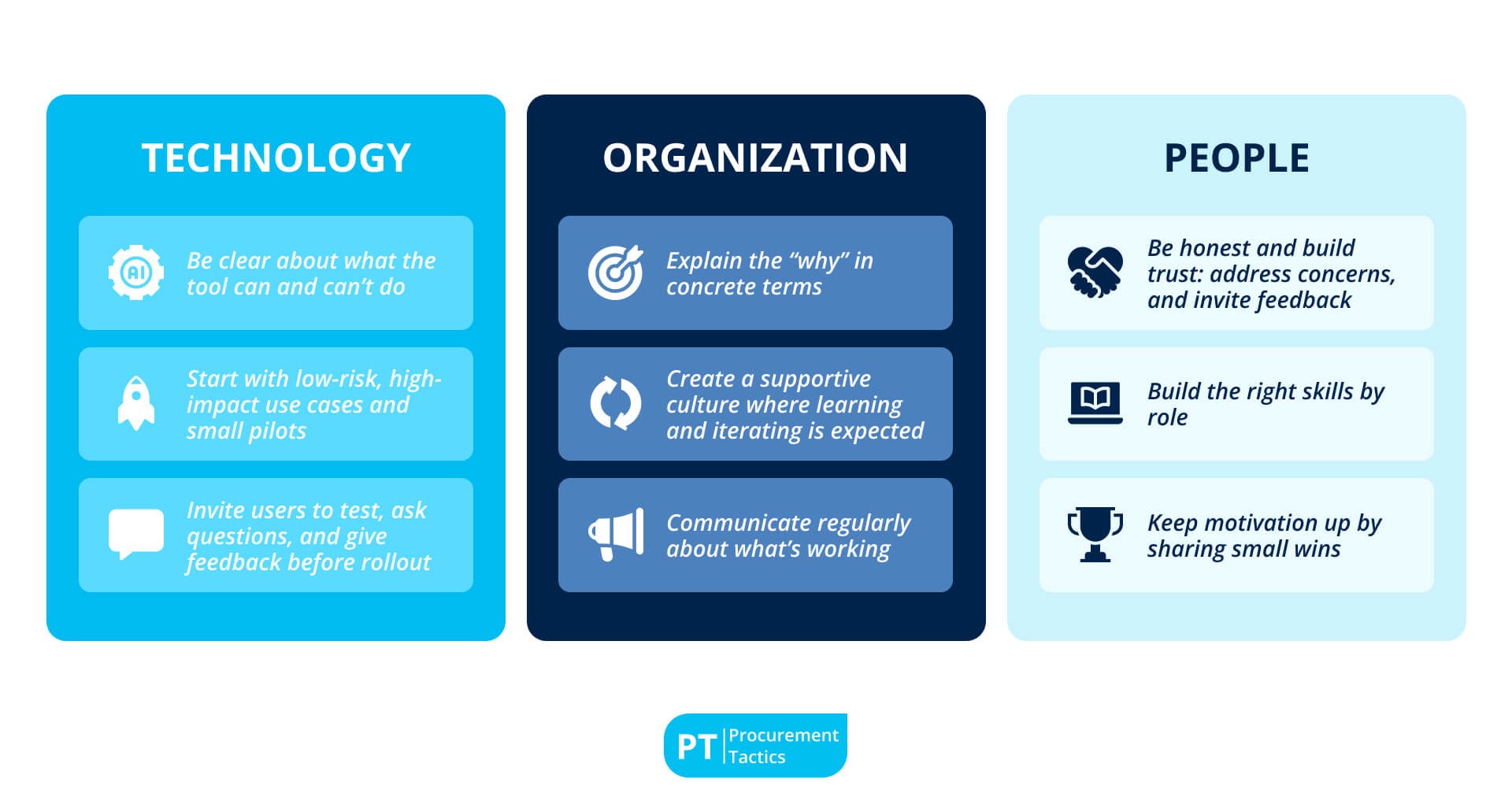
Use the TOP framework, which stands for Technology, Organization, and People, to keep AI rollout structured and people-centered, clarifying the right tools to use, the processes to support them, and how you’ll involve and equip the team.
1. Technology
- Be clear about what the tool can and can’t do; prefer explainable AI so people can see how results were reached.
- Start with low-risk, high-impact use cases and small pilots (e.g., contract review prep, spend categorization); time-box and iterate.
- Invite users to test, ask questions, and give feedback before wider rollout.
2. Organization
- Explain the “why” in concrete terms (faster supplier evaluations, earlier risk flags, less admin like invoice matching).
- Create a supportive culture where trying, learning, and iterating are expected; encourage cross-functional input since AI touches more than procurement.
- Communicate regularly about what’s working, what isn’t, and what’s next.
3. People
- Be honest and build trust: address concerns (job impact, complexity), and invite questions/feedback.
- Build the right skills by role (some need to understand scoring/classification; others need help interpreting outputs); use hands-on training and easy peer support.
- Keep motivation up by sharing small wins, recognizing early adopters, and pairing confident users with learners.
Conclusion
Getting started with AI in procurement is a people-first rollout: start small and smart, prove value with everyday tasks (proposal summaries, first-draft RFQs/SOWs, requirement write-ups), and explain clearly why AI helps.
Use the TOP framework to keep things structured. Choose tools that match the task. Prefer tools that explain their outputs, set supportive processes, and equip people with the skills to interpret and use outputs. Keep experimentation controlled: prioritize ideas with the ICE template, run time-boxed pilots with a human-in-the-loop, and log results (what worked, what didn’t, where AI added value).
Track simple KPIs such as time saved, accuracy/quality, and AI-driven insights used in decisions; then scale what works and refine the rest. Celebrate small wins and communicate regularly so trust and momentum build over time.
Frequentlyasked questions
What is AI in Procurement, and what is the best first step?
AI in Procurement uses artificial intelligence to support daily procurement tasks. These tasks include summarizing proposals, creating first drafts of RFQs or SOWs, and writing basic requirements. Start with a small project that offers quick and low-risk value. This helps the team see clear results early.
How should we prioritize AI in Procurement experiments?
Use the ICE Ranking Template. Score each idea for Impact, Confidence, and Ease on a scale from 1 to 5. Multiply the scores to get a total. Rank about 20 ideas. Start with the highest-ranking idea.
What guardrails support early AI in Procurement pilots?
Set a fixed time for each pilot, such as one month. Keep a human involved to review all outputs. Record what worked and what did not. Review the results as a team before starting more AI projects.
About the author
My name is Marijn Overvest, I’m the founder of Procurement Tactics. I have a deep passion for procurement, and I’ve upskilled over 200 procurement teams from all over the world. When I’m not working, I love running and cycling.

Procurement Roles Overview
Click on a role to learn more