


Written by Marijn Overvest | Reviewed by Sjoerd Goedhart | Fact Checked by Ruud Emonds | Our editorial policy
AI Adoption Roadmap for Procurement Template — Definition and Integration

As taught in the AI Implementation Course For Procurement Directors / ★★★★★ 4.9 rating
- The AI Adoption Roadmap for Procurement is a clear plan that helps procurement teams adopt AI tools, from initial testing to full use.
- AI adoption is gradual, with each step building on previous progress, aiming for long-term success.
- Sustainable AI adoption requires consistent habits. Normalize AI usage through small, repeatable actions and integrate it into daily workflows for long-term success.
What is the AI Adoption Roadmap for Procurement?
The AI adoption roadmap for procurement is a structured plan that guides teams from initial testing to full use of AI. It ensures gradual, scalable adoption, with each step building on the last for long-term success.
More than just testing tools, the roadmap provides a practical path to integration. Without it, adoption can stall, leaving teams unsure how to expand. The plan begins with small, low-risk tasks that deliver quick wins, then moves to more complex applications.
Measuring impact is key—tracking KPIs like time saved, cost reductions, and decision accuracy. As AI proves its value, the roadmap supports expanding its use across procurement for greater strategic impact.
Step-by-Step AI Adoption Roadmap Template
Adopting AI in procurement requires a clear, step-by-step approach. This guide helps your team integrate AI, from initial testing to full implementation.
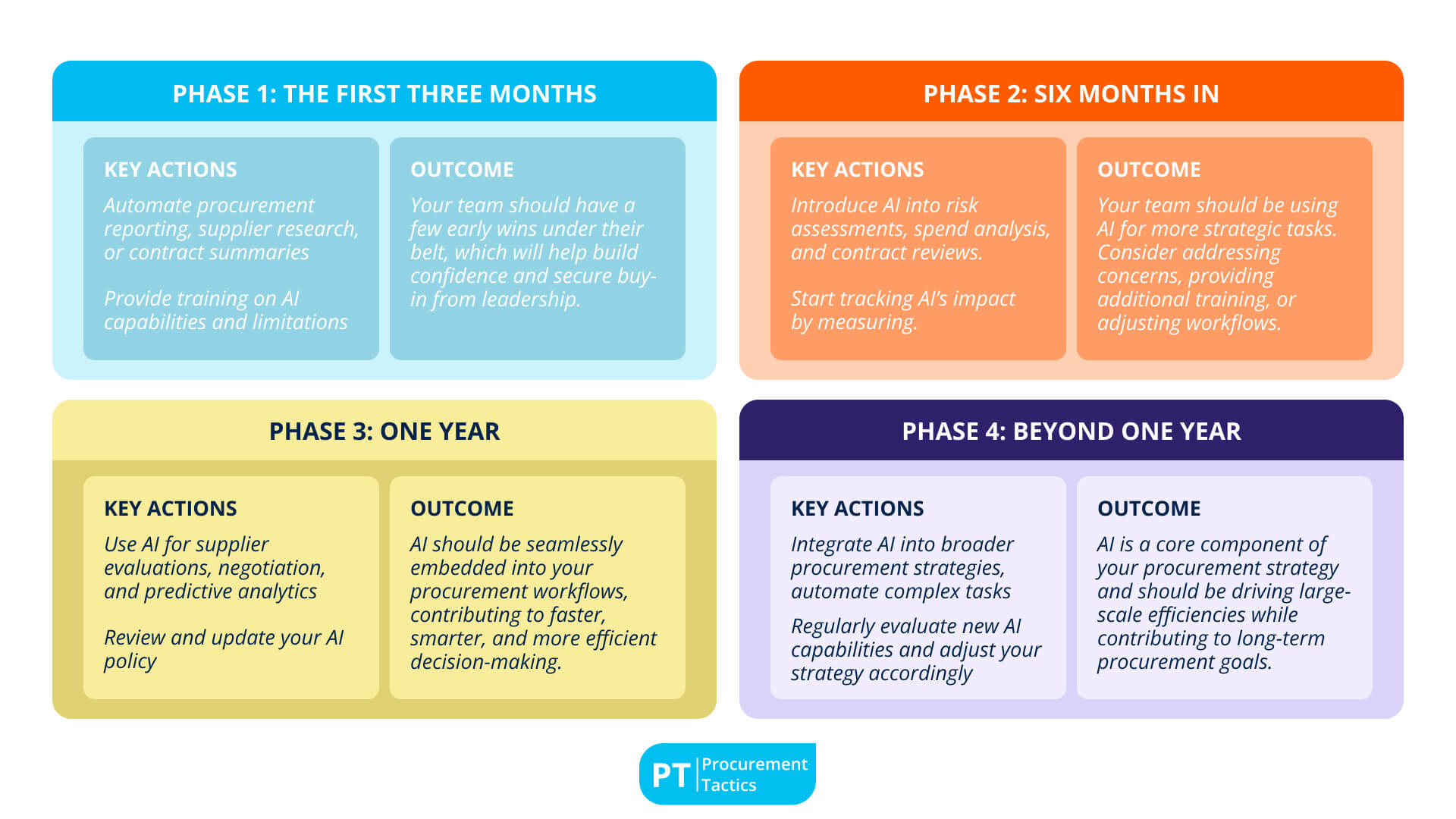
Phase 1: The First Three Months
Start small with quick wins. In the initial phase of AI adoption, focus on tasks that deliver immediate value without disrupting existing workflows. These are low-risk, high-reward tasks that show how AI can save time and reduce manual effort.
Key Actions:
- Automate procurement reporting, supplier research, or contract summaries. These are simple yet effective ways to demonstrate AI’s potential and make the technology accessible.
- Provide training on AI capabilities and limitations to ensure your team is set up for success.
Outcome:
At the end of this phase, your team should have a few early wins under their belt, which will help build confidence and secure buy-in from leadership.
Phase 2: Six Months In
Expand into more advanced tasks. By the six-month mark, it’s time to move beyond basic tasks and integrate AI into more complex procurement functions. This phase is about deepening AI’s role in decision-making and analysis.
Key Actions:
- Introduce AI into supplier risk assessments, spend analysis, and contract reviews. These areas offer significant value by improving decision-making accuracy and speed.
- Start tracking AI’s impact by measuring time saved, improvements in accuracy, and any cost reductions achieved through AI integration.
Outcome:
By this phase, your team should be using AI for more strategic tasks. If AI adoption has been slow, consider addressing concerns, providing additional training, or adjusting workflows to facilitate smoother integration.
Phase 3: One Year
Fully integrate AI into procurement workflows. By the one-year mark, AI should be a core part of your procurement operations. At this stage, AI is no longer seen as a separate tool, but as an essential part of decision-making and procurement processes.

Key Actions:
- Use AI for supplier evaluations, negotiation support, and predictive analytics to make smarter purchasing decisions.
- Review and update your AI policy to reflect how AI is being used in practice. Ensure the policy is aligned with AI’s evolving role in procurement.
Outcome:
By this point, AI should be seamlessly embedded into your procurement workflows, contributing to faster, smarter, and more efficient decision-making. Procurement leaders should see AI as a natural extension of the team’s capabilities.
Phase 4: Beyond One Year
Scale AI across the procurement function. After a year, it’s time to focus on scaling AI adoption across all procurement activities. This phase is about leveraging AI for broader strategic initiatives and optimizing procurement at a higher level.
Key Actions:
- Integrate AI into broader procurement strategies, automate more complex tasks, and leverage AI for strategic forecasting and supplier collaboration. This could involve using AI in vendor negotiations, supply chain optimization, and long-term strategic planning.
- Continuous Improvement: Regularly evaluate new AI capabilities and adjust your strategy accordingly. AI technology is rapidly evolving, so it’s essential to stay up to date with the latest advancements and adjust your tools as needed.
Outcome:
By this stage, AI is a core component of your procurement strategy and should be driving large-scale efficiencies while contributing to long-term procurement goals.
To help you map out your AI adoption strategy, we’ve created a template that breaks down the process from early experiments to full integration. This customizable roadmap outlines goals for each phase, with example use cases and space for you to define your action plan. Simply fill in what your team will do, what challenges you may face, and the support you’ll need at each stage. This template serves as a practical guide to ensure AI adoption is both sustainable and scalable.
How to Turn AI into a Long-Term Habit
It’s easy for AI to lose momentum once the freshness fades. But to make AI a long-term habit, it needs to become a natural part of your team’s workflow, not a one-off trial. This phase is about integrating AI seamlessly into the day-to-day activities of your procurement team.
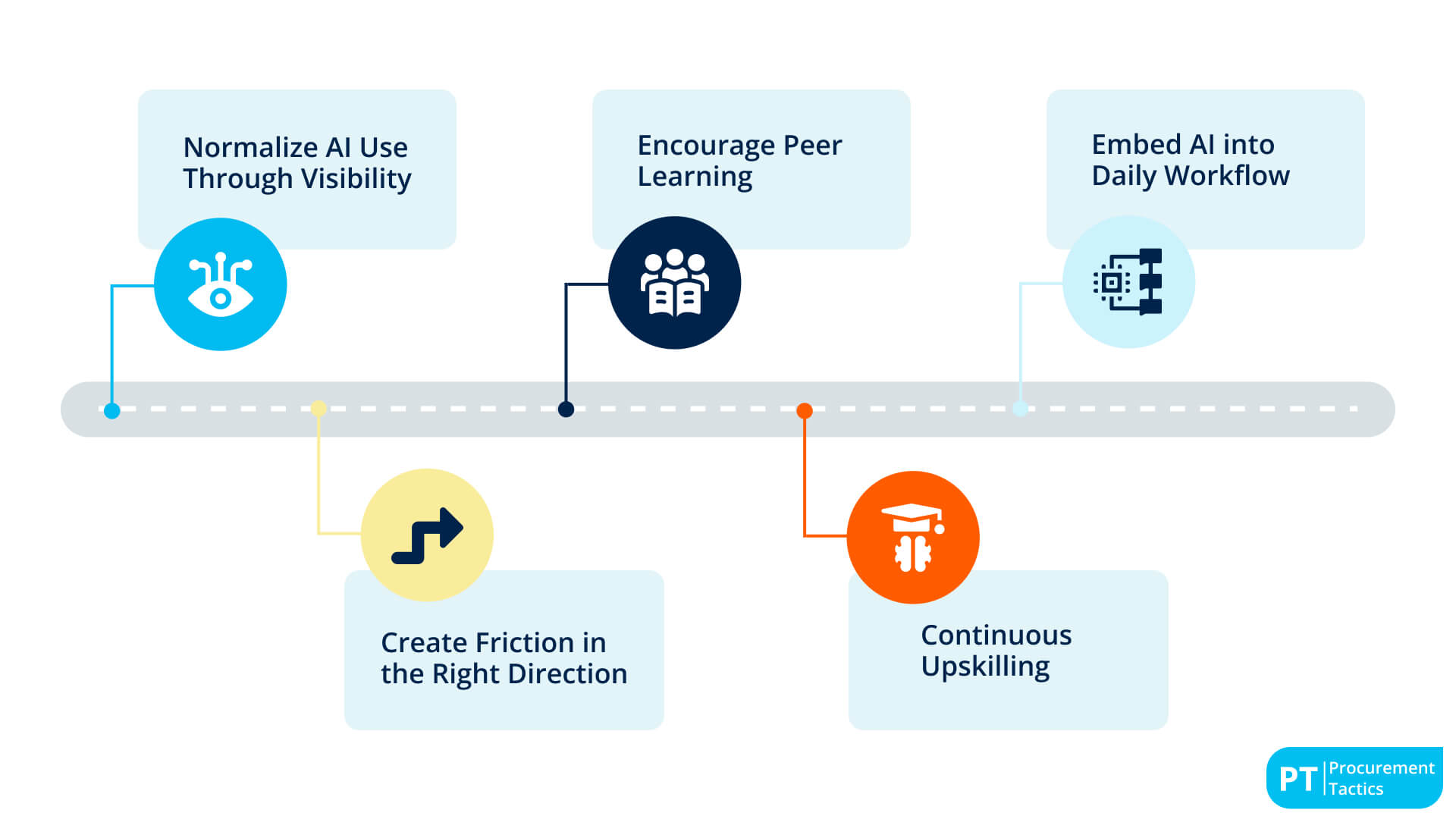
1. Normalize AI Use Through Visibility
When someone on the team successfully uses AI, share that example in a team chat or message thread. It doesn’t need to be a big presentation; just a quick mention or a screenshot can normalize the behavior and encourage others to try AI in their tasks.
2. Create Friction in the Right Direction
Rather than handing over a template, prompt your team with a nudge: “Can you try generating the first draft in ChatGPT first?” Small nudges like this make AI the default starting point, not just a backup plan.
3. Encourage Peer Learning
Designate a few team members who are AI-curious to be your internal go-to people. These individuals can help others get comfortable and share tips on best practices. You can also host monthly prompt reviews. Have your team review each other’s prompts. Share what worked, what didn’t, and why. Keep it light but make it part of the rhythm. Many AI tools have a feature that allows you to share chat conversations, and this works great for peer review.
4. Continuous Upskilling
Don’t expect your team to figure it all out on their own. Leverage proven resources like our AI in Procurement Course and AI Boot Camp for Procurement Teams to accelerate learning and confidence with AI tools.
5. Embed AI into Daily Workflow
Rather than over-engineering the process, focus on making AI a natural part of your team’s rhythm. Encourage simple interactions and make AI part of the normal workflow. When AI becomes second nature, it makes it easier to rely on for bigger challenges.
Conclusion
The AI adoption journey in procurement is a gradual process, but by following a clear, step-by-step roadmap, you can transition from small wins to full AI integration without overwhelming your team. Start small, prove value early, and expand AI’s role over time.
The key to success lies in embedding AI into your team’s daily habits, ensuring that it becomes a routine tool for smarter, faster, and more efficient procurement decisions. As AI technology continues to evolve, so should your strategy. Make sure to regularly revisit your AI approach to stay ahead of the curve and drive continuous improvements in procurement.
Frequentlyasked questions
What is the AI adoption roadmap for procurement?
The AI adoption roadmap for procurement is a step-by-step plan that guides teams from initial experimentation with AI tools to full-scale integration into procurement workflows. It focuses on achieving quick wins, measuring impact, and scaling AI over time.
How do I ensure AI becomes a long-term habit in my team?
You can ensure AI becomes a long-term habit by normalizing its use, creating friction to encourage AI as the default, promoting peer learning, and continuously upskilling your team.
What should we measure when tracking AI’s impact in procurement?
Key metrics to track include time saved on tasks, cost reductions, improvements in procurement accuracy, and supplier risk reduction. Measuring AI’s impact over time ensures continuous improvement and justifies further investment.
About the author
My name is Marijn Overvest, I’m the founder of Procurement Tactics. I have a deep passion for procurement, and I’ve upskilled over 200 procurement teams from all over the world. When I’m not working, I love running and cycling.

Procurement Roles Overview
Click on a role to learn more