


Written by Marijn Overvest | Reviewed by Sjoerd Goedhart | Fact Checked by Ruud Emonds | Our editorial policy
Manufacturing Procurement: Definition, Process, and Examples
- What is Manufacturing Procurement?
- The Manufacturing Procurement Process
- 3 Examples of Modern Manufacturing Procurement in Action
- The 7 Most Common Challenges in Manufacturing Procurement and How to Solve Them
- Digital & Supplier Trends in Modern Manufacturing Procurement
- Conclusion
- Frequently asked questions
- Manufacturing procurement is responsible for sourcing the right materials, components, and services so that production can run smoothly and efficiently.
- In manufacturing, procurement isn’t just about cost; it also affects lead times, quality, production uptime, and supplier reliability.
- A well-structured procurement process helps mitigate risk, align with business strategy, and support continuous manufacturing operations.
What is Manufacturing Procurement?
Manufacturing procurement is the process of acquiring all the goods, materials, components, and services a manufacturing company needs to make its products. This includes everything from raw materials and parts to equipment, maintenance, and logistics.
In manufacturing, procurement has two main responsibilities. It must ensure materials arrive on time to prevent production delays and that these materials meet the required quality, specifications, and cost standards for smooth operations. If a key component arrives late or is defective, the entire production line could stop, leading to much higher costs than the material itself.
As a result, manufacturing procurement plays a central role in operations. The decisions made in procurement affect production schedules, inventory levels, supplier reliability, overall costs, and the quality and quantity of products produced.
The Manufacturing Procurement Process
Manufacturing procurement follows a structured process that ensures materials, parts, and services are sourced efficiently and responsibly. Each step supports production continuity, quality, and cost control.
Here’s how it typically works in manufacturing:
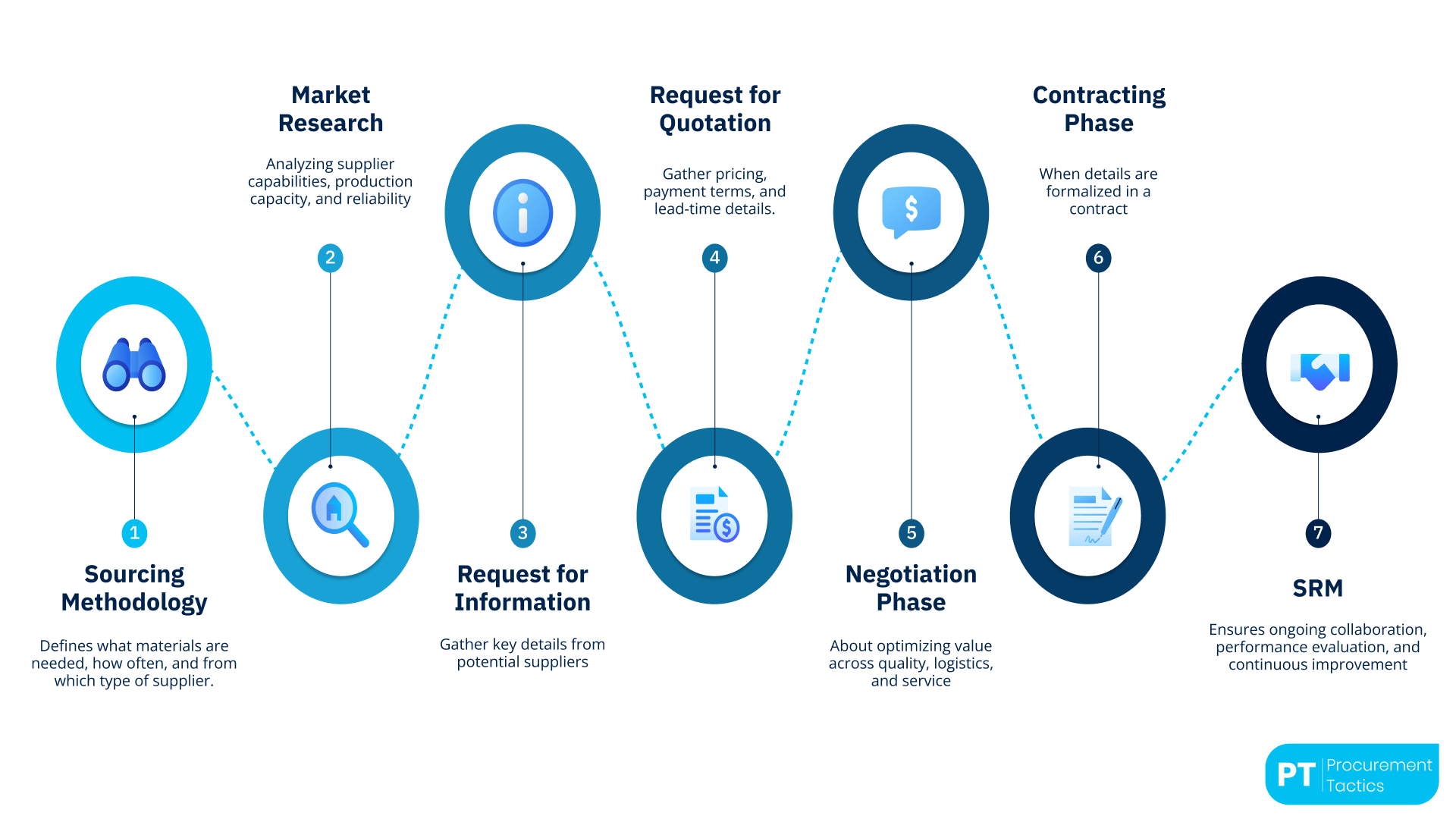
1. Sourcing Methodology
Every manufacturing company starts with a sourcing plan that defines what materials are needed, how often, and from which type of supplier.
Procurement teams work closely with production planners and engineers to determine specifications for components such as metals, plastics, or electronic parts.
This step also includes assessing whether to produce in-house or buy externally. A clear sourcing methodology ensures that all stakeholders align on cost targets, supplier criteria, and delivery expectations before procurement begins.
2. Market Research
Next comes market research, analyzing supplier capabilities, production capacity, and reliability. Manufacturers often depend on global supply networks, so understanding supplier performance, regional risks, and material price trends is essential.
For example, an automotive manufacturer might evaluate steel suppliers based on global market prices, carbon footprint, and delivery history to reduce risk and ensure compliance with ESG standards.
3. Request for Information (RFI)
The RFI stage helps gather key details from potential suppliers about product quality, certifications (like ISO 9001 or IATF 16949), and logistics capabilities.
In manufacturing, technical compatibility is critical — even small deviations in materials or processes can disrupt production.
Through RFIs, procurement ensures that shortlisted suppliers can meet strict specifications and maintain consistent quality under high-volume demand.
4. Request for Quotation (RFQ)
After filtering suppliers, procurement sends RFQs to gather pricing, payment terms, and lead-time details. RFQs in manufacturing also include specifications for batch sizes, quality testing, and packaging requirements.
Comparing multiple quotes allows teams to balance cost with reliability and flexibility. For instance, choosing a supplier offering slightly higher prices but guaranteed delivery may prevent costly production downtime later.
5. Negotiation Phase
Negotiation in manufacturing procurement isn’t just about lowering prices; it’s about optimizing value across quality, logistics, and service. Teams negotiate long-term supply agreements, volume discounts, and technical support services.
For example, a machinery manufacturer might secure fixed pricing for 12 months to protect against metal price fluctuations, while also requiring suppliers to maintain inventory buffers for urgent orders.

6. Contracting Phase
Once terms are agreed upon, the details are formalized in a contract. Manufacturing contracts must define production tolerances, delivery schedules, quality inspection processes, and penalties for non-conformance.
Digital contract management systems (CLM) are increasingly used to ensure documentation accuracy and simplify compliance tracking across complex supply chains.
7. Supplier Relationship Management (SRM)
Finally, SRM ensures ongoing collaboration, performance evaluation, and continuous improvement. Manufacturers use KPIs such as on-time delivery, defect rates, and cost savings to assess suppliers regularly.
Long-term relationships with trusted partners enable joint problem-solving, innovation, and shared risk management, especially valuable during supply disruptions or demand spikes.
3 Examples of Modern Manufacturing Procurement in Action
Manufacturing procurement has become a key driver of efficiency and innovation. The following examples from Toyota, General Electric, and BMW show how companies turn procurement into a strategic advantage through data, collaboration, and sustainability.
1. Toyota Motor Corporation: Lean Procurement and Just-in-Time Integration
What they do:
Toyota pioneered lean manufacturing and applies the same principles to procurement. The company follows a “pull” system where suppliers deliver parts only when needed on the assembly line. This means Toyota doesn’t produce or order anything until there is a real customer demand.
Their procurement model is built around precision, timing, and partnership. Instead of treating suppliers as vendors, Toyota views them as an extension of its own operations. Every supplier is part of a tightly coordinated network that shares data, demand forecasts, and improvement goals. This long-term collaboration allows Toyota to maintain consistency and reliability even during global disruptions.
How it works:
Toyota’s procurement teams work closely with engineers and production planners, using real-time demand signals to trigger orders. Instead of stockpiling components, materials arrive just in time for assembly, supported by long-term supplier relationships based on trust and shared performance goals.
Why it’s effective:
This approach reduces waste, lowers inventory costs, and ensures that production never stops due to overstock or shortages. It also strengthens supplier collaboration and keeps Toyota’s supply chain agile and efficient.
2. General Electric (GE): Data-Driven Procurement and Predictive Analytics
What they do:
GE transformed procurement through its “Industrial Internet” initiative, using data analytics to predict material needs and optimize supplier performance. The company integrates procurement with its engineering, production, and maintenance functions, ensuring that decisions are driven by real-time data instead of assumptions.
Procurement is no longer a separate department; it’s part of GE’s digital ecosystem. Every piece of equipment, from turbines to generators, is connected through sensors that collect data about wear, performance, and usage. This allows GE’s procurement teams to anticipate material needs long before issues arise.
By combining digital twins, AI, and analytics, GE has created a procurement model that is predictive, proactive, and fully aligned with operational goals.
How it works:
Procurement teams combine sensor data, machine logs, and historical purchase records to forecast component requirements. Predictive systems automatically trigger sourcing before equipment failure or shortages occur, keeping production on schedule.
Why it’s effective:
By using predictive analytics, GE reduced costs, improved supplier reliability, and aligned procurement decisions directly with production needs. The result is a proactive, data-driven system that prevents delays and increases operational efficiency.
3. BMW Group: Centralized and Sustainable Procurement Strategy
What they do:
BMW built a global procurement model that combines cost efficiency with sustainability and innovation. The company treats procurement as a key tool for achieving its long-term ESG goals, such as reducing carbon emissions and promoting circular economy practices.
Procurement teams work hand-in-hand with R&D, sustainability officers, and suppliers to ensure that every component meets high ethical and environmental standards. BMW uses a centralized global system that integrates all suppliers under one digital platform, allowing real-time tracking of compliance and sustainability metrics.
Through supplier training programs and transparent reporting, BMW encourages continuous improvement and innovation across its supply base, making sustainability a shared responsibility rather than an isolated initiative.
How it works:
Procurement operates under a centralized framework with standardized processes, verified suppliers, and strict ESG criteria. Suppliers are evaluated not only on cost and quality but also on carbon footprint, labor practices, and use of recyclable materials.
Why it’s effective:
This approach improves transparency, strengthens supplier accountability, and drives innovation in materials and design. By integrating sustainability into every sourcing decision, BMW enhances both brand reputation and long-term supply chain resilience.
Toyota focuses on lean efficiency, GE leads with data, and BMW champions sustainability. Together, they show that modern manufacturing procurement is not just about buying parts, it’s about creating smarter, cleaner, and more collaborative supply chains.
The 7 Most Common Challenges in Manufacturing Procurement and How to Solve Them
Procurement in manufacturing is complex because it connects engineering, supply chain, and finance. A single mistake, like a late shipment or poor-quality material, can stop an entire production line. Below are some of the most common challenges manufacturers face today and practical ways to solve them.
Digital & Supplier Trends in Modern Manufacturing Procurement
Below are the key digital and supplier trends reshaping modern manufacturing procurement and driving smarter, faster, and more sustainable production.
1. Digital Procurement Platforms
Traditional paper-based purchasing is too slow for today’s fast-paced manufacturing environment. Modern companies use e-procurement systems that automate the entire purchasing cycle, from requests and approvals to invoicing and supplier evaluation.
These systems connect procurement directly with ERP and MRP platforms, giving instant visibility into stock levels, open orders, and supplier performance. For example, automotive manufacturers like Toyota and Bosch use centralized e-procurement systems to manage thousands of suppliers, cutting lead times and improving accuracy.
The result is greater transparency, reduced manual work, and faster approval flows, keeping production uninterrupted even under tight schedules.
2. Predictive Analytics and Smart Forecasting
Manufacturing depends on precision. Predictive analytics helps procurement teams anticipate what materials or parts will be needed based on historical demand, production cycles, and even external market data such as commodity prices or weather conditions.
By connecting AI-driven forecasting tools with production planning, companies can order materials before shortages happen, reducing rush orders and excess stock. A good example is General Electric, which uses predictive models to align procurement with its turbine production schedules, lowering emergency procurement costs by over 20%.
3. Supplier Collaboration and Risk Management
Strong supplier collaboration is key to manufacturing success. Instead of transactional relationships, modern procurement focuses on partnerships built on data sharing, transparency, and performance tracking.
Companies now use supplier portals where vendors can update shipment data, certifications, and performance reports in real time. This shared visibility helps detect potential risks, such as delivery delays or quality issues, early. For instance, Siemens uses digital supplier scorecards that track KPIs like on-time delivery, defect rates, and sustainability practices, improving communication and accountability across its supplier network.
The benefit is clear: fewer disruptions, faster problem resolution, and better long-term trust between buyers and suppliers.
4. Automation and Smart Workflows
Automation reduces repetitive administrative work in procurement, like comparing quotes, sending RFQs, or processing invoices.
Smart workflows ensure every step follows compliance rules while freeing teams to focus on high-value strategic tasks.
Manufacturers such as ABB and Caterpillar have integrated robotic process automation (RPA) into their procurement systems, achieving up to 40% faster cycle times and significantly reducing manual errors.
Automation doesn’t just speed things up, it standardizes processes, improves compliance, and helps teams respond faster to production needs.
5. Sustainable and Responsible Sourcing
Sustainability is now a core goal for manufacturing procurement. Companies are expected to manage their environmental footprint, reduce waste, and ensure responsible sourcing of materials.
For example, Unilever and BASF require suppliers to disclose their carbon footprint and commit to renewable energy use. Procurement teams now evaluate not only cost and quality but also ESG metrics like emissions, labor conditions, and circular economy practices.
This shift makes procurement a driving force for both ethical supply chains and long-term cost savings through energy efficiency and waste reduction.
6. Integrated People-Process Approach
Even the most advanced tools fail without skilled people. Modern manufacturing procurement is as much about people as it is about technology. Procurement professionals are becoming strategic advisors who bridge engineering, finance, and production.
Training teams in negotiation, data analysis, and supplier collaboration ensures that digital tools deliver real value. As GEP emphasizes, digital transformation succeeds only when combined with a human-centric culture that values innovation and collaboration.
Conclusion
Manufacturing procurement has evolved into a strategic pillar of modern industry. It’s no longer limited to purchasing materials but now drives efficiency, sustainability, and innovation across the entire value chain.
When procurement teams follow a structured process, supported by digital platforms, predictive analytics, and strong supplier relationships, they not only secure materials but also ensure production resilience and quality excellence. The shift toward automation, collaboration, and sustainability has transformed procurement from a cost center into a source of long-term competitive advantage.
As shown by leading manufacturers such as Toyota, GE, and BMW, the future of manufacturing procurement lies in combining data-driven decisions, responsible sourcing, and human expertise. Those who master this balance can reduce risks, optimize costs, and build agile supply chains that power continuous growth in an increasingly complex global market.
Frequentlyasked questions
What is manufacturing procurement?
Manufacturing procurement is the process of sourcing, purchasing, and managing all materials, components, and services required to produce goods. It ensures that production runs smoothly, efficiently, and cost-effectively by delivering the right materials at the right time and quality.
Why is procurement important in manufacturing?
Because every production line depends on the timely delivery of quality materials. Effective procurement minimizes downtime, controls costs, and ensures suppliers meet performance and compliance standards, directly impacting productivity and profitability.
What are the main challenges in manufacturing procurement?
Common challenges include supply chain disruptions, fluctuating raw material prices, quality inconsistencies, and limited visibility across global suppliers. Sustainability and regulatory compliance have also become major priorities for modern manufacturers.
About the author
My name is Marijn Overvest, I’m the founder of Procurement Tactics. I have a deep passion for procurement, and I’ve upskilled over 200 procurement teams from all over the world. When I’m not working, I love running and cycling.

Procurement Roles Overview
Click on a role to learn more