

Written by Marijn Overvest | Reviewed by Sjoerd Goedhart | Fact Checked by Ruud Emonds | Our editorial policy
Procurement AI Policy — Definition + Free Template
- Procurement AI Policy sets rules for responsible and secure AI use in procurement, so teams know what is allowed.
- The policy protects supplier and contract data, ensures fairness and compliance, and keeps humans in control.
- Procurement AI Policy builds confidence and consistency by defining when to use AI, how to check outputs, and where oversight is required.
What is Procurement AI Policy?
A Procurement AI Policy is a clear set of rules that guides how teams choose, use, and manage AI tools in procurement. It ensures AI use is secure, ethical, and legally compliant. It also aligns AI use with the organization’s goals.
The policy sets protect data, vendor requirements, controls bias, and manages risks. It replaces one-off decisions with a consistent process. It explains how to review vendors, write contracts, and assign responsibilities. This creates a system for responsible decision-making.
A procurement AI policy helps teams adopt AI safely and at scale. It supports innovation while reducing risks such as misuse, bias, or poor judgment.
Procurement AI Policy Template
Writing down AI boundaries is harder than setting them. Many procurement leaders know they need an AI policy, but do not know how to start. One procurement director in Eastern Europe said he felt stuck until he saw an actual template. The template gave him a clear structure, helped him get legal approval, and sped up the process.
A procurement AI policy template can help you avoid starting from scratch. It gives you a clear format, protects sensitive data, and guides your team from the beginning.
What the Template Includes:
- Approved and Restricted AI Uses
For example, AI may help draft supplier RFQs. Legal must review all contract language.
- Data Security Rules
Defines what procurement data can be shared with AI. Promotes anonymization, avoids confidential inputs, and supports using secure AI tools.
- Compliance Guidelines
Aligns policy with current laws, such as the EU AI Act, using simple, clear language.
- Ownership and Responsibility
The procurement team manages the policy. IT and legal teams provide support, focusing on compliance and data protection.

To customize the template for your team, you must consider the following:
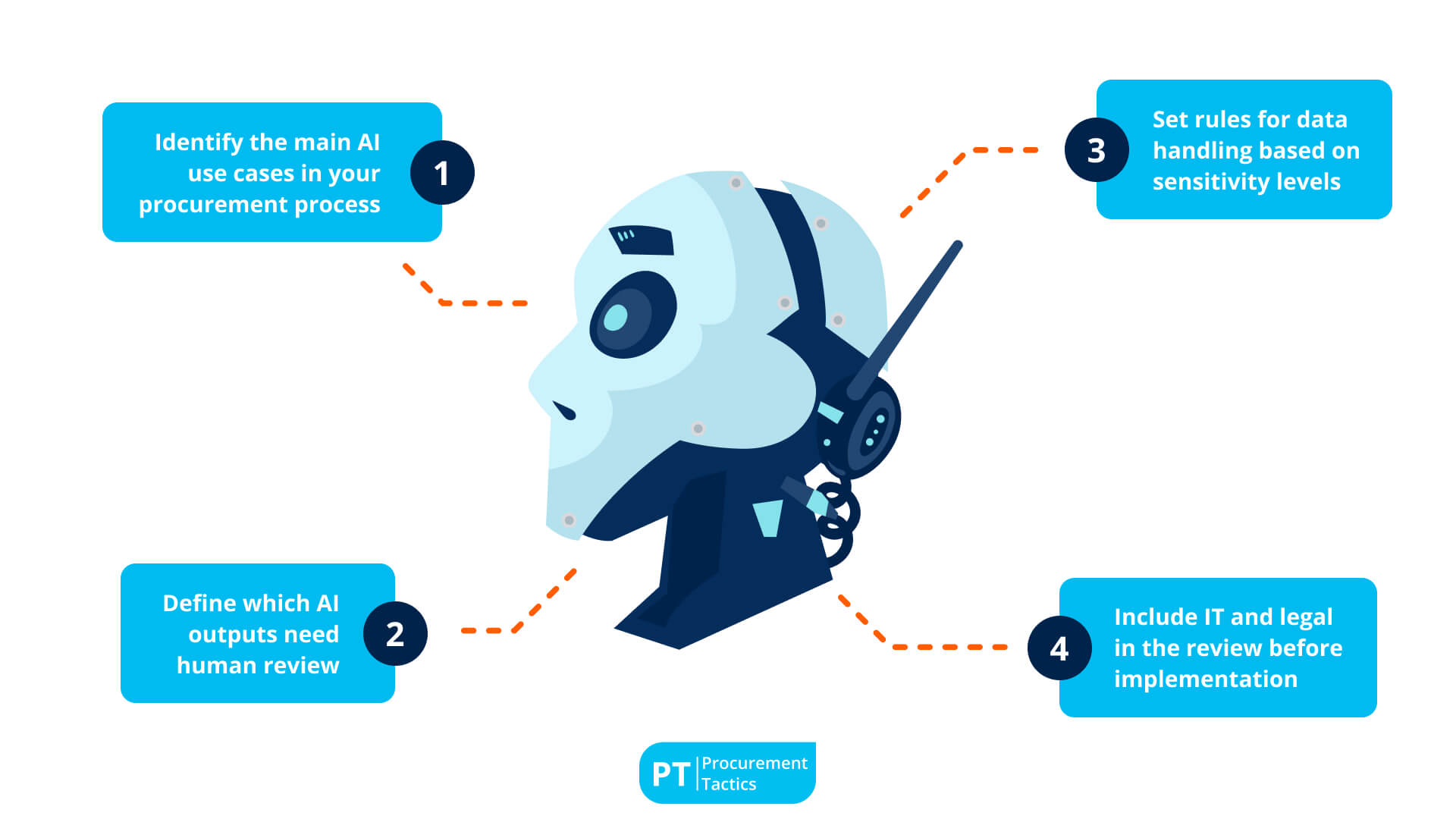
- Identify the main AI use cases in your procurement process.
- Set rules for data handling based on sensitivity levels.
- Define which AI outputs need human review.
- Include IT and legal in the review before implementation.
The template also comes with sample policy text, making it easy to adapt. If you’re short on time, you can plug in your company name and adjust the details as needed.
A template works because it brings clarity from the start. It removes hesitation by giving teams a clear structure to follow. It also saves time, helping procurement leaders move quickly without starting from a blank page.
A good template makes the policy easy to read, apply, and enforce. For an AI policy to be effective, it must be practical, assigned to the right people, and kept current. Use the template as your starting point, adjust it to fit your team’s needs, and review it regularly as your AI use expands.
How to Implement Your AI Policy
Even the best policy won’t help if no one follows it. Implementation should focus on change management, not just document delivery.
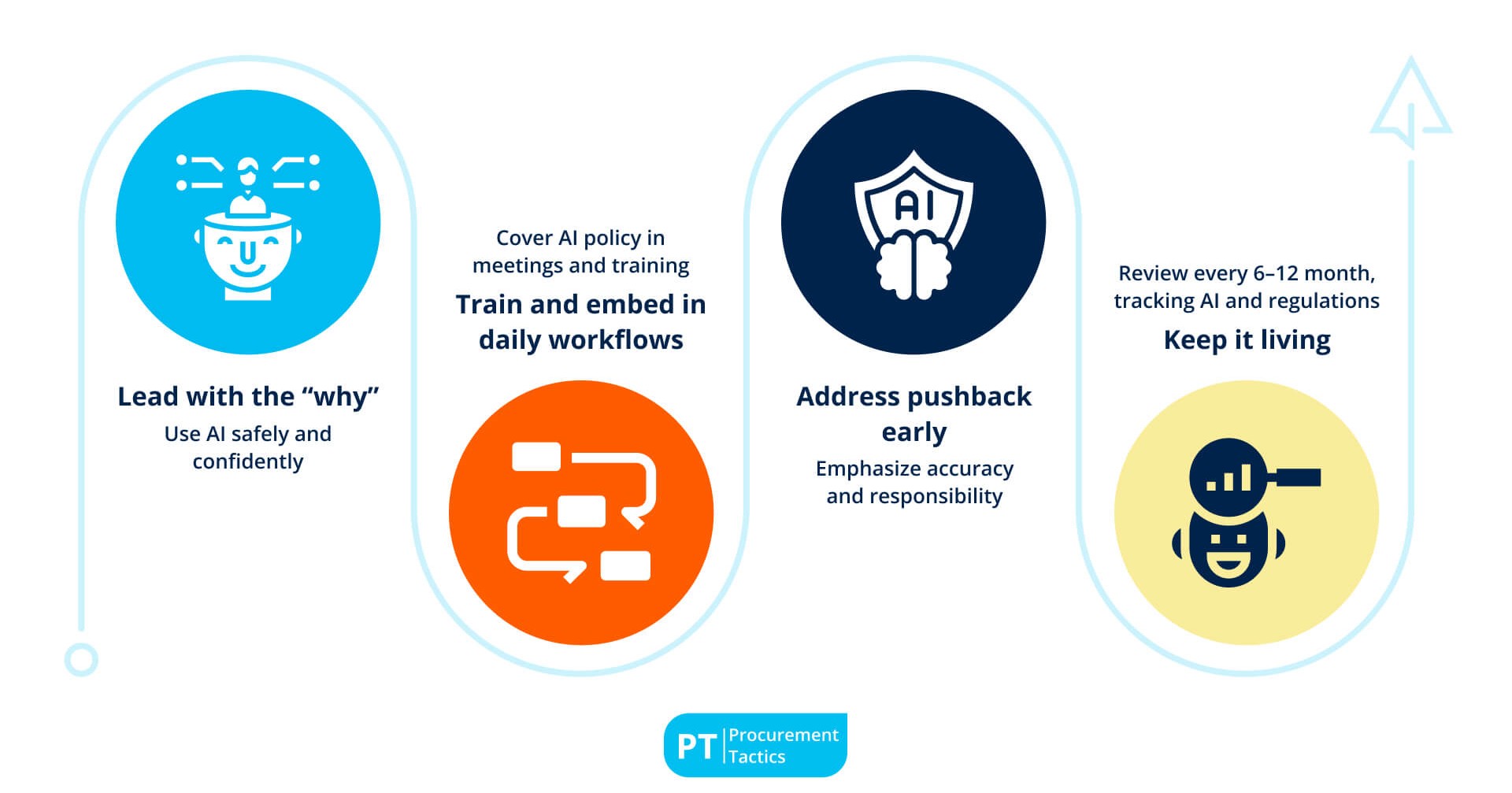
1. Lead with the “why”
Position the policy as a guide to use AI confidently and safely, not a list of restrictions. Emphasize that it protects sensitive data, prevents misuse, and supports (not replaces) procurement professionals.
Example: A procurement manager announced the policy via a short internal video, then did one-on-one check-ins. Framing it as a conversation and not a command made people pay attention and comply.
2. Train and embed in daily workflows
Include an AI policy walkthrough in team meetings, onboarding, and procurement training. Encourage managers to reinforce AI best practices in daily procurement workflows, such as requiring AI-generated supplier recommendations to be reviewed by a senior procurement professional.
3. Address pushback early
If someone says the policy is too strict, focus on fairness, accuracy, and responsible use. Explain that the goal is consistent, high-quality decisions and protection of sensitive data.
4. Keep it living
Review the policy every 6–12 months. Track changes in AI tools, regulations, and business needs. Gather feedback from your team about what’s working and what needs improvement.
Successful rollout isn’t about enforcement; it’s about clarity, consistency, and repetition.
Why Your Procurement Team Needs an AI Policy
When teams use AI without rules, work becomes inconsistent, security is at risk, and legal issues can appear. Some people enter sensitive supplier data into unsafe tools. Others use AI results without checking accuracy. Some avoid AI completely. This causes inefficiency, compliance risks, and missed opportunities.
A strong AI policy does three things:
- Protect sensitive data: keep contracts, pricing, and supplier information out of public AI tools.
- Ensure compliance: set clear rules for fair, transparent, and responsible AI use.
- Build trust: give teams confidence to use AI safely and consistently.
When a global procurement leader in France said his team avoided AI because they did not know what was allowed, he introduced simple rules such as “never upload contracts into public AI tools” and “use internal prompt templates,”. After that, adoption increased. The problem was not AI itself but uncertainty.
What to Include in a Procurement AI Policy
Effective procurement starts with a clear foundation. This policy supports procurement teams in meeting core governance needs and should include the following:
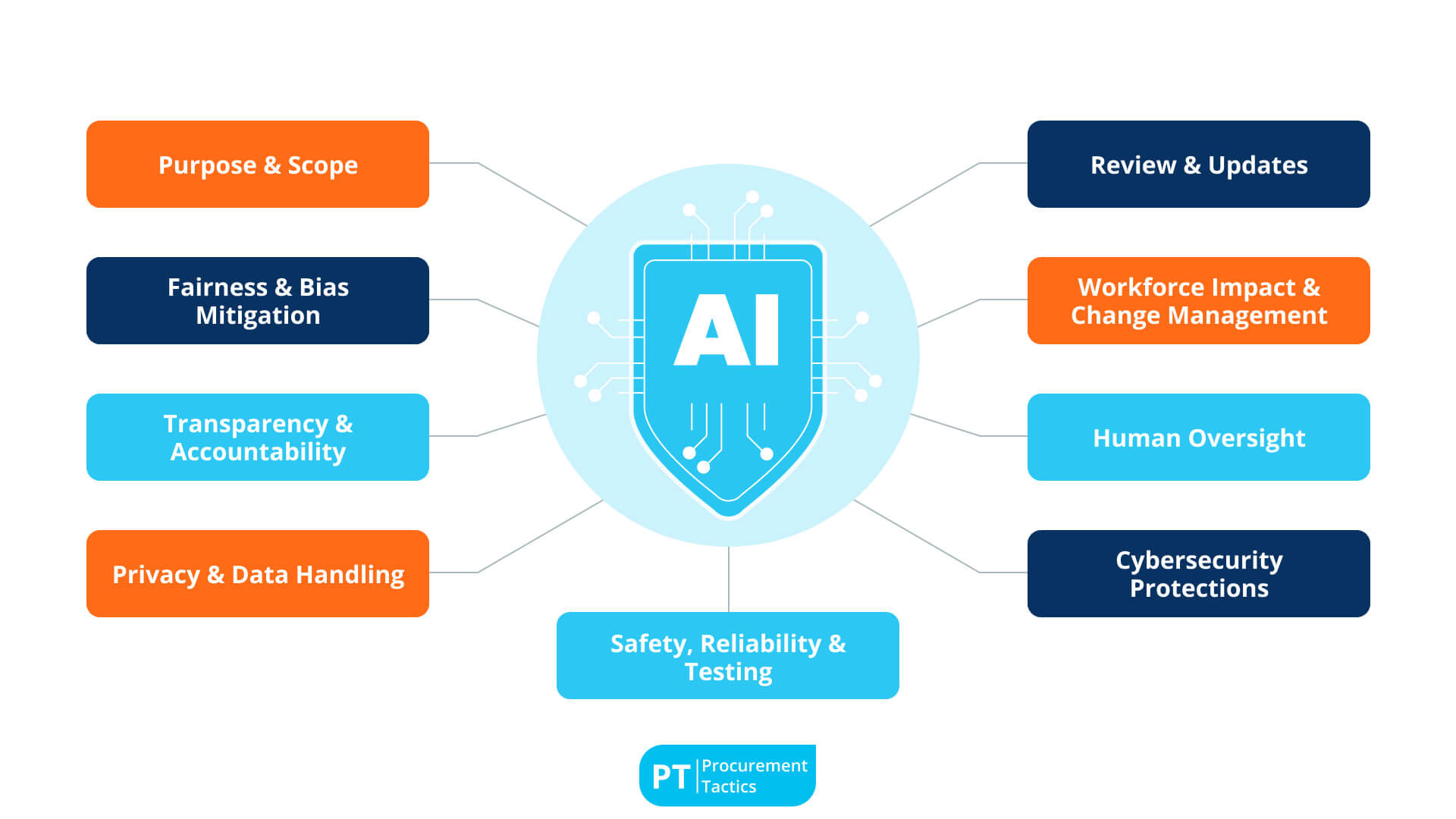
1. Purpose & Scope
Spell out what the policy is for, what it covers, who must follow it, and why it matters. For example, it might apply to all AI tools used in supplier selection, contract analysis, or spend forecasting.
2. Fairness & Bias Mitigation
Define steps to identify and reduce bias so outcomes are equitable and defensible. This could include auditing training data to avoid disadvantaging small or minority-owned vendors.
Explain how AI decisions are made, documented, and reviewed. Define who is responsible. For instance, procurement staff must document how an AI-generated supplier ranking was reviewed before final decisions.
Specify what data can be used. Define how it is collected, stored, shared, and protected. This might mean anonymizing supplier data used for benchmarking or ensuring third-party tools comply with privacy laws
Require testing before deployment. Mandate ongoing checks against clear standards. AI used to score vendor proposals should be tested regularly to confirm consistent performance and avoid regressions.
Set rules to block tampering, misuse, and outside threats. Define how to respond to incidents. For example, restrict access to AI tools using multi-factor authentication and monitor for unusual activity.
Make clear that AI does not replace human judgment. Define review and escalation steps. Buyers must review AI-generated recommendations and have the authority to override them if needed.
Anticipate process changes and provide training and support so people can adapt. This includes onboarding staff to new AI tools and offering guidance on interpreting AI outputs in procurement decisions.
Commit to regular reviews and revisions as tools, risks, and regulations evolve. The policy should be reviewed annually or after major regulatory changes impacting AI governance3. Transparency & Accountability
4. Privacy & Data Handling
5. Safety, Reliability & Testing
6. Cybersecurity Protections
7. Human Oversight
8. Workforce Impact & Change Management
9. Review & Updates
Procurement AI Policy Risks That You Should Address
Procurement-specific AI risks are real and must be covered by policy. For example:
1. Supplier bias
AI can favor certain vendors if it mirrors historical patterns instead of current market reality.
2. Contract misreads
AI can misinterpret clauses or obligations, creating costly mistakes.
3. Spend analysis errors
Misclassification or oversimplified assumptions can distort forecasts.
4. Over- or under-reliance on AI
Blind trust invites errors; total avoidance stalls progress.
5. Privacy and security gaps
Sensitive data mishandled in the wrong tools; systems targeted or manipulated.
A good policy sets clear limits around risks. It defines when human oversight is required. It explains how to test and verify outputs. It also covers fairness, transparency, accountability, and the impact of AI on jobs and workflows.
A procurement AI policy should not replace human judgment. It should position AI as a support tool that strengthens decision-making.
Conclusion
The key to using the power of AI responsibly lies in a good Procurement AI Policy. It secures the safety of delicate information, makes certain decisions impartial and traceable, and establishes critical areas to be handled by people. These are the straightforward steps that will allow your team to utilize AI with accuracy and certainty.
In order to sustain this advantage, consider the policy as a living document. Rework it in 6-12 months, adding the changes brought by emerging tools and regulations, as well as strategic changes. Most importantly, get feedback on processes through managers, teams, and user surveys to continuously refine and simplify processes.
However, the real value of the policy is achieved in the end when governance, training and workflow are combined. Together, they create a process that is faster, safer, and more reliable.
Frequentlyasked questions
What is a procurement AI policy?
A procurement AI policy sets clear rules for responsible, secure AI use in procurement so teams know exactly what’s allowed.
Why do we need a Procurement AI Policy?
Without a policy, AI use is inconsistent and risky. A policy ensures responsible, secure, and effective use. It helps teams gain benefits without exposing the organization.
What happens without a policy?
People may overtrust AI outputs. They may paste sensitive supplier data into unsafe tools. They may avoid AI completely. These actions cause inefficiency, compliance issues, and missed opportunities.
About the author
My name is Marijn Overvest, I’m the founder of Procurement Tactics. I have a deep passion for procurement, and I’ve upskilled over 200 procurement teams from all over the world. When I’m not working, I love running and cycling.

Procurement Roles Overview
Click on a role to learn more